

Introduction: The InsurTech Revolution
The global insurance industry, a sector long associated with tradition, paper forms, and slow processes, is currently undergoing a massive, technology-driven transformation. This seismic shift is being spearheaded by a new class of startups: the InsurTech unicorns. These are privately held companies, valued at over $1 billion, that aren’t just selling insurance—they’re rewriting the rulebook on risk, distribution, compliance, and customer experience.
The companies at the forefront of this revolution—including Coalition, Next Insurance, Newfront Insurance, Unqork, Ethos, Extend, Cambridge Mobile Telematics (CMT), AgentSync, At-Bay, and Caribou—have cracked the code on scaling disruptive technology within a highly regulated and complex financial environment. Their collective success is a blueprint for any entrepreneur looking to build the next generation of financial, software, or technology giants.
This deep dive distills the strategies, philosophies, and core innovations of these market leaders into ten indispensable lessons. These aren’t just ideas for the insurance industry; they are foundational principles for any founder aiming to turn a bold vision into a multi-billion dollar reality.
The term “unicorn” itself, coined in 2013, signifies rarity and immense, rapid growth. In the context of the centuries-old insurance world, a unicorn represents a foundational breakthrough—a complete rethinking of how a product is built, distributed, and serviced. For decades, the industry’s profitability relied on information asymmetry and slow-moving, complicated processes. The InsurTech unicorns dismantled this model by leveraging cutting-edge technology: artificial intelligence, big data, telematics, and no-code software.
The ten InsurTech unicorns companies highlighted here operate across diverse, complex sectors: from cyber insurance and small commercial policies to life insurance, auto finance, and regulatory compliance. Despite their varied focus, a common thread runs through their ascent to billion-dollar valuations: a laser-like focus on solving a singular, acute pain point with a superior technological solution.
These InsurTech unicorns companies were founded not merely to make money, but to correct systemic flaws. They observed the confusing auto loan market, the laborious process of agent compliance, the high barrier to entry for life insurance, and the rapidly growing threat of cybercrime—and they built platforms that fundamentally solve those problems. Their success proves that in modern finance, transparency and efficiency are the ultimate competitive advantages.
The subsequent lessons serve as a masterclass in market disruption. They illustrate how domain expertise, technological audacity, and an uncompromising focus on the end-user experience can coalesce to generate extraordinary value. The path to becoming an InsurTech unicorn is paved with an obsession for speed, a full-stack approach to control the product, and a culture that prioritizes people and mission above all else.
1. Fuse Tech and Product to Solve a Growing Problem
The greatest opportunities in InsurTech are found at the intersection of a legacy industry and a rapidly escalating, modern threat. Coalition(Case Study) exemplifies this by not just offering cyber insurance, but by fusing it with active security technology.
The company recognized that the traditional insurance model—pay a premium, and we’ll pay a claim later—was inadequate for cyber risk. In the digital age, a reactive product is a failing product. Coalition’s innovation was to proactively offer tools and monitoring to prevent an incident, effectively selling prevention and protection in a single, seamless package. This blending of disciplines—cybersecurity expertise and insurance underwriting—creates a new category entirely.
For aspiring founders, the first lesson from the top 10 lessons from InsurTech unicorns is clear: don’t just insure the risk; build technology to reduce the probability of the risk occurring in the first place. This not only drives a more profitable underwriting process but also transforms the company from a necessary evil into an indispensable partner. When an entrepreneur merges two seemingly disparate industries to form a novel solution, they secure a defensible, multi-billion dollar niche. Coalition’s success proves that blending disciplines—in their case, security and financial services—is the key to unlocking exponential growth in complex markets.
2. Own the Customer Journey with a Full-Stack Model
The second lesson from the top 10 lessons from InsurTech unicorns is: Controlling every touchpoint in the customer experience—from the first quote to the final claims payout—is essential for eliminating legacy friction. Next Insurance(Case Study) took this to heart by adopting a full-stack capability model for small business insurance.
Next Insurance handles everything: distribution (direct to consumer), underwriting, pricing, policy issuance, billing, and claims servicing. The co-founder, Guy Goldstein, highlighted that the core problem in the market was an outdated and cumbersome experience. By becoming a full-stack carrier, Next Insurance could replace the antiquated, multi-party process with a single, fast, and transparent digital interface. This control allows for rapid iteration on the product and a level of data collection that traditional intermediaries cannot match.
The sheer depth of data gathered across the entire lifecycle—from initial application data to final claims data—allows them to achieve far more sophisticated and accurate pricing models. This vertical integration is expensive and difficult to execute, but it is the ultimate barrier to entry, giving them an iron grip on quality control and unit economics. The goal isn’t just to be “better,” but to be “soup to nuts” capable, ensuring the service is both swift and perfectly tailored to the small business owner’s needs.
3. Leverage Insiders’ Pain Points for Disruptive Software
The most powerful business ideas often emerge from founders who have personally suffered from an industry’s inefficiency. AgentSync(Case Study) was born from the co-founder, Niji Sabharwal’s, firsthand compliance issues at Zenefits.
The pain point was insurance producer licensing and compliance—a complex, time-consuming, and error-prone process. The solution was AgentSync’s software, which set out to automate and modernize the entire regulatory lifecycle. The third lesson from the top 10 lessons from InsurTech unicorns is in market validation: when a founder has deeply felt the problem, they build a solution that truly resonates with their target user. The resulting software is not merely a feature improvement; it’s a necessary utility that saves an enormous amount of time, money, and regulatory risk.
The sheer volume and complexity of state-by-state insurance regulations make a unified, automated solution an indispensable asset for large carriers and agencies. For entrepreneurs, the takeaway is to look at their own professional suffering and ask: “What massive, hidden compliance or operational burden is crying out for an automated solution?” The technical software that solves these deep, systemic, and unglamorous problems often leads to the highest valuations.
4. Digitize Opaque Systems for True Consumer Empowerment
The “InsurTech” movement is fundamentally about rebalancing the power dynamic in favor of the consumer. Caribou(Case Study) achieved unicorn status by dedicating itself to bringing transparency to the auto loan and insurance space, systematically dismantling outdated, opaque systems.
The core observation was simple: auto financing remained confusing and costly, with consumers paying far more than necessary for their loans. Caribou’s fintech platform solved this by simplifying the process of refinancing and bundling insurance, making it transparent and easy. The company, formerly known as MotoRefi, focused on a clear and urgent gap in the market. This strategy is rooted in a fundamental human desire for clarity and fairness. When a company shines a light on hidden fees, complex jargon, and poor value, it builds instant, powerful trust.
The fourth lesson from the top 10 lessons here transcends insurance: any financial system that profits from consumer confusion is ripe for disruption. Caribou’s success is a testament to the fact that democratizing complex financial processes is a direct and repeatable path to billion-dollar success, proving that simplicity is the ultimate sophistication.
5. Prioritize Speed and the ‘Instant Feedback Loop’
The fifth lesson from the top 10 lessons from InsurTech unicorns is related to Fast Feedback. In the modern competitive landscape, the speed of product iteration is a greater differentiator than the initial feature set. Newfront Insurance(Case Study) built its operational foundation on a fast feedback loop.
Their process was described as: build something, get it in the hands of the user, see how they use it, ask them questions, fix it, and send it back. The key was the speed: they would know if the feature was successful within a minute. This rapid, agile development model is incredibly effective, especially in a traditional industry like commercial insurance brokerage. Furthermore, the company fostered this through community, with employees literally going to drinks after work to talk about what they built.
This not only improved the software but also created a strong, cohesive company culture. The takeaway is that a company must structure its entire organization—from software engineering to sales—to maximize the speed of learning. Proximity and immediate communication are not just nice-to-haves; they are foundational design principles for a high-growth business.
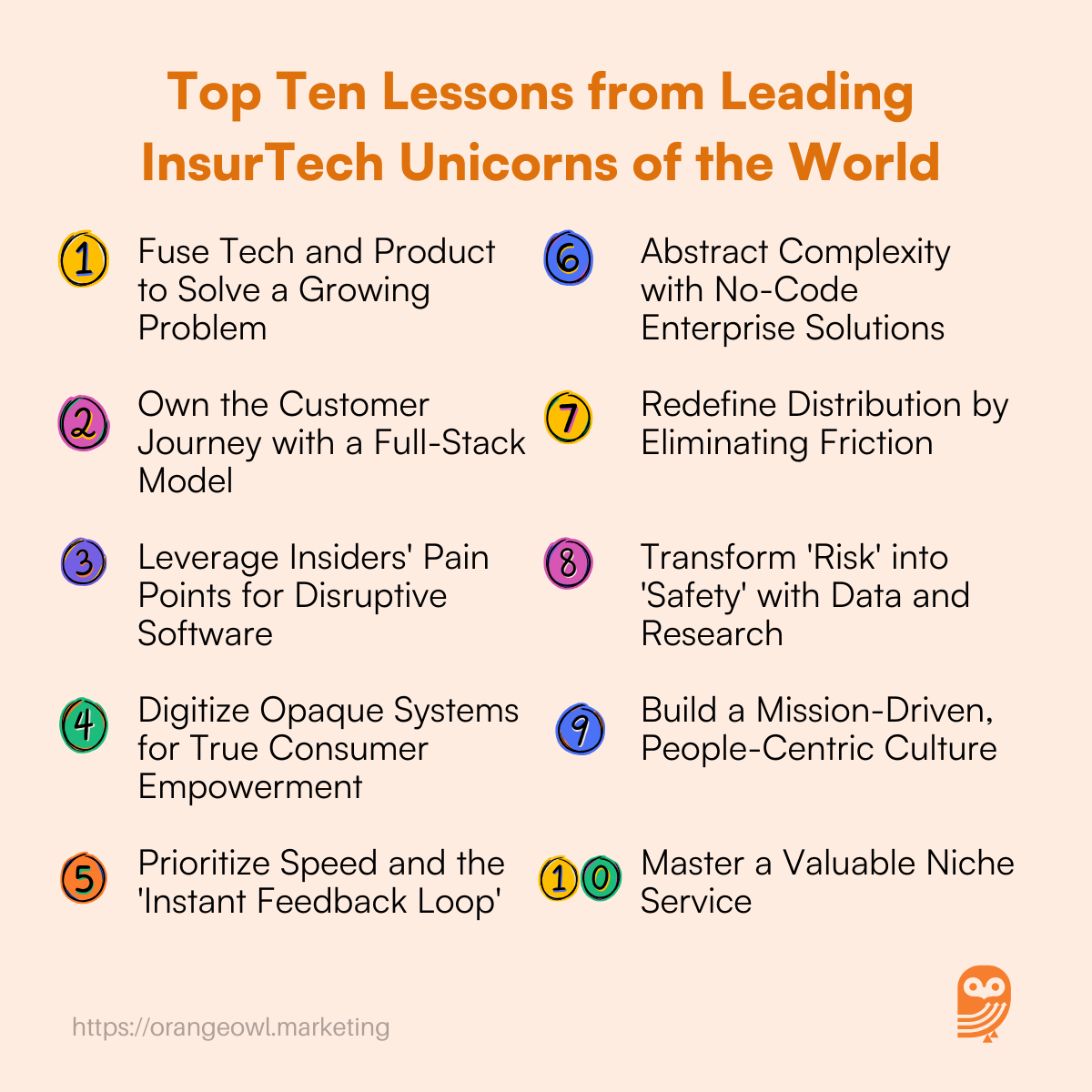
6. Abstract Complexity with No-Code Enterprise Solutions
The sixth lesson from the top 10 lessons from InsurTech unicorns is: How to build fast. For massive, complex enterprises like those in finance and insurance, the challenge is not just what to build, but how to build it fast enough without accruing mountains of technical debt. Unqork(Case Study) provided the answer with its no-code platform for enterprise software development.
Founded by former MetLife CIO Gary Hoberman, the company recognized that legacy code and complex programming languages were the primary bottlenecks to digital transformation. Unqork’s no-code environment allows non-programmers to build mission-critical, highly regulated applications. This dramatically cuts down development time and cost, and critically, reduces the risk of errors in regulatory compliance.
The brilliance of this model is its scale: it empowers giant institutions to move at startup speed. For any aspiring B2B founder, the lesson is that the ultimate value proposition is not just a great app, but the tool that allows the customer to build the great app themselves. This meta-tool approach, abstracting the immense complexity of enterprise-grade security and compliance, is a proven model for achieving unicorn status by serving the largest players in the industry.
7. Redefine Distribution by Eliminating Friction (The 10-Minute Policy)
The most significant barrier to purchasing life insurance has historically been the friction in the application process—the blood tests, the paperwork, the weeks of waiting. Ethos(Case Study) turned this problem into its core competitive advantage by focusing on frictionless distribution.
By utilizing technology and predictive analytics, Ethos often eliminates the need for medical exams, offering an affordable policy to users in as little as 10 minutes. This speed and ease of access fundamentally changes the consumer’s relationship with the product. When a process takes weeks, a consumer has ample time to abandon the purchase; when it takes 10 minutes, the cognitive load and opportunity for dropout are minimized. Co-founder Peter Colis’s vision was to make life insurance accessible.
The seventh lesson from the top 10 lessons from InsurTech unicorns is: identify the single biggest point of friction in your industry and design your entire company to surgically remove it. In a world that prizes instant gratification, converting a complex, weeks-long process into a 10-minute transaction is not just an improvement—it is a market-defining revolution.
8. Transform ‘Risk’ into ‘Safety’ with Data and Research
The future of insurance is not just risk management; it is risk reduction and active safety promotion. Cambridge Mobile Telematics (Case Study) embodies this by leveraging academic research and mobile telematics to improve driver behavior and make roads safer.
Co-founded by MIT professors, CMT is a powerful example of taking deep, proprietary research and converting it into a commercial product with measurable real-world impact. The company’s technology monitors driving behavior, providing personalized feedback that nudges users toward safer habits. Insurers using CMT see demonstrable improvements in driver safety and, consequently, a reduction in claims.
The eighth lesson from the top 10 lessons from InsurTech unicorns is that proprietary data science and academic rigor can be monetized by creating positive externalities. When a company can prove, with hard data, that it makes the world safer and saves lives, it creates a powerful and highly defensible business model that attracts massive investment and industry partnerships. CMT proves that utility and social good can be the most profitable business drivers.
9. Build a Mission-Driven, People-Centric Culture
In high-growth startups, culture is not a perk—it is an operational strategy. At-Bay’s(Case Study) success is inextricably linked to its focus on talent, people, and culture, with a core mission of “using insurance as a force for good.”
The CEO, Rotem Iram, expressed immense pride in the way the team treats each other and works together. In a fast-paced environment where employees are often remote and under high pressure, a strong, unified culture ensures speed, quality, and loyalty. An explicit mission—such as seeing insurance as a “force for good”—provides a moral compass for difficult decisions and acts as a powerful recruiting tool for top talent.
The ninth lesson from the top 10 lessons from InsurTech unicorns in building a world-class company is that a superior product is built by superior people. Investing in a people-centric culture, where values are not just posters on a wall but daily operating principles, translates directly into a more efficient, innovative, and valuable organization.
10. Master a Valuable Niche Service
Sometimes, the smartest path to billion-dollar valuation is not to revolutionize a giant market, but to perfectly execute on a specific, highly valuable niche within it. Extend(Case Study) proved this by focusing solely on providing a product protection solution.
In the massive world of e-commerce, offering extended warranties and product protection is a crucial revenue stream and a key part of the customer experience. Extend focused all of its energy on making this particular service best-in-class, providing a seamless, API-driven solution for retailers. By mastering this niche, they became the preferred partner for countless e-commerce platforms. This strategy avoids direct, broad competition with industry behemoths and instead makes the unicorn an essential part of their partners’ value chain.
The final lesson from the top 10 lessons from InsurTech unicorns is for entrepreneurs is to first become the undisputed market leader in a narrowly defined category. Once that niche is mastered, the company can then leverage its platform to expand horizontally, but the initial, successful launch should be defined by a surgical focus on doing one thing exceptionally well.
Conclusion: The Blueprint for the Next Billion-Dollar Idea
The collective success stories of Coalition, Next Insurance, Newfront Insurance, Unqork, Ethos, Extend, Cambridge Mobile Telematics, AgentSync, At-Bay, and Caribou offer more than just inspiration; they provide a definitive roadmap for modern entrepreneurship.
The InsurTech revolution is defined by three overarching mandates:
Mandate for Experience: The bar for a digital experience has been set by the world’s best consumer technology companies. Customers will no longer tolerate cumbersome, weeks-long processes. Ethos and Next Insurance prove that the winner will be the company that makes the complex simple and the slow instant.
Mandate for Data: Data is not a byproduct; it is the core product. CMT and Coalition demonstrate that by using proprietary data and analytics, companies can pivot from merely pricing risk to actively mitigating it. The future of insurance is predictive, not reactive.
Mandate for Excellence: High-growth companies like AgentSync and Unqork found their fortunes not in flash, but in solving hard, unglamorous, foundational problems like compliance and technical debt. They built enterprise-grade, defensible technology that scales because it is a need-to-have, not a nice-to-have.
For the next generation of founders, the opportunity remains vast. The insurance industry, even with its current transformation, remains one of the largest financial sectors globally. The ultimate lesson from these leading unicorns is one of audacity: be unafraid to challenge the status quo, to blend disparate fields, and to commit to a vision where technology not only powers profit but fundamentally makes the customer’s life better and safer. The companies that internalize these ten lessons will undoubtedly build the next generation of global unicorns.