Cambridge Mobile Telematics Success Story Introduction
Cambridge Mobile Telematics (CMT) is a premier global provider of mobile telematics and analytics, transforming the auto insurance and mobility sectors through its innovative technology. This unicorn company has pioneered the use of mobile sensing, the Internet of Things (IoT), and artificial intelligence (AI) to accurately measure driving risk and, crucially, to improve driver safety worldwide. CMT was co-founded by two distinguished MIT professors, Hari Balakrishnan and Samuel Madden, alongside business leader Bill Powers.
The company achieved unicorn status in late 2018 after securing a massive $500 million investment from the SoftBank Vision Fund, reaching a valuation of approximately $1.53 billion. CMT’s growth trajectory serves as a profound case study in how deep academic research, combined with strong business acumen, can foster a global enterprise with a powerful social mission: making the world’s roads safer. For aspiring entrepreneurs and founders of startups, CMT’s journey offers invaluable lessons and practical takeaways on leveraging data for societal good and achieving massive scale.
Origin Story
CMT was born from a fundamental desire to leverage technology to solve a massive, real-world problem: road safety. The founders recognized a significant gap in the market where traditional insurance models struggled to accurately assess individual driving risk and, more importantly, lacked the tools to actively prevent crashes. The co-founders, Balakrishnan and Madden, came from MIT’s Computer Science and Artificial Intelligence Lab (CSAIL), bringing decades of expertise in mobile sensing and data analytics to the table. Bill Powers, as CEO, provided the essential business leadership to translate the groundbreaking academic work into a scalable, commercial product.
The genesis of CMT lies in the partnership between world-class academics and a seasoned business leader. Hari Balakrishnan serves as the CTO and Chairman, while Sam Madden is the Chief Scientist. Their work at MIT laid the research foundation for using smartphone sensors to detect and analyze driving behavior. Bill Powers is the CEO, steering the company’s strategic vision and commercial execution. This unique combination of deep technical expertise and market execution has been a cornerstone of the company’s success stories.
CMT’s initial mission was simple yet ambitious: to improve safety in the mobile world for people and goods using mobile sensing and IoT, AI, and behavioral science. They aimed to move beyond simply assessing risk to actively mitigating it. Their early focus was on developing the DriveWell platform-the first service to efficiently gather and process sensory data from phones for auto insurance, marking the beginning of the mobile usage-based insurance (UBI) category. This vision was about creating a feedback loop where data-driven lessons could induce safer driving habits.
Business Space and Early Challenges
CMT operates in the burgeoning telematics and Usage-Based Insurance (UBI) markets, a sector poised for exponential growth, with the global insurance telematics market projected to grow at a nearly 19% Compound Annual Growth Rate (CAGR) from 2025 to 2034. CMT’s primary business model involves providing data monitoring solutions and analytics platforms to auto insurance companies, cellular carriers, and fleets. They essentially license their technology—the DriveWell platform and its associated hardware (like the DriveWell Tag) and software—to clients who then use it to power their own UBI programs.
The early days of the telematics industry were fraught with challenges. Insurers were skeptical of a system that relied on consumer-grade smartphones, questioning the accuracy and reliability of the data. Key hurdles included:
Data Accuracy: Ensuring that phone sensors could accurately distinguish between a vehicle crash and a phone drop, or between passenger and driver.
Privacy Concerns: Overcoming user reluctance to constantly share location and driving data.
Behavioral Science Integration: Designing a platform that didn’t just collect data, but actively used principles of behavioral science, rewards, and gamification to motivate drivers to change their habits.
To tackle the accuracy challenge, CMT poured resources into R&D, leveraging their MIT heritage to pioneer innovations like using phone sensors to measure phone distraction (2013) and inducing better driving through gamification (2014). They realized early on that purely academic accuracy wasn’t enough; the product needed to deliver measurable behavioral change. The compelling results—a 35% reduction in phone distraction and a 20% reduction in risky driving behaviors within 30 days—provided the irrefutable evidence needed to win over major global partners. These early lessons proved that technology needed to be a tool for improvement, not just measurement.
Growth Strategies
CMT’s scaling strategy has been a masterclass in platform expansion, strategic partnerships, and continuous innovation. Their growth is centered on three core pillars:
Platform Expansion: Evolving the DriveWell platform from a simple UBI tool to a comprehensive mobility platform that integrates data from various sources: smartphones, proprietary tags, and connected vehicles. This has enabled them to process over 1 trillion data points daily, feeding their advanced AI models.
Geographic Expansion: Actively partnering with insurers in over 20 countries, proving the platform’s ability to adapt to diverse driving cultures and regulatory environments globally.
Strategic Partnerships: Forming deep relationships with key insurance companies to power their telematics programs, essentially becoming the invisible engine behind major insurer success stories.
Unique Strategic Moves
A unique strategic move was the early development of the DriveWell Tag in 2014, the first fully wireless IoT device designed to complement smartphone data. This hybrid approach overcame the limitations of smartphone-only data collection and gave their partners a robust, high-fidelity data stream, differentiating them from many startups in the space. More recently, CMT has expanded the value proposition beyond the crash by launching AI-powered Roadside Assistance and personalized Hail Alerts, ensuring the technology helps drivers in more aspects of their mobility journey.
CMT’s true measure of success is its quantifiable impact on safety. The driving feedback and gamification delivered via the DriveWell platform have been shown to reduce crash rates for insurers by up to 35%. This success has led to significant results for its partners, with the technology helping to prevent over 93,000 crashes worldwide and protecting more than 50,000 people from serious injuries. This safety focus creates a powerful, mission-driven narrative that resonates with consumers and corporate partners alike.
Marketing Strategies
CMT’s marketing approach is unique because it is primarily a B2B model, targeting large insurers and carriers, rather than individual consumers. Traditional B2B marketing focuses on demonstrating a clear Return on Investment (ROI), which CMT delivers through proven crash rate reduction and automated claims processing.
However, their most innovative “marketing” is rooted in the platform’s direct behavioral engagement with the end-user. The DriveWell platform uses a blend of gamification, rewards, and leaderboards to keep drivers engaged—a form of in-app, behavioral marketing. This not only gathers more data but also fosters a community of safer drivers.
CMT’s marketing efforts often center on publicizing major safety achievements and industry recognition, such as being named “Vehicle Telematics Company of the Year” multiple times. They use these accolades as a powerful case study for why insurers should choose their platform. Their channels are focused on industry events, white papers, and thought leadership that highlight their deep scientific and engineering prowess, which stems from the academic roots of the entrepreneurs.
CMT’s branding is centered on Credibility, Innovation, and Safety. Their close ties to MIT lend immediate credibility and gravitas that most startups lack. Their content strategy often features the founders, like Professor Balakrishnan, who can articulate the complex technical lessons in a way that emphasizes the real-world impact. This authenticity is a key differentiator. The success stories they share are always backed by compelling data on crash reduction.
Scaling to Unicorn Status
The journey to unicorn status was defined by major technological and financial milestones:
2010: Company founded out of MIT CSAIL.
2012: Deployed the first service for mobile usage-based insurance (UBI), creating a new product category.
2014: Invented the DriveWell Tag and introduced gamification to induce behavioral change.
2018: Secured the $500 million Series C investment from SoftBank Vision Fund, confirming the unicorn status and accelerating global expansion.
The “Secret Sauce”
CMT’s secret sauce lies in its unique fusion of academic rigor and scalable technology. The company was built on the premise that genuine AI-driven innovation must originate from deep, fundamental research, as emphasized by co-founder Hari Balakrishnan:
This commitment to pushing technological boundaries is reflected in their constant R&D investment and product updates, ensuring they remain the market leader. The company culture prioritizes safety as a core value, which guides every product decision.
5 Key Lessons for Other Entrepreneurs
For ambitious entrepreneurs looking to build the next generation of impact-driven startups, the CMT case study provides five crucial lessons and takeaways:
1. The Power of Deep Tech and Academic Heritage
CMT’s foundation in MIT’s research labs gave it an almost insurmountable advantage. It was not a superficial app; it was a deeply researched solution to a hard problem. Founders should not fear “hard tech.” Building a company on foundational, proprietary technology—developed through research or internal R&D—creates a high barrier to entry for competitors. The most valuable startups solve problems others cannot, and often, that requires academic rigor.
2. Focus on Behavior Change, Not Just Data Collection
Early on, CMT realized that collecting data was only half the battle; the real value lay in changing driver behavior. Their platform uses principles of behavioral science, rewards, and competition (gamification) to motivate safer driving. For any business dealing with user data, the ultimate lesson is to move beyond mere analytics. The best products create a positive feedback loop that actively encourages users to improve their own outcomes, turning data into a tool for self-betterment, which leads to better success stories.
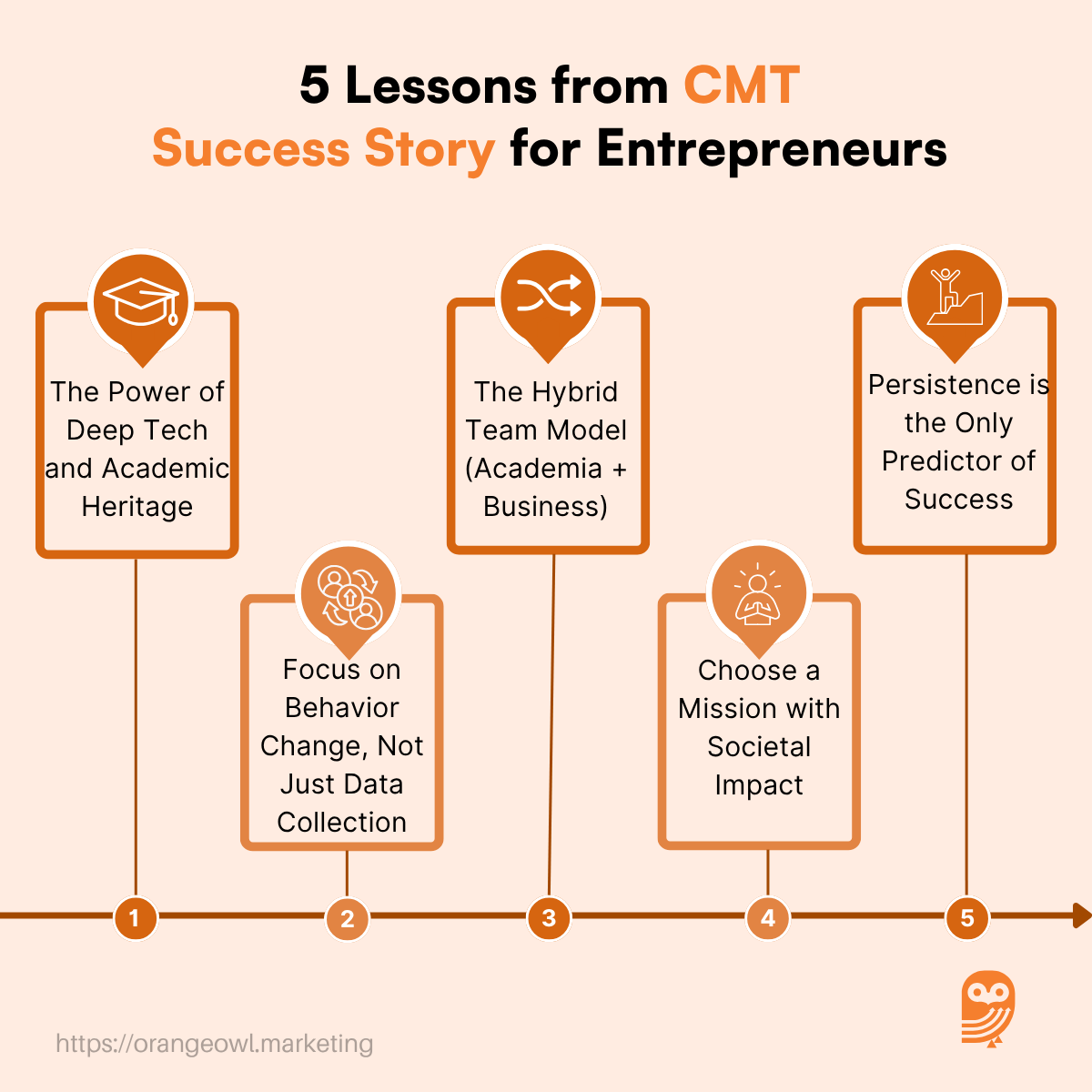
3. The Hybrid Team Model (Academia + Business)
The co-founder structure of two MIT professors (Balakrishnan and Madden) paired with a seasoned CEO (Powers) is critical. The academics drove the what (the innovation), and the business leader drove the how (the scale and commercialization). Entrepreneurs must look beyond homogeneous founding teams. Creating a balanced leadership group that couples deep technical or scientific expertise with robust commercial, marketing, and operational talent is a powerful model for startups aiming for global scale.
4. Choose a Mission with Societal Impact
CMT’s core mission is road safety. This elevates the company beyond a simple financial technology vendor and imbues it with a noble purpose. This mission attracts top talent, resonates with major corporate partners, and generates positive public perception. Startups with a clear, positive social impact often find it easier to recruit, retain, and market. When your success stories include saving lives or reducing injuries—as CMT’s do—the product sells itself to ethical corporations and consumers.
5. Persistence is the Only Predictor of Success
CMT’s journey involved years of perfecting technology, navigating skepticism, and constantly innovating. Co-founder Bill Powers spoke to the grit required in the entrepreneurial journey:
“Nobody can predict success — just work harder, surround yourself with good people, and make it happen.”– Hari Balakrishnan
The final, enduring lesson for all entrepreneurs is resilience. Success in a major field like telematics doesn’t happen overnight; it is the culmination of working hard, surrounding yourself with a supportive and capable team, and refusing to be stopped by the inevitable challenges.
Cambridge Mobile Telematics Success Story Conclusion
Cambridge Mobile Telematics represents a rare and compelling case study of a deep-tech company built on a powerful social mission. Their success stories are rooted in technological superiority, strategic partnerships, and a focus on actively changing user behavior for the better. The core takeaways for startups are clear: leverage academic rigor, build balanced founding teams, and ensure your product delivers a measurable, positive impact in the world. As Bill Powers noted, the journey itself is the essence of their drive:
CMT is not slowing down; they continue to push the boundaries of mobility and safety. Their future is focused on integrating with the emerging connected vehicle ecosystem, expanding their AI-driven platforms like StreetVision (which predicts and prevents crashes), and extending their services beyond auto insurance to areas like fleet management and smart cities.
The CMT journey is an inspiration for every aspiring entrepreneur. It proves that a commitment to fundamental science and a passion for solving the world’s most challenging problems can be a pathway to unicorn status and a global legacy. The biggest lesson for startups is to find a problem worth dedicating your life to—like road safety—and then apply relentless effort and world-class innovation to solve it