Next Insurance Success Story Introduction
Next Insurance stands as a powerful case study in how modern technology can fundamentally reinvent one of the world’s most traditional industries: insurance. Founded in 2016 by a trio of seasoned entrepreneurs – Guy Goldstein, Alon Huri, and Nissim Tapiro—the company set out to solve the decades-old problem of complex, expensive, and slow insurance for small businesses.
This Palo Alto-based insurtech startup quickly found success by offering a fully digital, end-to-end platform. This rapid ascent culminated in the company achieving unicorn status in October 2019, with a valuation surpassing $1 billion. Following aggressive growth and a strategic focus on the small and medium-sized business (SMB) market, its valuation soared to $4 billion by March 2021.
This incredible journey offers indispensable takeaways and lessons for aspiring entrepreneurs across every sector. Our deep dive into the Next Insurance success story provides an authentic blueprint for building a multi-billion dollar enterprise from the ground up.
Origin Story
The foundation of Next Insurance was laid by Guy Goldstein, Alon Huri, and Nissim Tapiro, all experienced founders in the tech space. Goldstein, who serves as the CEO, previously founded Check Inc., which was acquired by Intuit for $360 million. The founders observed a significant and painful gap in the insurance market: small business owners were underserved by large carriers, forced to navigate an antiquated, cumbersome, and time-consuming process to get the basic coverage they needed.
The initial vision for Next Insurance was to become the one-stop, digital shop for all small business property and casualty (P&C) insurance needs. Their mission was clear: to make commercial insurance simple, affordable, and tailored to the specific needs of every business. This required building a complete full-stack capability from scratch. As CEO Guy Goldstein put it:
This vision of a fully integrated, modern experience was a direct response to the frustration felt by millions of small business entrepreneurs facing an “outdated experience,” a crucial lesson the founders learned from the market.
3. Business Space and Early Challenges
Next Insurance entered the Insurtech sector, specifically targeting the $140 billion small business insurance market in the United States. This space is characterized by massive, decades-old incumbents and a traditional distribution model reliant on brokers and agents. The niche was ripe for disruption because existing solutions lacked the flexibility, digital access, and speed modern startups and small businesses require.
The primary challenge the founders faced was the inherent complexity of the insurance industry. Unlike building a pure software platform, an insurtech startup must also take on the regulated and capital-intensive aspects of an insurance carrier—namely, underwriting and claims. This full-stack approach, while ultimately their competitive advantage, required immense technical and regulatory expertise.
Another challenge was shifting the customer mindset. Small business owners were accustomed to the traditional, slow, and paper-heavy process. Building trust and demonstrating that a new, purely digital platform could offer reliable coverage and superior claims handling was an early obstacle. The team tackled this by focusing on rapid iteration, a fast-feedback loop from early users, and investing heavily in proprietary technology for precise, real-time underwriting. This focused execution is a prime case study in overcoming industry inertia.
Growth Strategies
Next Insurance’s explosive growth was driven by two core strategies: deep vertical integration and strategic M&A. By being a full-stack carrier, they controlled the entire value chain—from policy issuance to claims settlement—allowing them to offer hyper-personalized policies and an unmatched user experience. Their commitment to technology as a differentiator is a vital lesson for any emerging startup.
The company also executed strategic acquisitions, notably acquiring Juniper Labs for its data and analytics capabilities and AP Intego, a major insurance agency, which instantly added approximately $185 million in active premium and a large customer base. This was a bold move that significantly accelerated their journey to becoming a full-service provider, offering one of the most powerful takeaways on growth strategy: buy, don’t just build, to own the market.
Unique Strategic Moves and Metrics of Success
A particularly unique strategic move was their partnership with Amazon. By integrating its tailored insurance offerings into the Amazon Business platform, Next Insurance gained direct access to millions of small business entrepreneurs, effectively turning an e-commerce giant into a massive distribution channel. This unprecedented partnership was a game-changer for a budding startup.
Metrics of their success story are telling:
Their Gross Written Premium (GWP) doubled in the half-year following their Series D funding round in 2020.
They hit a GWP run rate of $100 million in early 2020, and $200 million just one year later.
The company has raised over $1.1 billion in total funding, a staggering figure that demonstrates investor confidence in their model.
Marketing Strategies
Next Insurance’s marketing mirrored its product: digital-first and highly targeted. They largely eschewed traditional insurance marketing channels (like television or generic direct mail) in favor of online platforms where small business owners actively search for solutions. This included highly optimized search engine marketing (SEM) and specialized digital content.
Their most successful channel was their product itself. By offering an online quote and bind process that took minutes rather than days or weeks, the product generated significant word-of-mouth referrals among time-sensitive entrepreneurs. Their partnership with Amazon also served as a powerful marketing and distribution channel, providing both visibility and instant credibility.
The core of their branding is simplicity and empowerment. They position themselves not just as an insurer, but as an ally to the small business owner, designing insurance around specific professions (e.g., landscapers, contractors, fitness instructors). This niche focus and clear, easy-to-understand language became a key driver of customer engagement and loyalty, a fundamental takeaway on brand identity.
Scaling to Unicorn Status
Next Insurance first reached a valuation of $1 billion in October 2019 with a $250 million Series C funding round. The journey continued with a Series D in September 2020 that doubled their valuation to $2 billion, followed by a Series E in March 2021 that pushed them to $4 billion. Each funding round represented not just capital, but a validation of their full-stack model and aggressive expansion, cementing their status as a preeminent insurtech case study.
The “Secret Sauce”
The “secret sauce” of this incredible success story lies in their unique blend of data and technology. They used machine learning algorithms to achieve better risk assessment and automated underwriting, a crucial aspect of their business. Guy Goldstein shared a valuable lesson on this front:
By prioritizing the accumulation of proprietary data and applying algorithms to it, they could price risk more accurately and service customers more efficiently than older carriers. It was the fusion of technology with a full-stack insurance license that allowed them to truly modernize the entire SMB insurance experience.
5 Key Lessons for Other Entrepreneurs
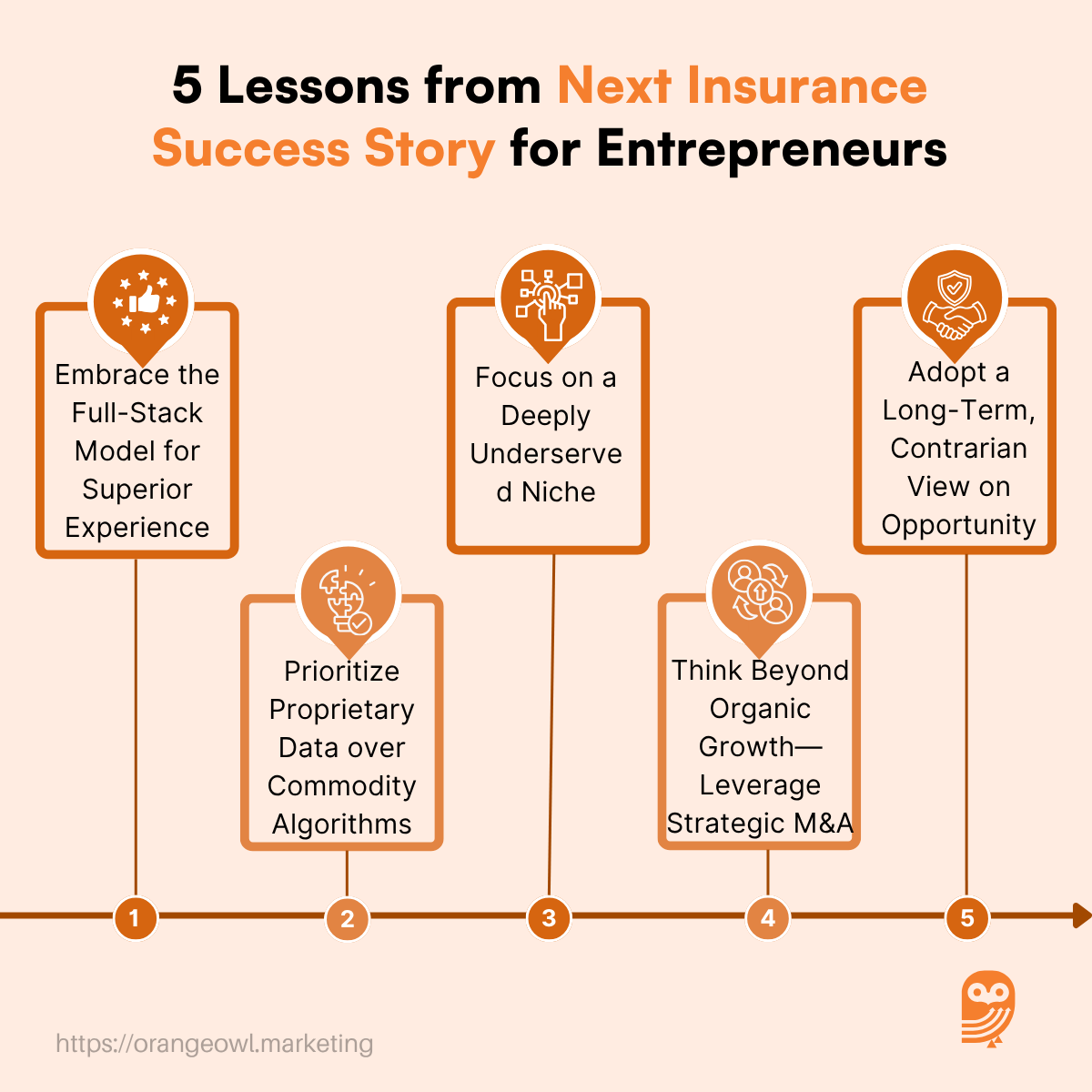
The journey of Next Insurance provides five crucial takeaways for any founder hoping to build the next generation of successful startups:
1. Embrace the Full-Stack Model for Superior Experience
The most significant lesson from Next Insurance is the commitment to being full-stack. While many insurtech startups partner with established carriers (a “fronting” arrangement), Next Insurance decided to become a licensed carrier itself, controlling everything from policy wording and pricing to claims handling. This massive undertaking ensures that they are not beholden to old systems or bureaucratic processes.
For entrepreneurs, this means: don’t just build a better interface; build a better underlying infrastructure. Complete control over the customer journey is the only way to deliver a truly differentiated experience, especially in highly regulated sectors.
2. Prioritize Proprietary Data over Commodity Algorithms
As Goldstein highlighted, the algorithm is often a commodity—the power is in the data. Next Insurance invested heavily in collecting vast amounts of proprietary data on small business owners’ operations, risk profiles, and claims history. This is a crucial takeaway for modern startups: Your core IP should be your unique data and how you use it to underwrite, not just a trendy software tool.
This data advantage translates directly into smarter pricing, better loss ratios, and more personalized products, giving them an almost unassailable competitive advantage over legacy players who rely on generic, industry-standard tables.
3. Focus on a Deeply Underserved Niche
Next Insurance didn’t try to insure everyone. They laser-focused on small business owners (SMBs) with under 100 employees, a niche that was often ignored or overcharged by major carriers. This focus allowed them to tailor their technology, underwriting, and marketing to specific vertical professions, such as contractors or fitness trainers.
The lesson here is to dominate a sub-segment before expanding. For aspiring entrepreneurs, find the market that is most in pain and build the perfect solution for them. This deep focus is what transforms a good idea into an essential service.
4. Think Beyond Organic Growth—Leverage Strategic M&A
The acquisitions of Juniper Labs and AP Intego demonstrate a bold growth strategy. Rather than spending years building an agent distribution channel or a data science team, they acquired existing, successful entities. This provided a massive, immediate boost to their customer base and technical capabilities. This provides an important case study on scaling: don’t be afraid to use capital strategically to compress your growth timeline.
For startups with strong funding, M&A can be a powerful accelerator, but it must be targeted at assets that directly support the core full-stack vision.
5. Adopt a Long-Term, Contrarian View on Opportunity
When asked about the future of technology, Guy Goldstein labeled blockchain as “underrated.”
“Blockchain underrated why it’s a big opportunity big opportunity okay it’s good to good to find someone bit on it.”– Guy Goldstein
This simple quote embodies a larger lesson: the importance of maintaining a contrarian, long-term perspective on new technologies. Next Insurance’s success stems from applying a powerful new technology (AI/ML and digital platforms) to an old problem (small business insurance). Entrepreneurs must continuously evaluate which current technologies are truly disruptive (underrated) and how they can be applied to legacy markets, rather than simply following industry hype (overrated).
Next Insurance Success Story Conclusion
The Next Insurance success story provides powerful takeaways for any founder. It is a remarkable case study on how a technology-first approach, a full-stack business model, a deep understanding of customer pain points, and strategic execution can completely modernize an industry. The crucial lesson is that entrepreneurs must be willing to take on the most challenging aspects of a legacy industry—like regulatory and capital requirements—to create a truly superior and lasting advantage.
As the small business market continues to grow and digitize, Next Insurance is perfectly positioned for continued expansion. With its $4 billion valuation and strong investor backing, the startup continues to broaden its product offerings and its distribution network, including its high-profile partnership with Amazon. It remains a key industry player and a leading candidate for a future public offering, ensuring its continued influence on the global insurtech landscape.
For all aspiring entrepreneurs looking at the Next Insurance journey, remember this: every antiquated industry is a wide-open opportunity in disguise. The biggest challenges—the “outdated experience and cumbersome” processes—are not barriers; they are the exact problems you were meant to solve. Have the audacity to go full-stack, leverage the power of data, and your startup could be the next great success story.