AgentSync Success Story Introduction
AgentSync stands as a prime example of a modern FinTech success story, born from the crucible of frustration with outdated, manual business processes. Founded by the dynamic husband-and-wife team, Jenn Knight (CTO) and Niji Sabharwal (CEO), the company set out to fundamentally change how the insurance industry handles producer licensing and compliance.
While its current valuation and unicorn status year are subject to market fluctuations, AgentSync’s rapid ascent cemented its place as a crucial player in the RegTech space, having achieved unicorn status in 2021. The purpose of covering this company’s growth story is to offer inspiration and crucial takeaways for aspiring entrepreneurs looking to build scalable startups by solving deeply painful, industry-specific problems. This detailed examination serves as one of the essential case studies on turning regulatory burden into a multi-billion-dollar business opportunity.
Origin Story
The foundation of AgentSync was laid in the direct, painful experience of its co-founder. Niji Sabharwal worked at Zenefits, where he personally encountered the immense, archaic challenge of ensuring insurance producer compliance and licensing. The process was a labyrinth of paperwork, state-by-state variations, and manual checks, leading to significant bottlenecks and regulatory risk. He recognised that this systemic failure was not an anomaly but a universal problem plaguing carriers, agencies, and the individual agents—a problem ripe for a modern, automated software solution. The initial drive was simple: to create a single source of truth for all licensing data.
AgentSync was co-founded by Niji Sabharwal and Jenn Knight in 2018. Niji, with his critical compliance experience from Zenefits, brought the deep domain knowledge and understanding of the market gap. Jenn, on the other hand, brought a strong technical background, having previously worked at Dropbox as a software engineer. Their combined expertise—industry pain and robust engineering—provided the perfect synergy for tackling such a complex, data-intensive problem.
The initial mission was to automate and simplify insurance producer licensing and compliance. Their vision extended beyond mere software; they wanted to create a system that was so effective, it could become the new industry standard, allowing insurance companies to onboard agents in days instead of weeks or months. This focus on a niche but crucial back-office function allowed the startup to quickly demonstrate immense value.
Business Space and Early Challenges
AgentSync operates in the RegTech (Regulatory Technology) and InsurTech spaces, specifically addressing the compliance requirements for insurance carriers and agencies. This sector is characterised by high regulatory complexity, entrenched manual processes, and a general slowness to adopt new technology. The mandatory need for compliance makes it a highly sticky and critical function for any insurance business, meaning that once a solution is adopted, it becomes indispensable.
The core challenge in this space is the inherent complexity of state-level regulation. Each U.S. state has its own licensing rules, fees, and renewal processes. A single insurance agent may need to be licensed in dozens of states, a process that requires constant monitoring. Building a platform that could reliably integrate with all state databases and automate this verification was a monumental technical hurdle. This required an almost obsessive focus on the problem’s painful details. As CEO Niji Sabharwal reflected on their approach:
This clarity on both the pain and the tactical solution was a key lesson in product-market fit.
The main early struggle was bridging the technical chasm between fragmented, often legacy, state regulatory systems and a modern, scalable SaaS platform. For any successful tech startup, securing the first few anchor customers is essential. AgentSync had to not only build the core technology but also prove its reliability and security to an inherently risk-averse industry. They overcame this by focusing on delivering a product that provided instant, tangible value, effectively turning compliance from a necessary evil into a competitive advantage. Their dedication to a deep understanding of customer pain points guided their early product development.
Growth Strategies
AgentSync’s growth was driven by a classic B2B SaaS playbook, coupled with a highly efficient, focused product strategy. Their general growth strategies included:
Product-Led Growth (PLG): Focusing on building a truly superior product that demonstrably solves the problem better than any manual process or legacy competitor, thus making it a natural choice for scaling enterprises.
Targeted Sales: Initially focusing on mid-market and large enterprises that had the most acute and costly compliance issues, using those case studies to attract others.
Strategic Funding: Raising multiple rounds of funding from top-tier VCs who understood the massive market potential of automating an entire industry’s compliance backbone.
Unique Strategic Moves
One of the most unique strategic moves was the laser-like focus on compliance automation as a product niche. Many other FinTech startups might try to address multiple parts of the insurance value chain. AgentSync, however, chose to be the absolute best at a single, critical function: producer management. This specialisation allowed them to build deep expertise and a superior data-driven product, providing a crucial takeaway for any founder. They leveraged the fact that compliance is a non-negotiable area—failure is not an option for their customers.
While specific public KPIs are limited for a private company, the speed of AgentSync’s growth from its 2018 founding to its 2021 unicorn valuation is a powerful metric of success. The key internal metric would be the reduction in agent onboarding time and compliance failure rates for their clients, proving the software’s efficiency and regulatory integrity—a clear success story measured in operational excellence
Marketing Strategies
Given their B2B nature, AgentSync’s marketing relied less on mass-market campaigns and more on Content Marketing and Thought Leadership . They positioned themselves not just as a software vendor but as compliance experts, providing a vital lesson in establishing trust in a regulated industry.
Their most impactful “campaign” was likely the distribution of case studies and white papers demonstrating the financial and operational return-on-investment (ROI) of their platform. By quantifying the time and money saved by replacing manual processes, they provided a compelling narrative for C-suite decision-makers. They focused heavily on industry-specific channels like insurance conferences and compliance publications to directly reach their ideal customer.
The brand identity is built on competence and clarity in a complicated world. The content focuses on simplifying the labyrinthine rules of insurance licensing. For entrepreneurs in niche B2B fields, this approach offers a significant takeaway: don’t market the technology; market the relief and the compliance guarantee it provides.
Scaling to Unicorn Status
The journey to unicorn status was defined by significant funding rounds, which validated the market’s recognition of their case studies in client transformation. Securing a valuation over $1 billion in 2021 placed them in an elite category, signalling massive scalability potential beyond just their initial compliance solution. Each milestone confirmed their belief that automating foundational industry pain points leads to dramatic growth.
The “Secret Sauce”
AgentSync’s “secret sauce” lies in their successful marriage of deep regulatory domain knowledge and world-class engineering. Jenn Knight’s technical background and Niji Sabharwal’s compliance expertise created a highly defensible moat. They didn’t just digitise a process; they optimised it with technology, offering an indisputable value proposition in an area where mistakes are costly.
Another critical factor in their growth was the focus on customer feedback to ensure the product was solving the real pain points.
This relentless customer-centric approach is a powerful takeaway for all startups.
5 Key Lessons for Other Entrepreneurs
This incredible success story provides invaluable takeaways for aspiring entrepreneurs navigating the difficult waters of founding and scaling a technology company. The commitment to solving a non-sexy, painful problem is a profound lesson in finding true product-market fit.
1. Embrace and Automate Industry Pain
The most significant lesson from AgentSync is to find the most painful, manual, and mandatory task in an industry and automate it entirely. They chose insurance compliance, a problem every carrier must solve, but hates doing. This created an inelastic demand for their product. Founders should look beyond consumer trends and focus on infrastructural bottlenecks that, once solved, create a critical, high-value B2B SaaS business.
This is a strategic takeaway that ensures your startup solves a need, not just a want.
2. The Power of Complementary Co-Founders
The pairing of Niji Sabharwal (industry expert) and Jenn Knight (technical builder) is a crucial lesson in co-founder selection. Niji ensured the product solved the right problem; Jenn ensured the solution was scalable and modern. Entrepreneurs should seek co-founders whose skills are not redundant but complementary, creating a complete and balanced leadership unit ready to handle both the business strategy and the product execution.
This unity and shared vision is a powerful ingredient in numerous success stories.
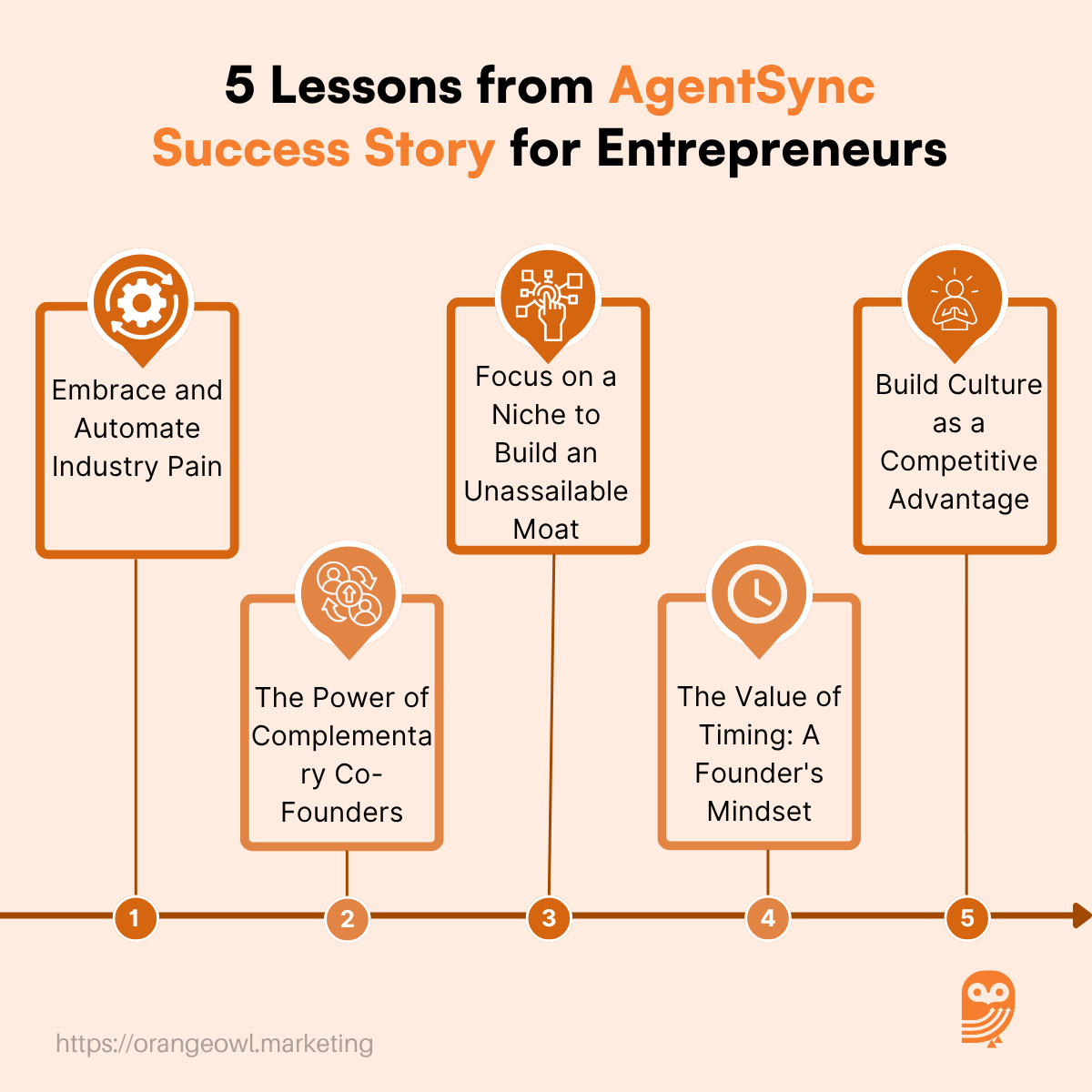
3. Focus on a Niche to Build an Unassailable Moat
AgentSync’s deep dive into the highly niche area of producer licensing allowed them to become the undisputed expert. This is a vital lesson for early-stage startups: narrow the focus to dominate a segment. By becoming the best at this one, complex task, they built a technological and data-driven moat that is incredibly difficult for larger competitors to replicate.
This focus provides tangible case studies of success that they can use to expand into adjacent compliance solutions.
4. The Value of Timing: A Founder’s Mindset
Timing the market is essential, but equally important is the founder’s mindset regarding risk. Niji Sabharwal encourages a focus on building in the current economic environment, where the risks of starting up are relatively lower than in previous generations.
This is a profound lesson in embracing calculated risk and starting small to achieve immense scale. Every aspiring entrepreneur can learn this strategic takeaway.
5. Build Culture as a Competitive Advantage
AgentSync understands that company culture is part of its strategic growth. They operate with a hybrid work model, offering flexibility while maintaining a physical office for in-person collaboration. They view this not just as a benefit, but as a competitive advantage over large companies that have gone fully remote, providing an environment that fosters community and real-time problem-solving.
This demonstrates a key takeaway: for startups, a thoughtful, intentional culture can be a powerful recruitment and retention tool that enables the rapid growth seen in successful case studies.
AgentSync Success Story Conclusion
The AgentSync success story is a powerful testament to the value of solving genuine pain with elegant software. The biggest takeaways for entrepreneurs are to find an intrinsically painful, mandatory problem; to build an uncompromisingly high-quality product; and to embrace a founder mentality that focuses on long-term value creation. This case study proves that complex regulatory landscapes are not obstacles, but rather high-barrier opportunities for the best startups.
AgentSync is positioned to become the operating system for insurance producer management, moving beyond its initial licensing solution to integrate and automate broader compliance and credentialing processes. As the regulatory environment becomes even more complex, their service will only become more critical, promising continued growth and innovation in the InsurTech space.
For all aspiring entrepreneurs who are hesitant to start their journey, let the AgentSync success story be your guiding lesson. Identify the broken piece of the world you see, focus on fixing it with unmatched quality, and remember that deep industry knowledge combined with modern technology can transform any painful problem into a multi-billion-dollar opportunity. Your deep-dive into this case study is the first takeaway on your path to building the next great startup.