
At-Bay Success Story Introduction
At-Bay, a pioneer in the InsurTech space, has fundamentally changed how companies manage digital risk. Founded by a team of cybersecurity and insurance experts, including Rotem Iram (CEO), Roman Itskovich (CRO), Etai Hochman, and Tilli Kalisky-Bannett, the company has rapidly become a beacon of innovation. By merging a world-class security team with a proprietary insurance model, At-Bay transformed cyber insurance from a mere financial product into a powerful risk management tool.
The company’s exceptional growth trajectory culminated in its official “unicorn” status in July 2021, following a $185 million Series D funding round that placed its valuation at $1.35 billion. For aspiring entrepreneurs and growing startups, At-Bay’s journey offers a crucial lesson: the future of complex risk lies in combining technology and financial incentives. This success story details the strategic moves that propelled At-Bay to the top of its niche.
Origin Story
The foundation of At-Bay was driven by the realization that traditional insurance models were fundamentally broken when it came to managing digital risk. Cyber risk is dynamic, evolving, and largely invisible to conventional underwriters, leading to volatile pricing and inadequate coverage. The founders recognized a critical market gap: the lack of an insurance provider that truly understood and actively managed the underlying cyber risk.
The company’s genesis was rooted in a desire to tackle a problem deemed too complex for others. CEO Rotem Iram shared this founding motivation in his interview, stating:
The initial vision was clear: to build the world’s first insurance company that actively helps its insureds reduce their risk. This meant developing a proprietary, continuous risk-assessment technology—the At-Bay Platform—and baking it directly into the underwriting and pricing process. This was a challenging lesson that other startups in the financial services sector would soon follow: product and underwriting must be inseparable.
Business Space and Early Challenges
At-Bay operates in the highly competitive and rapidly evolving InsurTech sector, specifically focusing on cyber insurance for the middle market. This space requires deep expertise in two separate disciplines: financial risk management and cutting-edge cybersecurity.
The core challenge in cyber insurance is the ‘asymmetric information problem.’ Insurance companies historically lacked a real-time view into a client’s security posture. They had to rely on static questionnaires, which failed to capture dynamic threats and led to adverse selection. Furthermore, the very nature of digital threats—such as zero-day exploits and sophisticated ransomware attacks—meant that a massive, single loss event was always a high probability.
The earliest obstacles At-Bay faced centered on credibility and adoption. Traditional insurance brokers, the critical distribution channel, are inherently risk-averse. They were wary of entrusting their clients’ complex cyber policies to a new technology-first company. The At-Bay success story hinged on overcoming this skepticism by demonstrating that its technical insights resulted in both superior risk selection (a takeaway for the carrier) and better security and service for the client (a lesson for the insured). Their proprietary platform had to prove, through initial case studies, that it could accurately predict and mitigate risk better than industry incumbents.
Growth Strategies
At-Bay’s growth was fueled by its unique ‘Active Risk Monitoring’ strategy, a core takeaway for successful startups. Instead of only paying out claims, At-Bay’s platform continuously scans the digital assets of its policyholders for vulnerabilities. By providing personalized, actionable recommendations, they empower clients to address security gaps before a loss occurs. This focus on prevention reduced the frequency and severity of claims, creating a virtuous cycle: lower claims lead to a more profitable book of business, which attracts more underwriting capital, allowing for more competitive pricing.
Unique Strategic Moves
One of At-Bay’s boldest strategic moves was using its capital not just to assume risk but to drive security improvement. Rotem Iram elaborated on this novel concept:
This shift—from passive indemnity to active risk-reduction—is a pivotal lesson in the insurtech case studies space. They built partnerships with top reinsurers like Munich Re, who were confident in At-Bay’s technology-driven approach, providing the necessary capacity to scale rapidly.
Marketing Strategies
Unlike many InsurTech startups that tried to bypass the broker channel, At-Bay adopted a broker-first model. Their innovative approach was to empower the broker with better data. Instead of generic marketing, At-Bay focused on technical credibility. Their At-Bay Platform provided brokers with specific, data-backed insights on a client’s security posture, transforming the broker from a salesperson into a trusted cyber security consultant. This technical differentiation was the key takeaway for gaining market share.
At-Bay successfully branded itself as “Insurance as a Force for Good.” This messaging highlighted the ethical and practical benefit of their model: they weren’t just selling a policy, they were selling the path to a safer company. This success story relies heavily on positioning the company as a partner in risk reduction, building a stronger and more trustworthy brand identity than its purely financial competitors.
Scaling to Unicorn Status
At-Bay’s scaling journey included several crucial funding rounds: Series B ($34M), Series C ($50M), and the unicorn-clinching Series D in 2021, led by prestigious investors like Icon Ventures and Lightspeed Venture Partners. These injections of capital allowed the company to rapidly expand its product lines, enter new states, and, most importantly, continuously invest in its core proprietary technology.
The “Secret Sauce”
The secret sauce behind At-Bay’s success story lies in its holistic view of risk. It operates as a technology company that underwrites insurance, not an insurance company that uses some technology. The firm’s ability to underwrite the digital risk better than anyone else—by quantifying it, pricing it accurately, and reducing it through proactive measures—is the defining lesson for all financial startups.
5 Key Lessons for Other Entrepreneurs
At-Bay’s phenomenal growth offers valuable, detailed takeaways for aspiring entrepreneurs aiming to build resilient, enduring businesses:
1. Solve the Root Problem, Not Just the Symptom (The Insurance Lesson)
Traditional insurance addresses the symptom (financial loss after an event). At-Bay’s profound lesson is to solve the root problem (security vulnerability). This requires a fundamental shift in business model: building a technical product that constantly improves the client’s condition, and then leveraging that data advantage for better underwriting.
For startups in any highly technical or dynamic field, the long-term success story belongs to those who control and influence the underlying variables of risk, not just those who financially mitigate the consequences.
2. Integrate Product and Distribution Deeply (The Broker Lesson)
Many InsurTech case studies show the friction of disrupting existing distribution channels. At-Bay chose a different path: embedding their technical platform as a value-add for the existing broker channel. By providing brokers with an intuitive platform and unique security insights, At-Bay made them more effective and more valuable to their clients.
This lesson in indirect sales is a critical takeaway: don’t eliminate the middleman; arm them with indispensable technology that only you can provide.
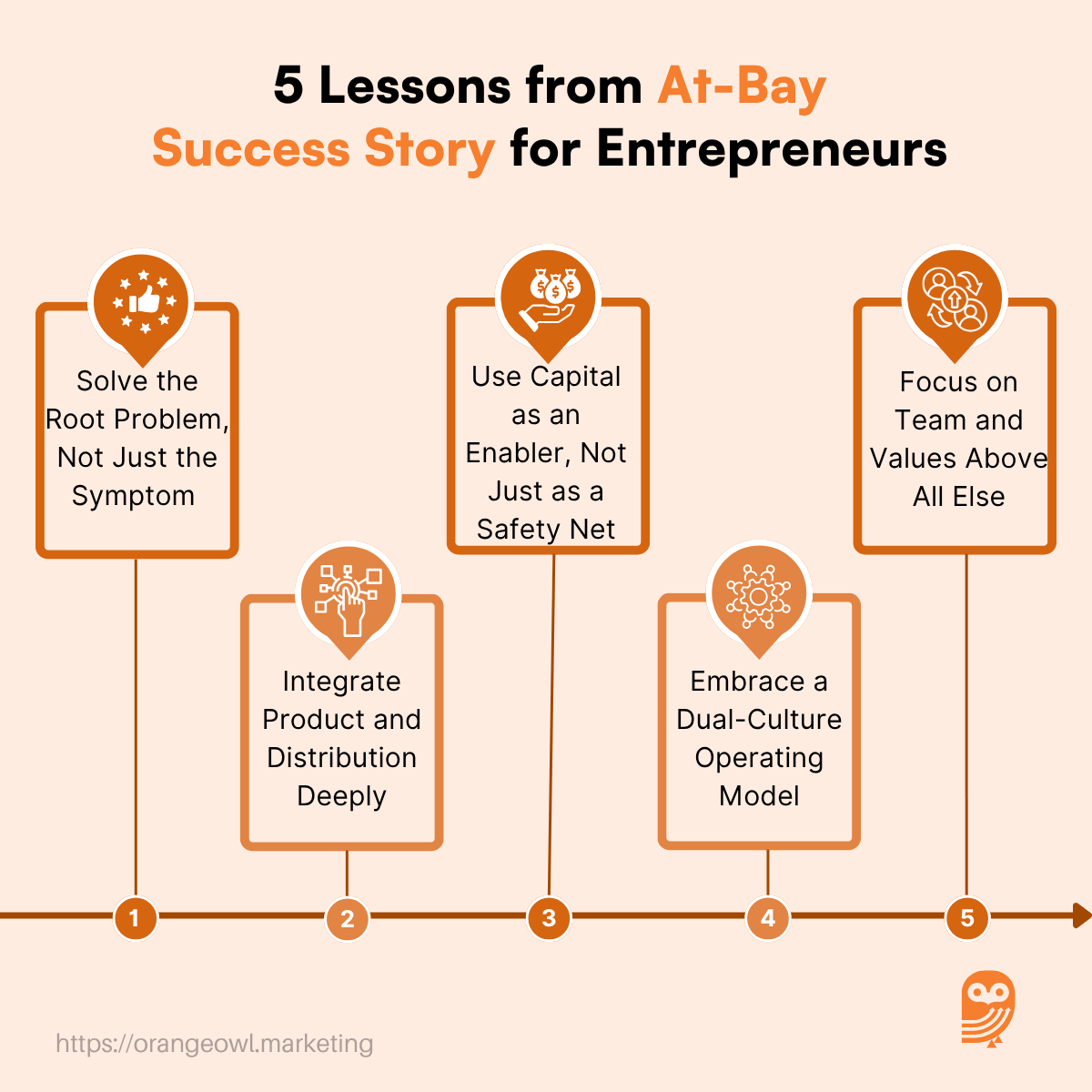
3. Use Capital as an Enabler, Not Just as a Safety Net (The Capital Lesson)
Rotem Iram’s insight on using the balance sheet as an enabler is a massive takeaway. At-Bay used its risk capital to incentivize security improvements. If a client implements a specific security measure identified by At-Bay’s platform, the company might offer better pricing or reduced retention. This demonstrates a deep commitment to partnership and moves the relationship beyond a transactional policy sale.
This approach, a compelling case study in itself, is a powerful lesson for entrepreneurs on how to turn balance sheet risk into a competitive moat.
4. Embrace a Dual-Culture Operating Model (The Talent Lesson)
Building a successful cyber insurance company requires merging two distinct cultures: the cautious, highly regulated world of insurance and the fast-paced, innovative world of cybersecurity technology. At-Bay achieved this by cultivating a truly integrated team. The engineers and security experts work directly with the underwriters, sharing data and knowledge daily. This “no rule company” culture, where domain experts from different fields learn from each other, is a difficult but essential lesson for complex startups.
The ability to speak both ‘Tech’ and ‘Finance’ fluently is a core takeaway for any cross-functional B2B success story.
5. Focus on Team and Values Above All Else (The Founder Lesson)
Ultimately, every success story comes down to the people. Rotem Iram reflected on the pride he feels in the collective effort:
This final lesson underscores the importance of a strong, value-driven culture. Entrepreneurs must prioritize hiring talented, collaborative individuals who are dedicated to the company’s mission, as their combined effort is what truly enables the disruptive change seen in this powerful case study.
At-Bay Success Story Conclusion
At-Bay’s journey from a bold concept to a billion-dollar company is a compelling success story for the modern era. The core takeaways are clear: combine technology and finance to manage risk actively; empower existing distribution channels rather than disrupt them entirely; and foster a high-trust, collaborative culture. This approach has established a new lesson in the market: the best insurance is the one that helps prevent the claim.
As cyber threats continue to proliferate, At-Bay is positioned to become the new industry standard, pushing the entire insurance market toward proactive risk management. The company has shown that by using technology to solve for risk, not just respond to it, the future is brighter for both startups and established enterprises. For aspiring entrepreneurs watching this journey, the biggest lesson is that the hardest problems often yield the most valuable and enduring solutions.