

Introduction: Top 10 Lessons from Leading Media Industry Unicorn Companies of the World
The media landscape of the 21st century is defined by revolutionary technologies and business models that were unimaginable just a decade ago. At the vanguard of this transformation are a select group of privately held companies—unicorns—valued at over a billion dollars, who have not just adapted to the new digital reality but have actively built it. These companies, including giants like Epic Games, the community powerhouse Discord, the Web3 pioneer OpenSea, and the generative AI leader Runway, represent a new playbook for achieving monumental growth in a world of constant disruption.
They prove that media is no longer just about consuming content; it’s about participating, creating, connecting, and building entire digital worlds.
The collective success stories of these ten titans—Epic Games, Discord, OpenSea, Grammarly, Niantic, Automattic, Clubhouse, Yuga Labs, Rec Room, and Runway—offer a masterclass in innovation. They navigated market volatility, outmaneuvered incumbent giants, and cultivated fiercely loyal global communities. Their journeys, from nascent startups to multi-billion-dollar entities, are not merely tales of capital accumulation; they are deep case studies in strategic foresight, technological mastery, and a profound understanding of evolving user psychology.
What unifying principles underpinned this unparalleled success? By analyzing the core strategies, philosophies, and operational decisions of these media behemoths, we can distill a set of ten powerful lessons for any entrepreneur or company aiming to define the future of their industry. These lessons reveal that the next era of media dominance will be built on a foundation of creator-first ecosystems, relentless authenticity, and the courageous democratization of cutting-edge technology.
The blueprint for media unicorn success is here, and it demands not just growth, but a generational shift in how we approach product, community, and purpose. The following lessons, drawn directly from the experiences of these leaders, represent the most critical takeaways from the world’s most successful, privately-held media and technology companies.
The extraordinary growth of the world’s leading media industry unicorns is a testament to the power of a clear vision executed with strategic precision. Each company, while unique in its market, shares a common DNA of innovation that has allowed it to scale to multi-billion-dollar valuations. Below are the ten most critical lessons derived from their distinct paths to success:
1. Master a Core Technology to Build a Creator-First Ecosystem (Epic Games Case Study)
Epic Games’ incredible valuation and influence stem not only from a popular video game like Fortnite but from its unwavering “relentless dedication to technology innovation”. The first core lesson from the top 10 lessons is to master a foundational technology and leverage it to construct a sustainable, creator-first ecosystem. Their Unreal Engine serves as a fundamental building block for the entire media industry unicorns, extending its utility far beyond gaming and into film, architecture, and automotive design.
This “strategic focus on ‘building the tools that build the world'” ensures they are an indispensable partner across multiple creative fields. For founders, the core takeaway is to “think beyond the immediate app and identify a foundational layer of technology that can scale into an entire ecosystem”. This requires not only technological superiority but also the “willingness to take strategic risks” , such as challenging established digital storefronts, and maintaining a “visionary commitment to the open metaverse”. This multi-layered approach ensures long-term power and relevance.
2. Democratize Powerful, Complex Technology (Runway Case Study)
The generative Artificial Intelligence revolution is highly complex, but Runway’s success is built on making it radically accessible. Runway proved that “complex AI can be both powerful and accessible” by becoming an “indispensable tool for filmmakers, designers, and marketers”. The lesson here is that cutting-edge technology—the kind that truly disrupts—must be placed directly into the hands of the everyday creator. Runway’s platform essentially democratized the ability to create high-quality, professional-grade content with machine intelligence.
This strategy focuses on reducing the technical barrier to entry, transforming a powerful, esoteric capability into a widely usable creative utility. By focusing on the user experience and the creative output, rather than the underlying algorithm, a company can “spearhead the revolution” and accelerate adoption across industries. The second lesson from the top 10 lessons is that: In essence, the power of a tool is measured by its utility, not its complexity.
3. Treat Your Product as a “Sandbox of Life” for Community Building (Discord Case Study)
Discord’s transformation from a chat app for gamers to a general-purpose community platform highlights the power of a virtual “sandbox.” The founder links early success in his life and the product’s design to the idea of a game as a “little sandbox of life” where one is “learning about people, you’re learning about teamwork, you’re learning about strategy”. The lesson is to design your platform as a highly flexible, low-friction environment where human-to-human interaction can be the primary feature, not just a sideline.
By facilitating collaboration, conversation, and shared experience in a way that mimics the organic dynamics of life—but digitally—Discord unlocked exponential network effects. The third lesson from the top 10 lessons is that: Success is found by creating a space where users can build their own social rules and rituals, thereby fostering deep, genuine connections. This is about building a social utility that transcends its initial market and becomes a foundation for diverse, user-generated subcultures.
4. Embrace the Frontier and Define the Centralized/Decentralized Spectrum (OpenSea Case Study)
OpenSea established itself as a pioneer by embracing a completely new, risky market: NFTs and the broader Web3 ecosystem. Operating in the “frontier of internet money and internet finance”, the fourth lesson from the top 10 lessons from OpenSea is the necessity of building essential infrastructure for an unproven, high-potential future. Furthermore, their journey highlights the critical strategic challenge for Web3 companies: navigating the “spectrum” of being a traditional, centralized company versus a decentralized application.
To achieve unicorn status, the company had to provide the security, stability, and ease-of-use of a centralized entity while serving the needs of a decentralized community. This requires a unique blend of corporate governance and crypto-native philosophy, proving that in a new frontier, the company that provides the most reliable gateway wins, even if the ultimate destination is decentralized.
5. Let Mission and Values Power Your Growth and Investor Selection (Grammarly Case Study)
Grammarly’s Max Lytvyn emphasizes the central role of “mission, values, how to use them to power growth of a company… how to use them to scale a company”. The core lesson is that a clear, articulated mission is not just marketing copy; it is a vital operational tool. It acts as a compass for product development, hiring, and, critically, investor relations. Lytvyn cautions against the mistake of “pretending to share the values of their investors” when seeking funding, because if the deal goes through, the company would “have to keep pretending for next five to ten years”.
The fifth lesson from the top 10 lessons stresses the importance of value alignment at every level, ensuring that investors, employees, and the company are all fundamentally rowing in the same direction. A rock-solid, authentic value system attracts the right talent and capital, enabling genuine, sustainable scaling.
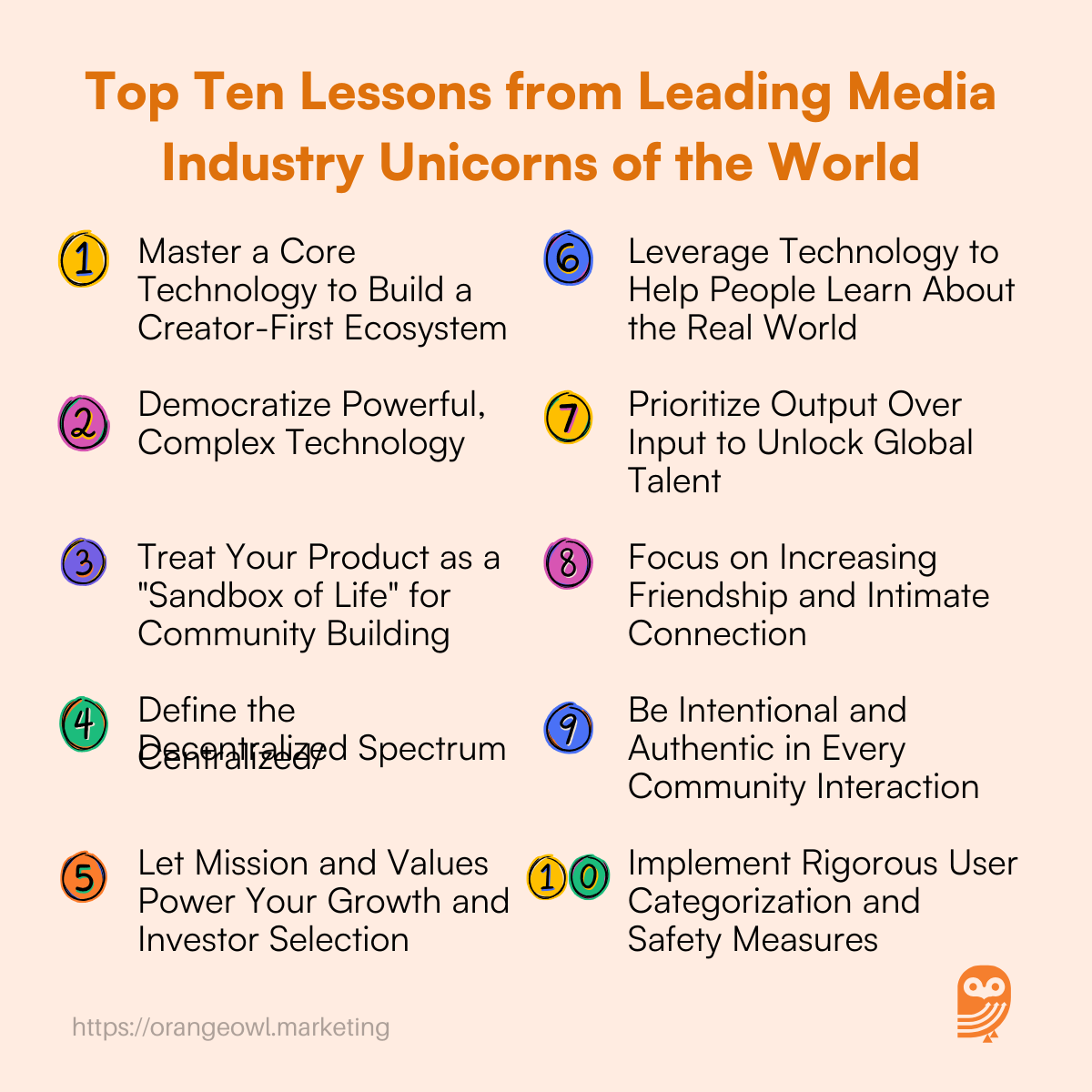
6. Leverage Technology to Help People Learn About the Real World (Niantic Case Study)
Niantic’s approach, from its origins within Google to its focus on Augmented Reality (AR), provides a lesson in blending the digital and physical. The initial driving idea was “using technology to help you learn about the world” through AR and “wearable Computing”. The sixth lesson from the top 10 lessons is that the most enduring media experiences are those that encourage users to engage with reality, rather than escape from it.
By overlaying digital experiences onto real-world geography—a focus that continues with its platform for “geospatial AR”—Niantic created a powerful new media category. This strategy proves that connecting users to their physical surroundings and local history can generate intense, unique, and location-dependent network effects, driving both massive adoption and a tangible sense of discovery. The media of the future will augment, not replace, our everyday environment.
7. Prioritize Output Over Input to Unlock Global Talent (Automattic Case Study)
As a leader in the remote-first working model, Automattic’s success is a lesson in organizational design that prioritizes talent over geography. CEO Matt Mullenweg famously focuses on “output based management rather than input based management”, stating, “I don’t care how many hours you work I care about how well you work”. This philosophy allows them to “hire people that you would normally be able to hire”, tapping into a global talent pool that is inaccessible to location-bound companies.
The seventh lesson from the top 10 lesson is that for a digital-native company, strict schedules and physical presence are artifacts of a past industrial model. By structuring work around results and trusting employees, a company can unlock global talent and gain a significant competitive advantage in terms of skill, cost-efficiency, and diversity.
8. Focus on Increasing Friendship and Intimate Connection Over Mass Scale (Clubhouse Case Study)
Clubhouse’s explosive, though ultimately volatile, growth provided a powerful lesson in the value of intimate, real-time audio. The company’s mission is to “increase friendship in the world” and “create a place where you can be among friends”. The eighth lesson from the top 10 lessons is the need to hyper-focus on the quality and intimacy of the connection, rather than just the sheer volume of users. Even after its initial boom, the company retained a “core community” who survived the hype cycle, proving that genuine connection is the ultimate form of stickiness.
This strategy focuses on providing a space where users “can always just open their phone and and they can feel at home”. The lesson is: build a product that facilitates deeply human, authentic interactions, and the community—even if smaller—will become far more resilient than a fleeting trend.
9. Be Intentional and Authentic in Every Community Interaction (Yuga Labs Case Study)
Yuga Labs, the creator of the Bored Ape Yacht Club and a major player in Web3 IP, demonstrates the necessity of radical authenticity in building a modern brand. The co-founder stresses the need to be authentic in every decision, posing the critical self-check: “does this feel phony is this fake am I like mimicking what somebody else would do”. Their most successful moments came from reminding the world that they were “just four idiots in a room trying our best here” and that they shouldn’t “treat it that way” (like a big corporate thing).
The ninth lesson from the top 10 lessons proves that in a highly engaged, decentralized, and creator-owned economy, the brand’s identity must be intentionally human and transparent. Every interaction, even the smallest tweet, must reinforce an authentic, non-corporate ethos to maintain the trust and loyalty of a community that views itself as an owner.
10. Implement Rigorous User Categorization and Escalating Safety Measures (Rec Room Case Study)
For any media platform that relies on social interaction, especially in an immersive 3D environment, safety and moderation are paramount for sustained health. Rec Room’s lesson lies in its highly granular approach to community management, which involves an “escalating series of suspensions” and the use of user-defined categories or “buckets”. Users are explicitly segmented into types like “trolls,” “gamers,” and “Sparkle ponies” (first-time/drunk users).
This level of sophistication in moderation is the key to managing the chaos inherent in an open social world. It acknowledges that not all disruptive behavior is the same, and different user types require tailored safety protocols. The final lesson from the top 10 lessons is clear: robust and nuanced safety systems are not an afterthought; they are a core feature that preserves the platform’s social capital and ensures a welcoming environment for the majority of users.
Conclusion
The ten media unicorns examined—Epic Games, Discord, OpenSea, Grammarly, Niantic, Automattic, Clubhouse, Yuga Labs, Rec Room, and Runway—have not merely succeeded; they have architected the future of how we interact, create, and consume. Their combined lessons offer a profound roadmap for navigating the volatile, high-stakes world of technological entrepreneurship.
The common thread uniting these diverse companies is a commitment to a creator-first, community-driven, and technology-mastered vision. They have learned that true scale is not achieved by simply attracting users, but by building comprehensive ecosystems where users are empowered to create value, whether through professional-grade AI tools (Runway ), foundational gaming engines (Epic Games ), or decentralized digital assets (OpenSea). They prioritize output and talent globally (Automattic) and cultivate core communities with a fiercely authentic voice (Yuga Labs). Moreover, they understand that building a resilient platform requires an unwavering focus on the quality of connection (Clubhouse, Discord) and the safety of the user experience (Rec Room).
For the next generation of founders, the message is one of audacity and intentionality: master a core technology, embed your business in powerful, non-negotiable values (Grammarly), and use your product to augment the human experience, whether by connecting the digital to the physical world (Niantic) or by fostering new forms of digital friendship. The journey of these unicorns proves that a long-term vision, backed by a superior product and a willingness to build the entire scaffolding for a new market, is the true formula for not just a billion-dollar valuation, but for generational impact. Embrace these lessons, and the next great media revolution will be yours to lead.
Read more on Unicorn Success Stories here, also check out lessons from the top 10 Enterprise Tech Unicorns and FinTech Unicorns