
OpenSea Success Story Introduction
OpenSea stands as one of the most remarkable success stories in the history of Web3 startups. Founded at the very dawn of the modern NFT movement, it established itself as the indispensable digital marketplace for buying, selling, and trading unique digital assets. OpenSea’s explosive growth not only cemented its position as a market leader but also served as a critical case study in the power of building infrastructure on a burgeoning decentralized platform.
The company, co-founded by Devin Finzer and Alex Atallah, achieved unicorn status in 2021, culminating in a Series C funding round that reportedly valued the firm at $13.3 billion. This phenomenal scale-up in just a few short years offers invaluable lessons and strategic takeaways for aspiring entrepreneurs looking to build in new and volatile frontier markets. The following explores the journey of this Web3 giant, from its humble origins to its ascent as a global platform.
Origin Story
The founding entrepreneurs, Devin Finzer and Alex Atallah, launched OpenSea in December 2017. Their motivation stemmed from a core belief in “programmable property”-the idea that digital assets could be made scarce and unique, allowing for true digital ownership. At the time, the concept of a non-fungible token (NFT) was still incredibly niche, primarily centered around early projects like CryptoKitties. Finzer and Atallah recognized that while the first wave of NFTs proved the concept, the ecosystem lacked fundamental infrastructure. There was no single, reliable place to list, discover, and transact these unique digital items.
The initial vision for OpenSea was straightforward yet foundational: to be the “eBay for digital goods.” Their mission was to build a comprehensive, user-friendly marketplace that would make it easy for anyone—from seasoned crypto natives to new users—to engage with NFTs. This included support for a wide array of token standards, chains, and digital assets. This clarity of purpose, focused on solving a core infrastructure problem for a nascent market, is a key lesson for all technology startups.
In the context of that early vision, Finzer and Atallah noted:
Business Space and Early Challenges
OpenSea entered the nascent Web3 and NFT sector, an industry characterized by rapid innovation but also extreme volatility and technical complexity. Unlike traditional e-commerce, the NFT space involves self-custody of assets, blockchain transaction fees, and a shifting regulatory landscape. The company was building on the Ethereum network, providing a vital bridge between artists, collectors, and the underlying blockchain technology.
In its early years, OpenSea faced the classic startups challenge of liquidity. With few buyers and sellers, the marketplace was initially quiet. Furthermore, as a centralized company operating in a decentralized space, they constantly grappled with balancing platform control with Web3 ethos.
The platform was technically challenging to build, requiring integration with multiple smart contracts and decentralized protocols. The greatest test, however, came with the unprecedented NFT boom of 2021. The sudden influx of millions of new users pushed OpenSea’s infrastructure to its absolute limit, resulting in frequent outages, slow loading times, and a constant scramble to scale the engineering team. This period highlighted the inherent risks and scaling hurdles faced by platforms that sit at the intersection of traditional business models and cutting-edge decentralized technology. The operational takeaways from surviving this period were instrumental to their long-term success stories.
Growth Strategies
OpenSea’s primary growth strategy centered on product expansion and cross-chain support. By quickly integrating support for new NFT standards and various blockchains (like Polygon, Klaytn, and Solana), they captured network effects across the entire Web3 ecosystem, establishing the platform as the default entry point. Furthermore, securing several key funding rounds from high-profile investors allowed them to rapidly scale their team and product offerings, a common practice for successful tech startups.
Unique Strategic Moves
One of their most impactful moves was maintaining a developer-centric approach by offering powerful, open APIs. This allowed thousands of smaller startups and independent creators to integrate OpenSea’s listings directly into their projects, making the marketplace’s data ubiquitous across the NFT world. This strategy turned potential competitors into platform evangelists, a brilliant case studies model for achieving market dominance.
Key performance indicators (KPIs) that demonstrated OpenSea’s explosive growth included:
Monthly Trading Volume: Soaring from roughly $21 million in January 2021 to over $5 billion by January 2022.
User Count: Exponential growth in the number of active traders and creators on the platform.
Funding Rounds: Achieving the aforementioned $13.3 billion valuation after a Series C round.
Marketing Strategies
OpenSea’s marketing was less about costly traditional advertising and more about riding the wave of cultural relevance inherent to the Web3 community. Their approach was inherently innovative, relying on community engagement, social media virality, and organic adoption from influential NFT projects.
The most effective “campaign” was simply being the default platform for high-profile NFT drops (like Bored Ape Yacht Club and CryptoPunks). The company benefited from the network effect where every successful project that utilized OpenSea became an advertisement for the marketplace. They actively engaged on Twitter and Discord, the native social channels of the crypto community, ensuring transparency and rapid communication—a vital lesson for Web3 entrepreneurs.
OpenSea’s brand identity was that of the safe, reliable, and universal infrastructure layer. While NFT projects provided the cultural content, OpenSea provided the pipes. Their brand focus was on trust and stability, critical qualities after a period that included an “insider trading” scandal involving a former employee—a major challenge they had to overcome by reinforcing their values and compliance policies.
This led the founders to reflect on their operational philosophy:
Scaling to Unicorn Status
OpenSea officially crossed the unicorn threshold in 2021. The most defining milestone was their $300 million Series C funding round in January 2022, led by Coatue and Paradigm, which catapulted its valuation to $13.3 billion. This funding was critical for accelerating R&D, scaling customer support, and investing in new security features to protect users.
The “Secret Sauce”
OpenSea’s “secret sauce” was first-mover advantage combined with flawless execution in a rapidly growing market. They were the earliest to offer a truly seamless NFT buying experience. Their commitment to supporting the widest range of digital assets and blockchains made them an indispensable tool. This strategic alignment of timing, technology, and market demand is a crucial lesson found in countless success stories.
The founders often emphasized the conviction required to build in a new market:
5 Key Lessons for Other Entrepreneurs
The journey of OpenSea offers five profound takeaways for modern entrepreneurs and startups:
1. Focus on Infrastructure in a Frontier Market
OpenSea did not try to create the “killer NFT project”; they created the platform on which all killer projects could be born. This lesson is critical: in a new, unproven ecosystem (like AI today, or Web3 yesterday), providing the core, reliable infrastructure (the “picks and shovels”) is often a safer and more scalable bet than creating the application itself. OpenSea recognized a fragmented market and unified it, which is the foundational blueprint for a hyper-growth case studies firm.
2. Embrace the Network Effect of Open APIs
By providing a robust and open Application Programming Interface (API), OpenSea allowed external developers to integrate their marketplace into their own products. This move turned third-party developers into a decentralized sales and distribution force, dramatically increasing the platform’s reach without proportional marketing spend. The takeaways here are clear: for digital startups, a developer-friendly ecosystem can be the most powerful growth engine.
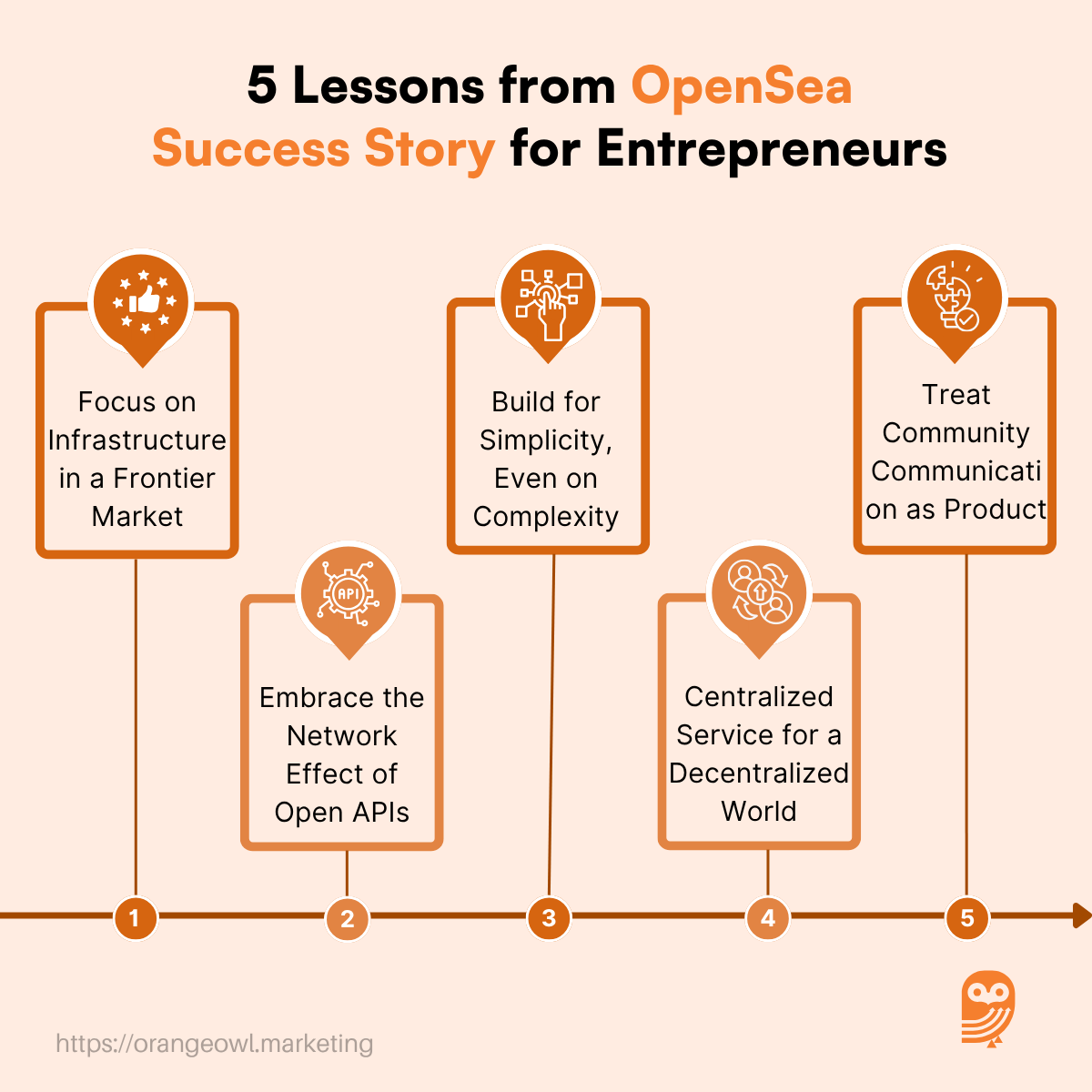
3. Build for Simplicity, Even on Complexity
The underlying technology (blockchain, smart contracts, Web3 wallets) is highly complex. OpenSea succeeded by abstracting this complexity away from the average user. Their smooth, intuitive user interface and experience (UI/UX) made transacting in NFTs feel as simple as buying on Amazon, despite the cryptographic complexity happening in the background. This lesson highlights the value of good design in democratizing new, complicated technologies.
4. Centralized Service for a Decentralized World
OpenSea successfully navigated the tension between a centralized corporate structure and the decentralized ethos of the market. They provided the stability, compliance, and user protection (customer service, moderation, fraud prevention) that early, purely decentralized solutions could not, making them the preferred choice for mass adoption. This case studies approach shows that for rapid growth, a blend of traditional business acumen (centralized trust) applied to a novel technology (decentralization) can be the most effective path.
5. Treat Community Communication as Product
In the volatile and highly speculative NFT market, transparent and rapid communication with the community on platforms like Discord and Twitter was non-negotiable. When a challenge arose—whether a technical outage or a business ethics issue—OpenSea’s response became part of their brand. The takeaways is that in Web3, the community is an extension of the product, and engaging them with honesty and speed is paramount to maintaining trust and weathering crises. These lessons are vital for all modern startups.
OpenSea Success Story Conclusion
OpenSea’s ascent from a niche crypto project to a multi-billion dollar platform is a prime example of a success story built on timing, conviction, and execution. The company’s key takeaways involve identifying essential infrastructure gaps, leveraging network effects through open design, and simplifying complex, frontier technology for the mainstream. For entrepreneurs, it remains a vital case studies example of building a market leader in a brand-new technological space.
While the NFT market continues to mature and evolve, OpenSea’s future lies in adapting to new competitors and the ever-shifting needs of the crypto landscape. It must continue to innovate on its core marketplace offering, support emerging protocols, and perhaps even embrace greater decentralization to stay relevant.
The OpenSea journey proves that the greatest opportunities for startups often exist not where the crowd is, but where the entrepreneurs with early conviction choose to build the fundamental tools. Find the chasm in a new market, build the bridge, and your success stories will follow.