
RecRoom Success Story Introduction
RecRoom is not just a game; it is a sprawling, user-generated metaverse where players can connect, play, and create immersive digital experiences. It stands as a brilliant modern case study in how a strong focus on community can drive exponential growth. Launched in 2016, the company, then called Against Gravity, was born from the minds of a dedicated team of entrepreneurs with a vision to make VR a social, welcoming space.
The company achieved its coveted unicorn status in March 2021 with a valuation of $1.25 billion, which later surged to an impressive $3.5 billion by the end of the year. This remarkable success story provides an invaluable lesson for all technology startups: the future of digital content lies in empowering the users themselves. This blog post explores the key strategies and takeaways from Rec Room’s rise, serving as an inspiration for the next generation of founders.
Origin Story
The company was initially conceived as a “recreation room” for virtual reality users, a place to gather and play simple games without the pressure or toxicity often found in traditional online gaming. The founders saw a fundamental gap in the burgeoning VR market: while the technology was impressive, it lacked compelling, easy-to-access social experiences. Their vision was simple: to bring people together in a fun, positive, and safe digital environment.
Rec Room was launched by a team of six co-founders—Nick Fajt (CEO), Cameron Brown (CCO), Dan Kroymann, Bilal Orhan, Josh Wehrly, and John Bevis. Their extensive experience at Microsoft, particularly working on the HoloLens and Xbox teams, provided them with deep insights into both immersive technology and large-scale platform development. This collective background was a foundational lesson in building a truly disruptive technology.
The initial mission was to create a social hub that felt like a digital community center, hence the name “Rec Room.” This wasn’t just about making games; it was about building a platform for social connection. The founders initially focused on in-house VR-only games, but their ultimate vision extended to establishing a truly open, cross-platform metaverse, a pivotal decision that would transform the company’s trajectory and become a major takeaway for other startups.
Business Space and Early Challenges
Rec Room entered the competitive and capital-intensive social VR and gaming industry. While dominated by giants like Meta and established PC platforms, Rec Room carved out a niche by focusing on an authentically social and low-fidelity aesthetic. This deliberate choice made it accessible to a wider range of hardware, from high-end VR headsets to basic mobile devices. This positioning has become a classic case study in achieving differentiation through inclusive design.
Early in the VR industry, technical hurdles like high hardware cost and user-sickness (vertigo) were common. However, as CCO Cameron Brown noted, the most unique challenges were social and behavioral, a key lesson for all social platforms:
The earliest version was a VR-only environment, which severely limited the potential audience. Like many other technology startups, Rec Room faced the “chicken-and-egg” problem: a social platform is worthless without users, but users won’t join a platform without compelling content and other people. The team’s ability to attract and retain an initial core community was their first major victory, providing an important takeaway about prioritizing user-love over mass market adoption in the initial phases.
Growth Strategies
Rec Room’s scaling has been driven by two core strategies: cross-platform expansion and the embrace of user-generated content (UGC). Moving beyond the constraints of VR to platforms like PlayStation, PC, iOS, and Android was critical, democratizing access and exponentially increasing the potential user base. This is a foundational lesson in how to grow a digital community.
Unique Strategic Moves
The company’s most unique and decisive strategic move was the introduction of the Creator Economy. By providing players with simple yet powerful tools to build their own custom rooms, games, and experiences, Rec Room transformed from a developer of games to a platform for content creation. This shift solved the content bottleneck and turned their most passionate users into a de-facto creative workforce. This single decision underpins much of their subsequent success stories.
Rec Room’s success is measured by its vibrant creator community. The company reported that top creators were earning hundreds of thousands of dollars annually through the platform’s in-game currency, Tokens, which can be exchanged for real money. Millions of user-created rooms now exist, far outpacing the development capacity of the original team of entrepreneurs and proving the power of the UGC model.
Marketing Strategies
While many gaming startups rely on expensive traditional advertising, Rec Room’s marketing has been inherently viral and community-driven. Their innovative approach focuses on amplifying the best user-created content through social channels like TikTok and YouTube.
The most effective marketing “campaign” is the organic virality generated by the community. By highlighting incredible player-made worlds and games, the company turns every user and every custom room into a piece of marketing content. The founders understand that in a social app, the best marketing is the experience itself, a key takeaway for aspiring entrepreneurs.
The Rec Room brand is defined by its low-poly, friendly aesthetic and its genuine commitment to inclusivity and safety. This clear branding provides a welcoming entry point for all ages and skill levels, contrasting with the high-fidelity, often aggressive tone of other metaverses. The company’s dedicated community management is also an essential part of its “brand.” As co-founder Cameron Brown mentioned, they heavily segment their user base to manage community health, offering another valuable case study in platform management:
Scaling to Unicorn Status
The expansion to non-VR platforms (iOS and Android) was a watershed moment, making Rec Room accessible to billions of potential users. The launch of the Creator Economy and the subsequent funding rounds—leading to its $3.5 billion valuation—solidified its place as a unicorn. These milestones demonstrate a masterful execution of a platform play over a simple game studio model. The Rec Room success stories are deeply intertwined with the success stories of its community creators.
The “Secret Sauce”
Rec Room’s “secret sauce” is the authentic empowerment of its community. It’s not just the technology that made it a unicorn; it’s the shift in mindset from a top-down developer to a bottom-up platform. By sharing revenue and creative control with their most engaged players, they cultivated a deeply invested community. This is a crucial lesson in modern platform business.
5 Key Lessons for Other Entrepreneurs
For aspiring entrepreneurs and founders of new startups, Rec Room’s journey offers a roadmap to building a durable, community-powered business. This comprehensive case study is replete with powerful takeaways.
1. Prioritize Accessibility Over Fidelity
Rec Room’s intentional choice of a low-fidelity, stylized aesthetic allowed it to be cross-platform, running on everything from a cheap smartphone to a high-end VR headset. This greatly expanded its addressable market and is a powerful takeaway: don’t sacrifice massive reach for a marginal improvement in graphics. The best product is the one everyone can use.
2. Unlock the Creator Economy Early
The single most important strategic lesson for Rec Room was realizing that the best content would be made by its users. By providing easy-to-use creation tools and a clear path to monetization (Rec Room Tokens), they built a self-sustaining ecosystem. This drastically reduced their content creation cost and scaled their offerings exponentially.
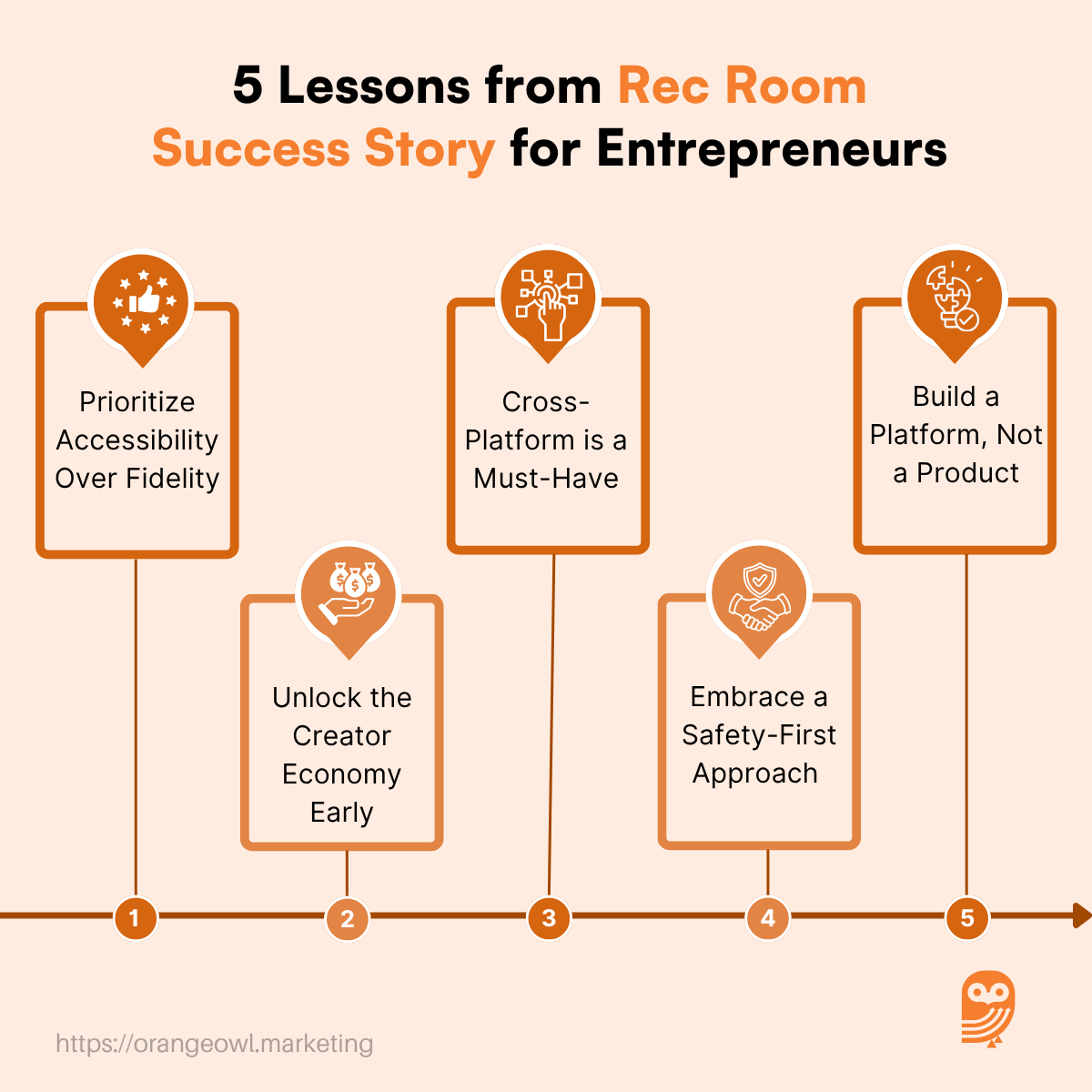
3. Cross-Platform is a Must-Have, Not a Nice-to-Have
For a social platform to achieve true scale, it must be available everywhere users are. Rec Room’s move from a VR-only niche to a mobile-dominant platform demonstrated the criticality of this strategy. This expansion ensured that new users could always find their friends, which is the ultimate driver of a social platform’s utility.
4. Embrace a Safety-First Approach to Community Management
The unique challenges of social VR, as described by the founders, require a proactive approach to moderation. The company’s policy of highly segmented user categorization, escalating suspensions, and clear community rules provides a valuable case study in maintaining a healthy digital environment, which is vital for long-term user retention.
5. Build a Platform, Not a Product
The largest takeaway for startups looking to become unicorns is the power of the platform model. Rec Room is not a single game; it is an operating system for games and social interaction. This architecture allows it to pivot, grow, and monetize multiple distinct revenue streams simultaneously. Founders should always ask: Can my product become a platform?
RecRoom Success Story Conclusion
Rec Room’s phenomenal success story provides an essential case study on the future of the metaverse, driven by user creativity, cross-platform ubiquity, and a deeply invested community. The crucial lesson here is that the most successful startups in the next digital wave will be those that prioritize platform-building over simple product delivery. This approach has generated one of the most compelling success stories in recent memory.
As the company continues its mission to connect the world through play, its focus remains on lowering the barriers to entry for both players and creators. With a robust economy and millions of unique rooms, Rec Room is poised to become one of the defining social platforms of the decade, continuing to inspire entrepreneurs globally.
The journey of Rec Room proves that the greatest businesses often emerge not from proprietary content, but from the simple, radical act of empowering others. For every aspiring entrepreneur watching this journey, the biggest takeaway is clear: the right tools in the hands of a passionate community can build an empire. The opportunity to leave your mark is waiting.