

Epic Games Success Story Introduction
Epic Games is one of the most transformative companies in the modern entertainment landscape, a powerful force that has profoundly shaped both the gaming industry and the future of the internet. The company was founded in 1991 by the visionary Tim Sweeney, starting as a small North Carolina-based team that has since grown into a global technology powerhouse. Epic Games has long been a unicorn company, with its valuation peaking at around $32 billion in April 2022, a testament to its disruptive innovation.
This case study on Epic Games’ colossal growth is a mandatory read for aspiring entrepreneurs and established startups alike. The journey of Epic Games provides invaluable lessons on long-term vision, strategic risk-taking, and the immense power of building a foundational technology platform. Understanding the takeaways from their path to success is key to navigating the turbulent waters of the modern tech world. The company’s trajectory is a definitive success story of sustained innovation over three decades.
Origin Story
The company’s origin lies in the intersection of Tim Sweeney’s passion for computers and his belief in the transformative potential of real-time 3D graphics. Sweeney saw a significant gap in the market for sophisticated, yet accessible, game development tools. He began with a simple mail-order business called Potomac Computer Systems, creating his first commercial game, ZZT, from his parents’ house. This early hustle is a prime lesson in how startups often begin with a scrappy approach and a founder’s singular focus.
Epic Games was founded by Tim Sweeney in 1991. Sweeney’s background was in mechanical engineering, but his true calling was in programming, a journey that began on his first Apple II. His early work showcased a rare talent for optimization and performance, laying the groundwork for the technological marvel that would become the Unreal Engine. For many entrepreneurs, Sweeney’s early dedication to mastering the technical craft is one of the most crucial takeaways.
The initial mission was straightforward: to create great games. However, a more profound vision emerged shortly after the release of the company’s first major title, Unreal, in 1998. The game was packaged with its underlying technology—the first generation of the Unreal Engine. Sweeney quickly realized the engine itself was a more valuable and disruptive product than the game. The vision expanded from being a game studio to being a platform provider, aiming to give other creators the power to build incredible worlds.
Business Space and Early Challenges
Epic Games operates in two primary, yet interconnected, spaces: video game development/publishing (Fortnite, Gears of War) and game engine technology (Unreal Engine). The game engine space, in particular, is highly competitive, dominated by a few powerful entities. Epic Games’ commitment to making the Unreal Engine accessible to game developers, filmmakers, and architects is a prime case study in platform strategy.
Early on, Epic faced the challenge of competing with established, well-funded developers and engine providers. However, their biggest challenge, one that is crucial for all startups in the graphics space, was overcoming the immense technical hurdles of creating realistic characters.
The company’s initial decades were a grind of producing successful titles to fund the continuous, expensive development of the Unreal Engine. Their most challenging strategic moment came with the seismic shift from retail sales to digital distribution and the free-to-play model. They had to transition a business model built on selling $60 boxed games to one based on in-game purchases. This pivot is a foundational lesson for all modern entrepreneurs: adapt to the market or perish.
Growth Strategies
Epic Games has relied on two key strategic pillars for scaling: Technology and Ecosystem. They continuously poured profits into R&D for the Unreal Engine, ensuring it remained cutting-edge. Their second strategy was ecosystem growth, most famously with the creation of the Epic Games Store (EGS). The EGS was launched to challenge the market dominance of digital storefronts by offering developers a significantly higher revenue split (88% vs. the industry-standard 70%).
Unique Strategic Moves
The single most unique and disruptive strategic move was the launch of Fortnite Battle Royale and its subsequent transformation into a “metaverse” social space. While many startups chase trends, Epic Games created one. They didn’t just make a game; they made a cultural phenomenon and a revenue-generation engine that bankrolled their broader strategic goals, including the EGS and their foray into the open-metaverse concept.
Beyond the impressive valuation of over $32 billion, Epic Games’ success is measured by its platform scale: hundreds of millions of registered accounts for Fortnite, a game engine used by a majority of AAA game studios, and its success in making the Unreal Engine free for developers until their revenue hits a commercial threshold. This focus on platform adoption over immediate revenue is a powerful takeaway for any technology company.
Marketing Strategies
Epic Games has consistently moved away from traditional marketing. Instead of massive ad buys, their strategy centers on two things: Community and Content. The Unreal Engine is marketed primarily through high-profile case studies (like The Mandalorian using their virtual production tools) and by simply giving it away for free to foster a creator community.
The marketing for Fortnite is the true case study in modern digital engagement. Its success is rooted in its continuous, innovative in-game “events,” which are essentially live, interactive advertising campaigns. Events like the Travis Scott concert or the destruction of the old map were organic, viral social media phenomena. This strategy taught the world’s entrepreneurs a valuable lesson: the product is the marketing.
Epic Games’ brand identity is defined by a commitment to the creator. By offering developers a superior revenue share and providing an industry-leading, free engine, they cultivate a brand of being the “good guys” for creators. This strong, creator-first mission has been instrumental in their success story.
Scaling to Unicorn Status
Epic Games’ road to unicorn status involved several key milestones:
1998: The launch of the first Unreal Engine, establishing them as a dual game and technology company.
2012: Investment from Chinese tech giant Tencent, which helped fund the shift to the Games as a Service (GaaS) model.
2017: The launch of Fortnite Battle Royale, which provided the massive cash flow necessary for radical expansion.
2018: Achieved unicorn status after a massive funding round, fueled by Fortnite‘s unparalleled revenue.
2020/2021: Subsequent multi-billion-dollar funding rounds solidified its position, with a peak valuation of $32 billion.
The “Secret Sauce”
Epic Games’ secret sauce is its dual product strategy and long-term vision. They monetized an entertainment product (Fortnite) to fund a foundational technology product (Unreal Engine). This gave them the financial leverage to challenge tech giants on two fronts: the gaming market and the digital distribution model. Their focus on the open metaverse is the continuation of this grand strategic vision.
5 Key Lessons for Other Entrepreneurs
This incredible success story provides five critical takeaways that every new founder should study:
1. Be Willing to Cannibalize Your Own Success (The Engine Strategy)
Instead of hoarding their groundbreaking Unreal Engine, Epic Games chose to license it widely. Later, they made it virtually free to encourage adoption, knowing that a ubiquitous engine would make them an industry foundation. Entrepreneurs must understand that an initial loss leader can become a long-term strategic advantage, creating a platform moat far stronger than any proprietary software. This bold move is a powerful lesson in platform economics.
2. Use Cash-Flow Products to Fund World-Changing Visions (The Fortnite/Metaverse Loop)
Fortnite became an unprecedented revenue generator, but that revenue wasn’t just pocketed. It was immediately and aggressively reinvested into building the Epic Games Store to challenge distribution monopolies and into the development of the Unreal Engine for the metaverse. Startups should seek a profitable venture that can act as a financial engine to fund their “moonshot” goal, a crucial lesson in disciplined resource allocation toward a higher purpose.
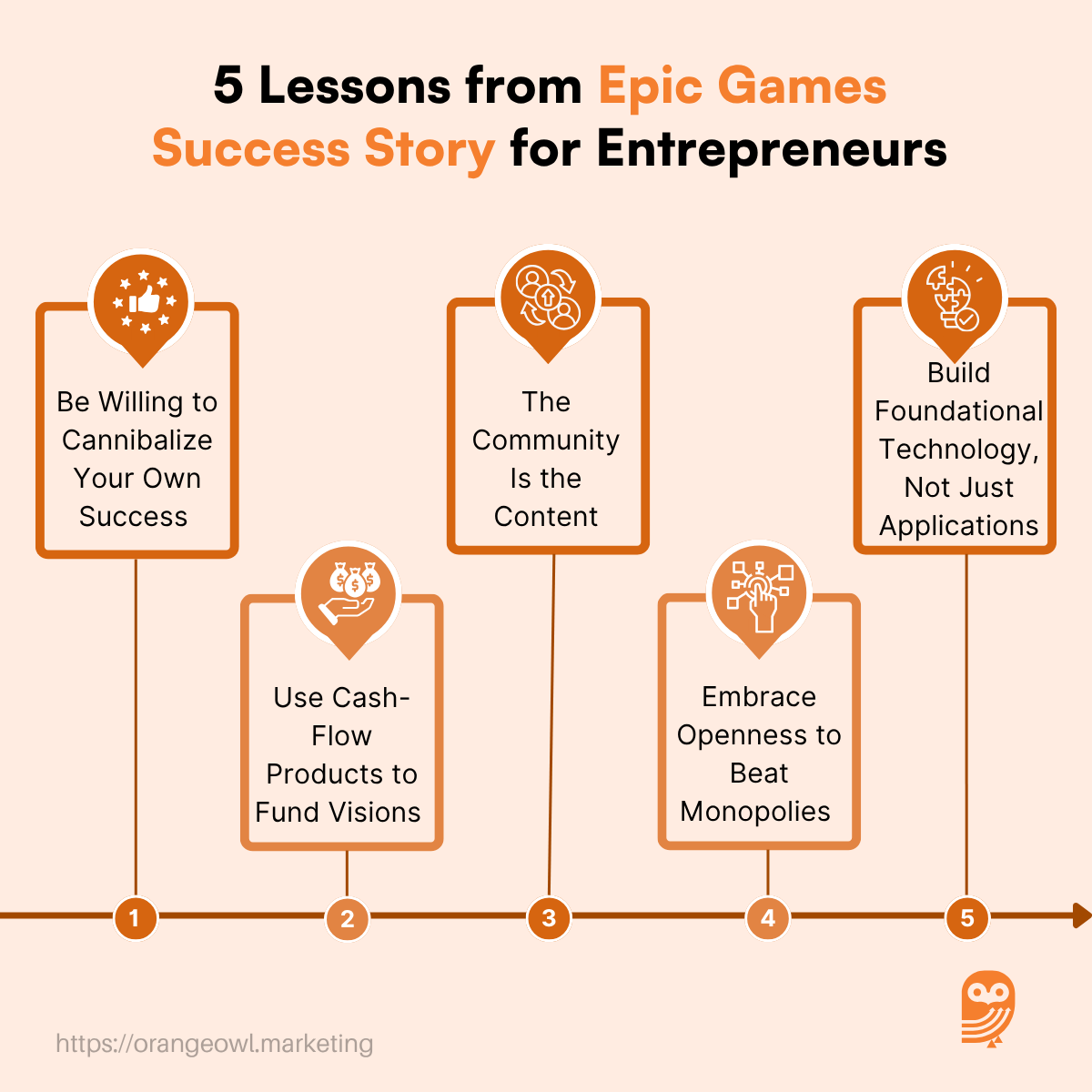
3. The Community Is the Content (Marketing Through Event-Based Storytelling)
Epic didn’t spend fortunes on traditional advertising. They built Fortnite as a dynamic world with constant, world-altering in-game events. This made the product itself a news generator. The most valuable takeaway here is that in the age of social media, organic cultural moments—not polished ads—drive long-term engagement and turn users into loyal community members. This is a master-level case study in modern content strategy.
4. Embrace Openness to Beat Monopolies (The 88/12 Revenue Split)
The decision to offer developers an 88% revenue share on the Epic Games Store versus the industry standard of 70% was a powerful ideological and business statement. It was a direct investment in the success of third-party startups and developers, forging alliances and chipping away at competitors’ dominance. This demonstrates a vital lesson for all entrepreneurs: sometimes, a long-term strategic loss in margin can translate into a massive gain in market influence and brand loyalty.
5. Build Foundational Technology, Not Just Applications (The Long Game)
From the start, Epic Games focused on creating the Unreal Engine, a technology layer that powers thousands of other applications. This strategic focus on “building the tools that build the world” ensures that they are indispensable. For founders, the core takeaway is to think beyond the immediate app and identify a foundational layer of technology that can scale into an entire ecosystem.
Epic Games Success Story Conclusion
The Epic Games success story is defined by three unwavering principles: a relentless dedication to technology innovation (Unreal Engine), a willingness to take strategic risks (challenging digital storefronts), and a visionary commitment to the open metaverse. For entrepreneurs and startups, the main lesson is clear: success comes from mastering a core technology and then leveraging that mastery to build a creator-first ecosystem.
Epic Games continues to push the boundaries of real-time 3D technology, with their sights firmly set on being the foundational technology for the metaverse—a vast, persistent, and shared virtual space. They continue to invest heavily in the Unreal Engine, extending its utility into film, architecture, and automotive design.
The journey of Tim Sweeney’s creation, from a small mail-order shop to a multi-billion-dollar unicorn, is an inspiring case study of perseverance and audacity. It proves that a long-term vision, backed by a superior product, can indeed change the world. Embrace the lessons learned from this monumental success story, and remember that every great startup is simply a founder with an idea that refuses to be ignored.