As enterprise buying becomes increasingly risk-averse, analyst research has shifted from “nice-to-have market intelligence” to a core trust layer in SaaS purchasing. This shift explains why analyst investments matter and why “Why Analyst Subscriptions Are a High-Stakes GTM Decision” for modern SaaS teams.
According to TrustRadius’s 2023 B2B Buying Disconnect Report,
87% of technology buyers require measurable proof of ROI before selecting a vendor.
And who do buyers trust to validate that proof?
Analysts.
As procurement scrutiny increases, SaaS companies face a critical inflection point:
Do we invest in analyst subscriptions now — or wait?
Are Gartner/Forrester seats justified for our stage?
Is there a risk of overspending with no coverage?
This guide breaks down the real costs, hidden fees, ROI situations, and maturity signals to determine if and when analyst subscriptions pay off — reinforcing “Why Analyst Subscriptions Are a High-Stakes GTM Decision” is not a one-size-fits-all answer.
And no — the answer is not the same for every SaaS company.
AR Subscription Cost Breakdown by Analyst Firm
A Note on Transparency
Analyst subscription pricing is rarely straightforward — and it’s often intentionally opaque. Unlike SaaS tools with published tiers, analyst firms price subscriptions dynamically based on how you intend to use the relationship, not just what you want access to.
Pricing can vary significantly depending on several factors:
• Geography – Global access costs materially more than single-region coverage, especially for North America and EMEA
• Seat type – Executive seats differ from PMM, AR, or sales-enabled seats in both access and pricing
• Role of the user – Analyst firms price differently depending on whether access is for leadership, product marketing, AR, or sales enablement
• Number of analysts engaged – Broader analyst coverage across categories, regions, or sub-segments increases cost
• Report alignment and category maturity – Emerging categories or misaligned positioning often require higher advisory involvement
What many SaaS teams underestimate is that subscriptions are not just content access. You are paying for analyst time, attention, and prioritization. Firms price based on expected engagement intensity — not simply the number of PDFs you can download.
Another common misconception is assuming pricing reflects vendor size alone. In reality, how strategically prepared you are often has more influence on cost than ARR. Companies with unclear narratives, weak category alignment, or no near-term report eligibility typically require heavier analyst guidance — which drives pricing upward.
The ranges below reflect realistic SaaS vendor benchmarks, based on actual subscription structures used by growth-stage and enterprise software companies. These are not inflated list prices designed to anchor negotiations, nor do they assume maximum analyst access by default.
Instead, they represent what SaaS vendors typically pay when subscriptions are aligned to maturity, category fit, and realistic analyst engagement goals.
Understanding these dynamics upfront helps teams:
Avoid overspending before they are analyst-ready
Set realistic ROI expectations
Choose the right firm, scope, and access level for their GTM stage
In the sections that follow, we’ll break down what different analyst firms typically cost, what those fees actually include, and how to evaluate whether the investment aligns with your growth trajectory — not just your aspirations.
Gartner Subscription Overview
Best for:
Enterprise-aspiring SaaS (Series B+), cybersecurity, fintech, infrastructure, IT ops, HRTech
What Influences Gartner Value
• If procurement asks “Are you in the MQ?”
• If you’re in a category with a Market Guide or MQ this year
• If analysts shape >50% of your enterprise pipeline
Pricing Structure (Typical Ranges):
• Core Advisory Seat: $50,000–$75,000/yr
• Leadership Seat (Exec-focused guidance): $85,000–$120,000/yr
• Additional Seat License: $20,000–$40,000/yr
• Market Guide / MQ support (not guaranteed inclusion): +$25,000–$50,000
What You Get:
• Analyst inquiries (3–6 per quarter depending on package)
• Research access
• Vendor briefings
• Peer benchmarks
Primary Value Drivers:
• Enterprise trust acceleration
• MQ/Market Guide credibility
• Strong influence on vendor shortlist decisions
When Gartner Pays Off:
• Enterprise buyers drive your pipeline
• Analysts already know your category
• Competitors are covered and referenced
When It Fails:
• Early-stage SaaS without buyer proof
• Undefined category → analysts can’t place you
• No upcoming reports for your segment
Forrester Subscription Overview
Best for:
Martech, commerce, customer engagement, CX, DevOps, PLG categories
Pricing Structure:
• Advisory Seat: $40,000–$65,000/yr
• Leadership Seat: $75,000–$110,000/yr
• Wave Project Participation Prep: +$30,000–$60,000
What You Get:
• Direct narrative reviews from analysts
• Market positioning feedback
• Buyer behavior research access
• Wave preparation support
Value Scenarios:
• If ICP research influences GTM pivots
• If analyst POV improves differentiation
• If Wave participation is realistic within 18 months
When Forrester Pays Off:
• Series A–C SaaS with strong activation metrics
• Clear buyer pain alignment (not tech-first messaging)
• Competitive categories where analysts drive differentiation
When It Fails:
• Pre-PMF confusion on category fit
• Low ARR traction → analysts won’t prioritize
• Expectation of “PR-style exposure”
IDC Subscription Overview
Best for:
• Deep tech, infrastructure, data platforms, AI/ML, industrial IoT
• Global expansion (strong APAC + EU credibility)
Pricing Structure:
• Advisory Seat: $30,000–$55,000/yr
• Leadership Seat: $60,000–$95,000/yr
• MarketScape participation prep: +$20,000–$45,000
What You Get:
• Technical capability evaluation
• Strong CIO visibility globally
• Deep market sizing research
• Global adoption patterns and buyer needs
Value Indicators:
• When selling into CIO-led architectures
• When technical procurement scrutiny is high
• When scaling into multiple regions simultaneously
When IDC Pays Off:
• Established product maturity with demonstrable technical benchmarks
When It Fails:
• Early-stage SaaS lacking proof of stability or scale
Everest Group Subscription Overview
Best for:
• Operationally complex categories
• SaaS + managed service models
• HRTech, CX, FinOps, Automation, Cloud Ops
Pricing Structure:
• Research Access: $25,000–$50,000/yr
• Advisory Seat: $55,000–$90,000/yr
• PEAK Matrix participation prep: +$15,000–$35,000
Primary Value:
• Operational capability benchmarking
• Analyst guidance for capability maturity
• PEAK Matrix visibility in services-heavy deals
When Everest Pays Off:
• When delivery excellence impacts enterprise trust
• When buyer personas are COOs, Ops leaders, Transformation execs
When It Fails:
• Pure-play SaaS before operational readiness exists
• Founders expecting PR-like awareness instead of evaluation rigor
Hidden Analyst Subscription Costs Most SaaS Teams Miss
Analyst subscriptions rarely show the total cost required for outcomes.
Below is the true cost picture:
Hidden Cost Layers:
• Additional seats for sales/product leaders
• Rights to reference research in marketing
• Customer reference and proof coordination
• Survey and evidence submission time
• Required product + roadmap preps
• Competitive benchmark packages
• Ghostwriting for submissions
• Analyst-requested data validation
These can add 20–60% to baseline pricing.
Total Cost vs Perceived Cost Model
Most SaaS teams budget only for the subscription fee.
But the real investment looks like this:
Perceived Cost = Subscription Fee
Total Cost = Subscription Fee
+ Briefing Prep
+ Analyst Follow-Ups
+ Customer Evidence Ops
+ GTM Enablement
+ AR Vendor Support
If an AR subscription costs $80K,
Total cost typically = $120K–$200K annually.
This is not a flaw — it is the actual price of market trust.
When Paid AR Subscriptions Are Worth It
Subscriptions deliver strong ROI if:
Enterprise demand is accelerating
• Analysts ask for more visibility into roadmap progress
• A Market Guide, Wave, or MarketScape is upcoming
• Analyst perception is neutral → could become positive
• Competitors are visible in analyst research
• Your category is structured and well understood
• Case studies support value claims
Value Outcomes:
• Increased shortlist inclusion
• Faster deal progression
• Improved pricing leverage
• Reduction in technical diligence friction
• Better GTM alignment with category trends
Example:
A Series C cybersecurity company selling to global banks bought Gartner + IDC seats:
→ Analysts validated roadmap maturity
→ Shortlist hit rate rose from 40% to 70%
→ ARR growth accelerated 1.6× YoY
When Paid AR Subscriptions Are NOT Worth It
Companies waste AR spend when:
Still pre-PMF or low customer proof
• Category is unclear or emerging
• Analyst expectations are mismatched
• Hiring PR firms pretending to do AR
• Buying a seat without an engagement plan
If analysts can’t answer:
“What category do you belong to?”
→ subscription ROI = zero
Example:
A Series A martech startup purchased Forrester + Gartner subscriptions early:
→ Analysts repeatedly said: “We don’t understand your differentiation”
→ No mentions
→ Budget dropped instead into demand gen to fix pipeline gaps
Lesson:
Don’t buy subscriptions to solve positioning issues.
Fix positioning first.
ROI Framework: ARC Value Map
(Decision Model for SaaS)
This framework helps determine if spending is justified:
ARC = Alignment + Relevance + Credibility
Alignment:
• Does the firm cover your category today?
Relevance:
• Do your target buyers trust this researcher?
Credibility:
• Does inclusion strengthen pipeline economics?
Scoring:
• 4–5 = Invest
• 3–3.9 = Later stage consideration
• <3 = Waste of budget right now
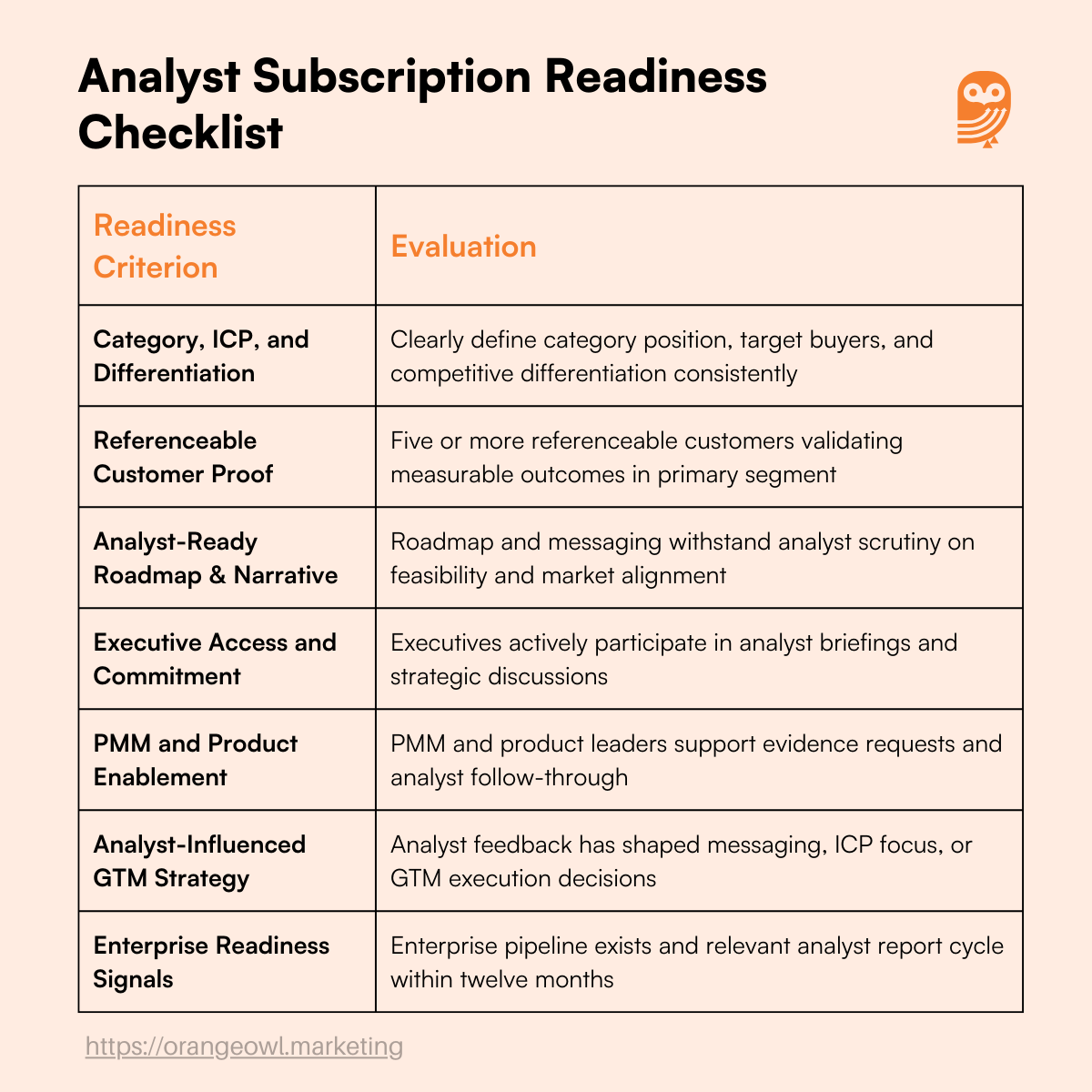
AR Subscription Readiness Checklist
Evaluate Internal Maturity Before Spending
Analyst subscriptions are a force multiplier — but only when foundational GTM elements are already in place. Before committing budget, SaaS leaders should assess whether the organization is truly prepared to convert analyst access into market credibility, report inclusion, and enterprise influence.
You are ready to invest in analyst subscriptions when most of the following conditions are true:
1. Clear Category, ICP, and Differentiation
You can articulate exactly where you sit in the market, who buys you, and why you win. Analysts penalize ambiguity more than immaturity. If your category placement or ICP shifts every quarter, subscriptions will amplify confusion rather than clarity.
2. Referenceable Customer Proof
You have at least five referenceable customers in your primary segment who validate outcomes, not just usage. Analysts rely heavily on customer evidence to assess credibility, maturity, and category fit.
3. Analyst-Ready Product Roadmap
Your roadmap can withstand external scrutiny. Analysts will challenge feasibility, differentiation, and alignment to market evolution. If roadmap conversations feel defensive internally, they will not land well externally.
4. Executive Access and Commitment
Founders or senior executives can attend key briefings. Analyst influence increases materially when leadership is present to discuss strategy, vision, and long-term bets — not just product features.
5. PMM and Product Enablement
Product marketing and product leadership can support evidence requests, competitive context, and follow-up materials. Analyst engagement fails when insights cannot be operationalized across teams.
6. Analyst Feedback Has Shaped GTM Decisions
You have already acted on analyst input at least once — whether adjusting messaging, refining ICP focus, or repositioning the category narrative. This signals readiness for a two-way advisory relationship, not one-way promotion.
7. Near-Term Report Eligibility
There is a relevant Market Guide, Wave, MQ, Radar, or MarketScape cycle within the next 12 months. Without a clear report horizon, subscription ROI is delayed and harder to justify.
8. Enterprise Pipeline Momentum
An enterprise pipeline exists or is beginning to scale. Analyst influence is strongest in deals involving procurement, risk committees, and executive buyers — not early SMB motions.
Decision Rule
If fewer than four of the above criteria are true, delay subscription purchase.
Instead:
Engage analysts through introductory briefings
Test and refine category positioning
Pressure-test narrative clarity
Build customer evidence
Subscriptions should accelerate momentum you already have — not compensate for foundations still under construction.
Conclusion: Paid AR Subscriptions Should Accelerate Growth, Not Replace Strategy
Paid analyst subscriptions are justified when they enable faster market trust and better GTM clarity, especially when:
Enterprise buyers already ask about analyst coverage
• Competitors are increasingly visible in reports
• Analysts proactively request updates
• You are entering a major evaluation cycle
• Your narrative is mature and category-aligned
Subscriptions do not create product-market fit. They amplify it.
The most successful SaaS companies view analyst subscriptions not as a demand-gen spend, but as a strategic investment in credibility, category positioning, and enterprise deal velocity — reinforcing Why Analyst Subscriptions Are a High-Stakes GTM Decision.
Buy subscriptions when they accelerate momentum you already have.
Not to manufacture momentum you are still building.