In the last few years, enterprise GTM teams have become dramatically more reliant on external validation: 30% of B2B buyers report relying on insights from industry experts, analysts, and influencers during their research phase Analysts, industry experts, and advisory firms have become the single most influential set of voices in shaping how B2B markets evaluate—and trust—technology companies. As buying cycles lengthen, as procurement teams grow more risk-averse, and as categories become increasingly crowded, Analyst Relations (AR) has shifted from a “communications function” to a foundational component of strategic go-to-market planning. This evolution highlights How Analyst Relations Influence Your GTM far earlier than most teams expect.
Yet most founders and GTM leaders still misunderstand AR’s true impact. They assume analysts only matter once you’re preparing for a Magic Quadrant cycle, or that analysts are “just another marketing channel,” or that AR exists to secure mentions in reports. In reality, AR shapes the core of your GTM: your positioning, your ICP clarity, your competitive stance, your differentiators, your pricing strategy, and even your roadmap. Analysts aren’t evaluating your GTM—they are influencing it. And the companies that understand this early end up with sharper narratives, more aligned products, and far stronger enterprise trust.
This guide breaks down exactly how How Analyst Relations Influence Your GTM and positioning, why analyst conversations often trigger major narrative shifts, and how founders can use analyst insights to refine their market strategy long before a Magic Quadrant ever enters the picture.
Why Analyst Relations Matters for GTM
When most people think of Analyst Relations, they think of reports—Magic Quadrants, Waves, Market Guides, or IDC MarketScapes. But analysts do much more than evaluate vendors. They speak to hundreds of enterprise buyers each year. They advise CIOs, CTOs, CISOs, CFOs, CMOs, and transformation leaders on which solutions are credible, which categories are evolving, and which vendors are solving problems meaningfully.
And because analysts act as trusted advisors to your buyers, they have more visibility into buyer preferences than nearly any internal team. That gives them unique insight into how GTM strategies succeed or fail long before pipeline numbers reveal it.
In B2B categories like cybersecurity, fintech, logistics tech, martech, and HRTech, Analyst Relations is now central to how companies shape their market narrative. For example:
- In cybersecurity, analysts influence shortlisting more than any single marketing channel.
- In fintech, Gartner and IDC are often mandatory checkpoints before procurement approves POCs.
- In supply chain and logistics, analyst-recommended vendors are often the only ones that make it to RFPs.
- In DevOps and cloud infrastructure, analyst perceptions dramatically affect category placement and competitive comparisons.
Analyst influence is woven directly into the enterprise buying process. When analysts misunderstand you, the market misunderstands you. When analysts clearly understand your strengths, buyers follow.
A B2B Example: DevOps Vendor Struggling With Category Fit
A mid-market DevOps platform kept losing deals despite strong product adoption in small teams. Sales insisted the positioning was correct. The website framed the solution as an “end-to-end DevOps automation platform.” The founders believed they were competing with the big three cloud DevOps suites.
But during their first analyst briefing, Gartner and Forrester analysts pushed back immediately. They noted that:
- The product lacked several components expected of full DevOps platforms
- Buyers described it more as a developer experience tool
- The ICP wasn’t enterprise DevOps leaders—it was engineering managers
This early feedback forced the company to reposition from “DevOps platform” to “developer workflow acceleration.” Within two quarters, sales cycles shortened, competitive losses decreased, and analysts finally understood the product’s true strengths.
Actionable Insight
If analysts question your category placement, listen carefully. Category misalignment is the root cause of most GTM friction.
What AR Actually Does Inside Your GTM Strategy
Unlike PR—which shapes public awareness—or PMM—which crafts internal narrative clarity—AR sits at the intersection of market reality and company storytelling. Analysts stress-test your narrative against:
- Buyer expectations
- Category definitions
- Competitive differentiation
- Pricing benchmarks
- Market readiness
- Product maturity
- ICP patterns
And because analysts talk to both buyers and vendors, their perspective is grounded in what the market actually cares about—rather than what founders wish it cared about.
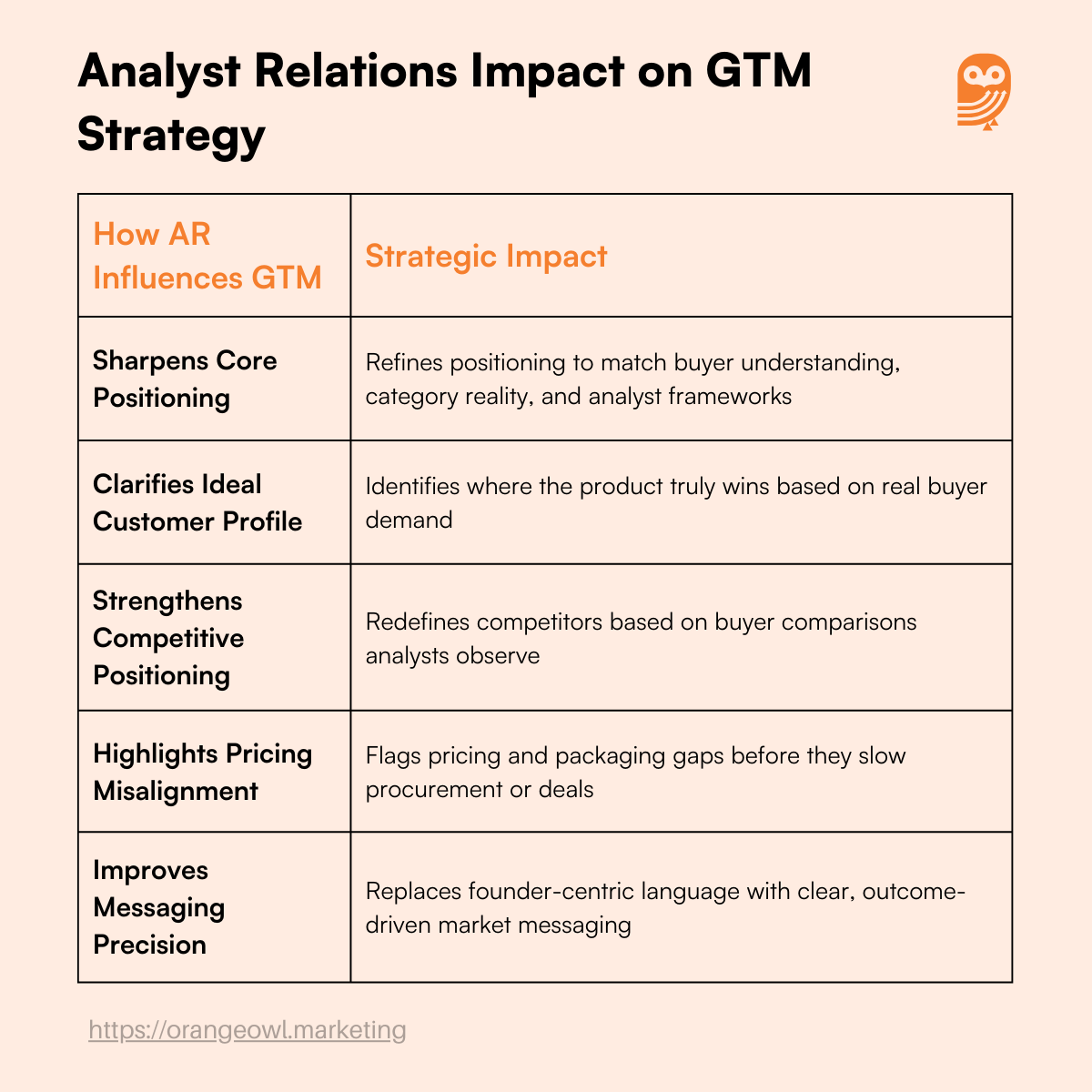
Below are five ways AR reshapes GTM strategy.
1. AR Sharpens Your Core Positioning
Positioning is the single biggest GTM driver for enterprise companies. Strong positioning creates market clarity; weak positioning creates confusion, longer sales cycles, and lost deals.
Analysts are uniquely qualified to pressure-test positioning because they:
- See how buyers perceive your category
- Understand what differentiators actually matter
- Know which narratives resonate and which fall flat
- Observe how the category is evolving in real time
During analyst inquiries and briefings, founders often discover that their positioning is too narrow, too broad, or too disconnected from buyer pain.
B2B Example: AI Security Vendor Adjusting Narrative After Analyst Feedback
A fast-growing AI security startup positioned itself as “the next-generation security platform for AI workloads.” The messaging was visionary—but vague.
Analysts responded with simple but critical questions:
- “Which segment of AI workloads are you protecting?”
- “What specific threats are you solving?”
- “What does your product replace?”
- “Who is your best-fit buyer today?”
This feedback revealed a major issue: the company’s narrative was aspirational but lacked clarity. Buyers didn’t understand what problem it solved. After refining the positioning based on analyst guidance—moving toward “runtime threat detection for LLM-powered applications”—the company gained much stronger traction in analyst conversations and enterprise POCs.
Actionable Insight
Analysts help you position your product the way buyers naturally understand it—not the way founders describe it internally.
2. AR Clarifies Your ICP (Ideal Customer Profile)
Most early-stage companies overestimate their ICP. They believe their product works for:
- SMBs
- Mid-market
- Enterprises
- Multiple industries
- Multiple verticals
Analysts cut through this immediately.
Because analysts routinely hear from buyers across industries, they know where your product can genuinely win—and where it cannot.
Industry Example: HRTech Startup Narrowing Its ICP
A HRTech vendor assumed they were ideal for mid-market and enterprise HR teams.
But analysts noticed:
- Mid-market adoption was stronger
- Enterprise requirements (global payroll, compliance, deep integrations) were not mature
- Competitors in enterprise HRTech were far ahead
After focusing their ICP on 500–2,000-employee organizations, the company saw:
- Higher win rates
- Shorter cycles
- Better analyst alignment
- Clearer narrative consistency
Actionable Insight
Your ICP isn’t who you want to sell to—it’s who analysts believe will actually buy.
3. AR Strengthens Competitive Positioning
One of the biggest mistakes B2B companies make is self-defining their competitive set.
Analysts often disagree.
Analysts see:
- Which vendors buyers compare you with
- Who you lose to
- Who you displace
- Who is emerging
- Who is fading
- Which features matter in competitive cycles
This perspective changes how companies pitch, message, and develop their product.
B2B Example: A Supply Chain Visibility Vendor Reframing Competition
A supply chain SaaS believed they competed with two traditional incumbents. Analysts pointed out that customers actually compared them with:
- A category-adjacent TMS vendor
- A rising AI-powered logistics startup
- A visibility tool with stronger tracking features
This competitive correction forced the company to redefine its differentiation narrative. Instead of “faster deployment,” analysts encouraged them to highlight:
- predictive ETA accuracy
- integration speed
- AI-driven anomaly detection
Once updated, this positioning resonated with buyers immediately.
Actionable Insight
Competitors are not who you think they are; they are who analysts hear buyers mention.
4. AR Highlights Pricing and Packaging Misalignment
Pricing is one of the most misunderstood aspects of GTM strategy.
Analysts have unparalleled visibility into pricing models across the market. They know:
- Typical pricing structures
- Where enterprises push back
- What buyers perceive as premium-vs-commodity
- Where market expectations are shifting
- Which early-stage vendors underprice or overprice themselves
Fintech Example: Usage-Based Pricing Before the Market Was Ready
A fintech API provider priced purely on consumption. Analysts quickly flagged that most banking clients preferred tiered models with predictable costs. After adjusting their pricing strategy, the company saw faster procurement approvals and fewer legal blockers.
Actionable Insight
If analysts consistently question your pricing, assume buyers will too.
5. AR Improves Messaging Precision and Narrative Clarity
Analyst feedback often leads to major revisions in messaging—even for mature companies.
Why?
Because analysts demand clarity. They cut through jargon. They focus on outcomes, not features. They understand buyer language better than almost anyone.
A strong AR program often leads to:
- clearer homepages
- sharper value propositions
- stronger differentiation language
- better problem statements
- improved sales decks
- more grounded narratives
Analysts help remove “founder speak” and replace it with “market speak.”
What Analysts Actually Ask in GTM-Focused Conversations
Companies are often surprised by how direct—and strategic—analyst questions can be.
These questions are designed to evaluate GTM readiness, not just product capability.
Analysts typically ask:
- “What customer segments are adopting your product most aggressively?”
- “What problems do they believe you solve?”
- “Which vendors do you lose to most frequently?”
- “What differentiator do your customers mention most often?”
- “How do you quantify the business impact of your solution?”
- “What is your short-term vs long-term roadmap alignment with category trends?”
- “Which features are you prioritizing and why?”
- “What objections come up most during sales?”
Founders often realize they don’t have crisp answers to many of these questions.
That’s exactly why AR is so powerful.
B2B Example: How a Cloud Observability Startup Repositioned to Win
A cloud performance startup entered the market firmly convinced they were an observability vendor. Their GTM strategy, messaging, and competitive positioning were built to compete directly with platforms like Datadog, New Relic, and Dynatrace. Sales decks emphasized “full-stack observability,” and analyst briefings framed the product as an alternative to established enterprise suites.
However, during a Gartner inquiry, analysts surfaced a different reality.
They highlighted several gaps:
Lack of full metrics, logs, and traces parity compared to leading observability platforms
Stronger performance in specific, niche workloads rather than broad enterprise coverage
Misalignment with enterprise observability requirements, particularly around scale, governance, and ecosystem breadth
Rather than dismissing the product, analysts reframed it.
They suggested positioning the company as a cost-efficient telemetry pipeline—a solution optimized for ingesting, processing, and routing telemetry data efficiently—rather than marketing it as a full observability suite.
This single reframing unlocked multiple GTM benefits:
A new ICP focused on engineering teams overwhelmed by observability data costs
Clearer messaging that aligned with actual buyer pain points
Stronger differentiation in a saturated observability category
Less direct competition with entrenched enterprise platforms
Within months, the company saw:
Improved analyst clarity and recall
More productive sales conversations
Increased interest from cost-sensitive mid-market and enterprise teams
Actionable Insight
Analysts aren’t trying to box you into a category—they’re trying to place you where you can win. When you listen to analyst feedback and adjust positioning accordingly, you reduce friction, sharpen differentiation, and often discover a more scalable GTM path than the one you originally planned.
Why Analyst Feedback Often Feels Uncomfortable (And Why That’s a Good Thing)
Analysts don’t evaluate your startup based on potential—they evaluate based on market readiness.
This causes many early-stage founders to feel:
- challenged
- misunderstood
- defensive
But analyst pushback is a gift.
It prevents companies from scaling a broken narrative.
Analysts offer a perspective founders rarely have access to: the buyer’s perspective at scale.
Their feedback forces alignment between what you think you are and what the market will actually accept.
How to Integrate Analyst Insights Into Your GTM Strategy
The companies that benefit the most from AR follow a consistent pattern:
1. They brief analysts early—not just during MQ/Wave cycles
Waiting until the last minute leads to poor evaluations and missed insights.
2. They treat analyst feedback as strategic input—not criticism
Buyers don’t sugarcoat. Analysts shouldn’t either.
3. They integrate analyst insights into Product Marketing
PMM becomes the bridge between analyst feedback and GTM execution.
4. They adjust ICP, messaging, and product roadmap accordingly
AR → PMM → GTM → Product—this is the real cycle.
5. They follow up regularly
Analysts remember vendors who take feedback seriously.
A B2B Example: FinOps SaaS Using AR to Fix Its ICP and Pricing
A FinOps cost analytics startup noticed that:
- enterprise deals stalled
- mid-market traction was stronger
- analysts questioned pricing complexity
After a few analyst inquiries, they discovered that:
- enterprises expected deeper automation
- mid-market teams valued simplicity
- pricing needed to shift to hybrid model
This led to:
- a mid-market focused ICP
- simplified pricing tiers
- clear messaging around ROI
- improved analyst perception
Actionable Insight
Analysts don’t change your product—they clarify what the market really wants from it.
Common Mistakes Companies Make With AR (And How to Avoid Them)
Mistake 1: Treating AR as PR
PR builds brand awareness.
AR builds enterprise trust.
They are not substitutes.
Mistake 2: Approaching analysts only during report cycles
Analysts dislike “drive-by briefings.”
Relationship-building matters.
Mistake 3: Not preparing a coherent narrative
Analysts expect clarity across product, market, ICP, and roadmap.
Mistake 4: Overloading analysts with features
Analysts care about impact, not feature lists.
Mistake 5: Avoiding difficult questions
Analysts remember evasive vendors—and not in a good way.
Mistake 6: Expecting analysts to “get it” from your website
They won’t.
You need a structured analyst deck.
Mistake 7: Ignoring analyst feedback
This is the fastest way to stall category momentum.
How AR, PMM, and GTM Work Together
The best-performing B2B companies follow the same sequencing:
PMM creates the narrative → AR validates the narrative → GTM amplifies the narrative.
Let’s break it down:
PMM defines the story:
- category
- ICP
- problem-solution fit
- differentiation
- value proposition
AR tests and strengthens the story:
- market fit
- buyer expectations
- competitive clarity
- pricing
- roadmap alignment
GTM executes the story:
- sales
- demand gen
- ABM
- product-led growth initiatives
- partner channels
This cyclical alignment is what creates category leaders.
A B2B Example: AI Ops Vendor Using the PMM → AR → GTM Flywheel
A fast-growing AIOps company adopted a systematic process:
- PMM defined narrative → “autonomous incident remediation for cloud-native teams”
- AR challenged scope → encouraged more realistic claims
- PMM refined messaging → aligned with analyst language
- GTM updated pitch decks, outbound scripts, and website
Result:
- stronger analyst advocacy
- better buyer clarity
- improved competitive positioning
- higher win rates
Actionable Insight
PMM is the storyteller. AR is the truth-teller. GTM is the amplifier.
What Startups Should Do First
Here’s a practical roadmap depending on stage:
If you’re Seed → Fix Positioning First
Analysts can’t help if your basics are unclear.
If you’re Series A–B → Start AR Immediately
This is when enterprise buyers enter your pipeline.
If you’re Series B–C → Use AR to Strengthen Category Leadership
You’re ready to scale analyst relationships.
If you’re scaling globally → Use AR to solidify competitive differentiation
Analysts help prevent positioning “drift” across regions.
Conclusion
Analyst Relations is not about reports—it’s about reshaping your GTM clarity. Analysts give founders something internal data rarely reveals: a window into how the market actually thinks, buys, compares, evaluates, and prioritizes solutions. They force clarity where narratives are fuzzy. They reveal competitive realities founders don’t want to face. They show where ICP boundaries are too broad. They highlight pricing gaps before procurement teams do. They help anchor messaging in real buyer outcomes—not internal assumptions.
Product Marketing defines who you are.
Analyst Relations helps the market believe it.
GTM amplifies it.
Companies that integrate AR deeply into their GTM strategy gain strategic advantages that compound over time: clearer positioning, stronger analyst reputation, faster buyer trust, better competitive differentiation, and a narrative that resonates both inside the company and across the enterprise market.
In the next decade, as categories grow more crowded and as buyers rely more on trusted advisors, the companies that win will be those who use AR not as a reporting function—but as a strategic lighthouse guiding their entire go-to-market engine.