Nearly 72% of B2B buying committees now rely on analysts or external consultants when making purchasing decisions, according to recent enterprise buying research from Corporate Visions. As analyst firms such as Gartner, Forrester, IDC, and Everest Group play an increasingly influential role in shaping market perceptions, vendor shortlists, and technology evaluations, an analyst briefing has become one of the most strategic conversations a B2B company can participate in.
For companies operating in SaaS, cybersecurity, fintech, logistics tech, or cloud infrastructure, analyst briefings often shape how the market understands their product, how buyers evaluate them against competitors, and whether they are seen as category leaders or emerging players. Yet many startups approach analyst briefings with the wrong mindset—treating them like sales demos, PR interviews, or marketing pitches.
In reality, analyst briefings are strategic dialogues that help analysts understand your vision, product maturity, differentiation, and impact in the market. A strong briefing can reshape how analysts talk about you in research reports, advisory calls, and industry conversations. A weak or unclear briefing can set your positioning back for months, or even an entire report cycle.
This guide breaks down exactly how to prepare for a high-impact analyst briefing, complete with real B2B examples, practical insights, and a step-by-step approach you can implement immediately to strengthen your analyst visibility and credibility.
What Is an Analyst Briefing? (And Why It Matters)
An analyst briefing is a structured meeting (usually 30–60 minutes) where you update analysts on your product, vision, roadmap, differentiation, customer success, and market traction. Analysts use this information to:
- Update research notes
- Shape category definitions
- Advise enterprise clients
- Decide which vendors to include in Market Guides, Waves, or Magic Quadrants
- Evaluate competitive landscapes
Unlike sales demos, analyst briefings are strategic dialogues, not pitches. Analysts want to understand your product objectively so they can represent you accurately in their research and client advisory calls. This is why the preparation is different from preparing for a sales conversation or a PR interview.
A strong briefing builds trust, clarity, and credibility. A weak briefing creates confusion that can persist for months or even a full report cycle.
Why Analyst Briefings Are Critical for B2B Companies
Enterprise buyers trust analyst opinions more than vendor marketing
When a CIO or Head of Procurement is evaluating vendors, analyst reports often act as the starting point. Whether you’re included or excluded can determine if you even make it onto the shortlist. A single strong analyst endorsement can outweigh months of sales outreach.
B2B Example (Cybersecurity — Threat Detection)
A mid-sized cybersecurity vendor was consistently losing RFPs because prospects asked, “Why aren’t you in Gartner’s Market Guide?” After delivering a well-prepared briefing with evidence of real innovation, Gartner added them as a Notable Vendor. This alone changed their credibility in the eyes of buyers.
Analysts shape categories—and your position within them
If your product narrative does not match how analysts define your category, you appear misaligned. Misalignment leads to misunderstandings, and misunderstandings lead to exclusion from reports.
B2B Example (Fintech — Reconciliation Automation)
A fintech startup originally positioned itself as a “smart reconciliation engine.” Analysts challenged the definition and suggested framing it as “Financial Close Automation,” which aligned better with enterprise buying trends. That single positioning shift improved relevancy in RFPs.
Analyst briefings influence report mentions for months to come
Reports such as Gartner’s Market Guide or Forrester Wave are not decided in a single call. Analysts continuously update notes based on every interaction. A strong briefing increases your odds of being considered during evaluation cycles.
B2B Example (Logistics Tech — Visibility Platforms)
A supply-chain visibility platform held quarterly analyst briefings, providing updated case studies and metrics. Consistent communication eventually led to inclusion in Everest Group’s PEAK Matrix—boosting credibility with global logistics enterprises.
What Analysts Look for in a First Briefing
Across thousands of vendor briefings, analysts consistently evaluate five areas — often within the first 10 minutes.
1. Category Carity
Analysts want a crisp, specific category definition. “We’re a platform for everyone” is a red flag.
B2B Example:
A workflow automation startup labeled itself as “workflow + integration + AI + orchestration.”
The analyst responded: “Which category do you actually want to win?” That question reshaped their next two quarters of positioning work.
2. Problem Definition & Market Relevance
Analysts want to understand the real buyer pain you solve — not just technically, but strategically.
B2B Example:
A fintech startup said they “optimize financial operations.”
The analyst asked: “Which part? Cash? Admin risk? Reconciliation?”
They realized they were telling a generic story with no depth.
3. Differentiation
Analysts compare dozens of vendors every week. They spot:
- Recycled claims
- Category buzzwords
- “Me too” feature sets
- Empty differentiation
B2B Example:
A cybersecurity vendor said, “We offer complete threat visibility.”
The analyst replied: “Everyone claims that. What’s uniquely effective about yours?”
The company had no clear response — and lost analyst confidence.
4. Roadmap Realism
Analysts want believable milestones — not AI wishlists or decade-long visions.
B2B Example:
A supply-chain startup showed a massive roadmap for a small engineering team.
Analyst’s internal note: “Ambitious but unrealistic.”
They were dropped from a Market Guide shortlisting.
5. Customer Proof & Adoption Signals
Nothing influences analysts more than real buyer evidence.
Analysts look for:
- Deployment depth
- Usage patterns
- Referenceable customers
- Measurable ROI
- Time-to-value
- Integration maturity
B2B Example
A DevOps vendor couldn’t answer, “How many active pipelines run daily?”
The analyst flagged them as “unclear adoption,” weakening future coverage eligibility.
Actionable Insight
Analysts rely on numbers, not adjectives. “Strong growth” means nothing. “18% MoM active usage growth” is everything.
How to Prepare for a High-Impact Analyst Briefing: The Complete Step-by-Step Approach
Preparing for an analyst briefing is both art and science. Analysts expect clarity, data, honesty, and strategic thinking. If you prepare well, briefings become powerful growth accelerators. If you don’t, they can set you back a full year.
Let’s go deep into how to prepare effectively.
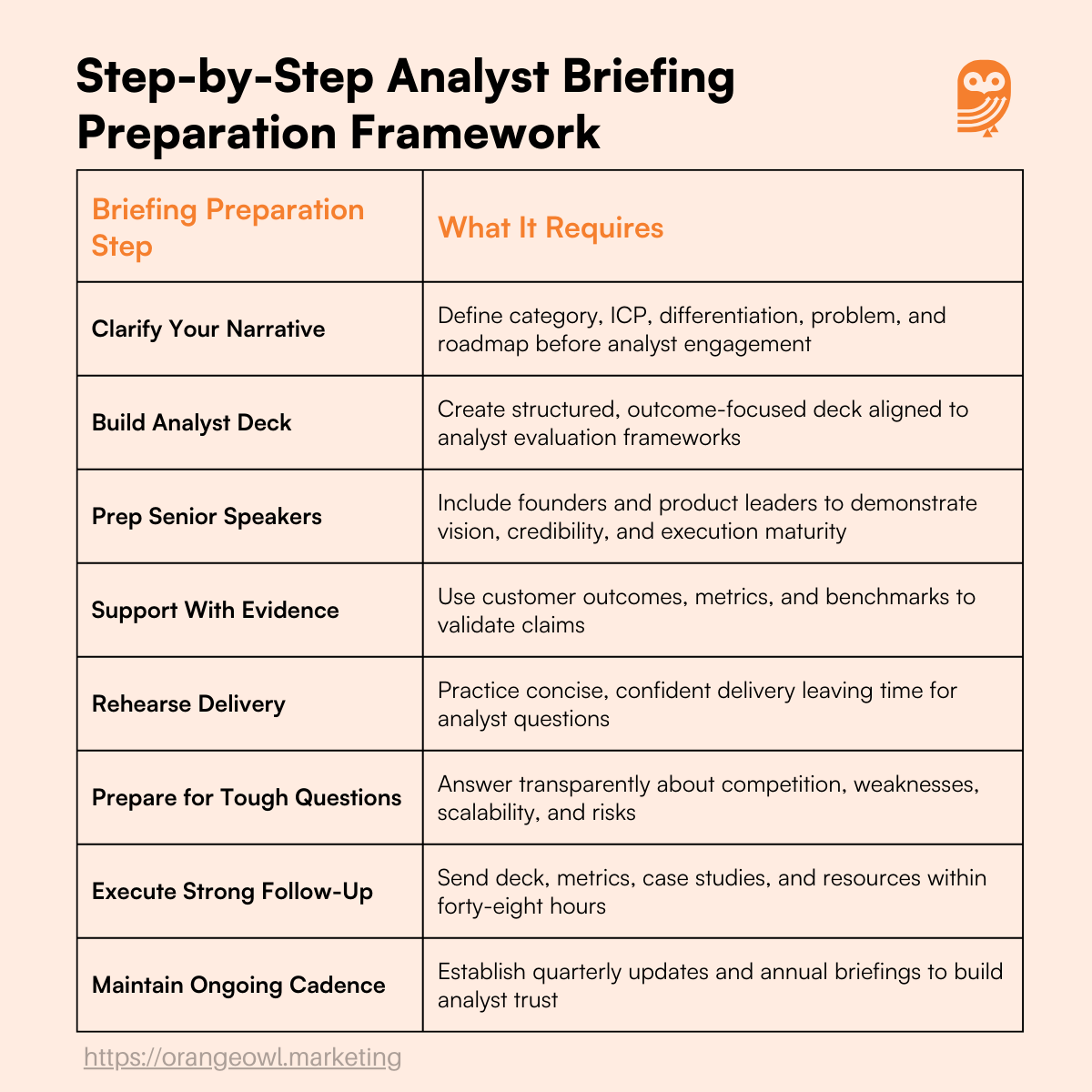
Step 1: Clarify Your Narrative Before the Briefing
Analysts see through vague marketing language instantly. If your product positioning isn’t well-defined, they will challenge it—and rightly so.
Before building your deck, ensure you have clarity on:
- Your category
- Your ICP
- The core problem you solve
- Your value prop
- Your differentiation
- Your competitive landscape
- Your roadmap
- Your traction metrics
B2B Example (MarTech — CDP Solutions)
A CDP vendor struggled with analyst confusion because their narrative mixed CDP, CRM, and personalization. After refining messaging with PMM, analysts finally understood their core value. Briefings became smoother, and analyst reports began describing them more accurately.
Actionable Insight
Your PMM team must finalize your messaging before analyst engagement, not after.
Step 2: Build a High-Impact Analyst Briefing Deck
Analysts expect a structured, logical briefing—not a sales deck.
A strong analyst deck usually contains:
Category context & problem statement
Show that you understand the market and the forces shaping it. Analysts want to know:
“Why does this product need to exist now?”
Your ICP & use cases
Analysts need clarity — who buys your product and how they use it?
Product overview
Explain what the product does, not through jargon, but through outcomes.
Key differentiators
Be objective and precise. Don’t say “best.” Say:
“We do X in a way no competitor does, because of Y.”
Competitive landscape
Analysts want your view of the ecosystem. If you skip this, they assume you’re hiding something.
Proof points (metrics + case studies)
This is where credibility is built:
- Adoption rates
- Retention
- Impact metrics
- Time to value
- ROI
Vision & roadmap
Analysts care more about your forward-looking strategy than slick UI screenshots.
Step 3: Prep Your Speakers (Founders + PMM + Product)
A great analyst briefing usually includes:
- Founder / CEO (vision)
- Product leader (roadmap)
- PMM or AR lead (positioning clarity)
B2B Example (Cloud Infrastructure — Monitoring Tools)
A monitoring platform repeatedly failed analyst briefings because only junior PMs attended. When the founder and head of product joined, analysts finally understood the roadmap seriousness and technical depth.
Actionable Insight
Analysts judge leadership maturity. Always bring senior voices to key briefings.
Step 4: Back Your Story With Data and Customer Evidence
Analysts value evidence over adjectives. Prepare:
- Revenue milestones
- Growth rates
- Retention numbers
- Performance benchmarks
- Usage data
- Before/after customer ROI
- Named customer references (if allowed)
B2B Example (HRTech — Workforce Management)
A workforce management vendor improved analyst perception significantly after adding quantified outcomes like:
“Reduced overtime cost by 23% for a 12k-employee client.”
Step 5: Rehearse the Delivery
Analyst briefings are time-bound. You must make every minute count.
A great briefing feels like:
- Clear
- Structured
- Insightful
- Confident
- Conversational
Not rushed, not overly detailed, not salesy.
Actionable Insight
Aim to complete your core narrative in 25 minutes so you leave space for Q&A.
Step 6: Prepare for Tough Questions
Analysts ask hard questions.
Examples:
- “Why are you different from X competitor?”
- “What’s your churn?”
- “Why are customers choosing you?”
- “What’s your biggest weakness?”
- “How scalable is your architecture?”
Don’t panic. Analysts aren’t trying to trap you—they’re trying to understand you.
B2B Example (API Governance Platform)
A startup once tried to avoid discussing outages. Analysts flagged them as “immature.” In the next briefing, they openly shared lessons learned, architectural fixes, and new SLAs. That transparency rebuilt credibility.
Actionable Insight
Be honest. Analysts trust transparency far more than perfection.
Step 7: Follow Up Within 48 Hours
Always send:
- Your deck
- Relevant case studies
- Metrics
- Product videos
- Access to sandboxes (optional)
- Press releases
- Updated roadmap notes (if discussed)
This keeps your narrative fresh in the analyst’s mind.
Step 8: Maintain a Quarterly Cadence
Analyst relationships mature over time. One-off briefings won’t create lasting impact. Build a rhythm:
- Quarterly updates
- Annual roadmap briefings
- Participation in surveys
- Sharing customer success stories
- Alerting analysts to key releases
Actionable Insight
Consistency = credibility. Analysts promote vendors they understand deeply.
Common Mistakes Companies Make in Their First Analyst Briefing
Here are the deeply expanded, B2B-rich mistakes that consistently derail vendor briefings — along with examples from SaaS, cybersecurity, fintech, logistics, DevOps, and HRTech.
1. Treating it like a sales pitch
Why this hurts: Analysts aren’t prospects. Overselling kills trust.
B2B Example:
A DevOps startup spent 25 minutes in demo mode. Analysts left confused about strategy → excluded from a landscape report.
2. Overloading slides with features
Why this hurts: Analysts care about value, not feature catalogs.
B2B Example:
A MarTech vendor showed 42 product features. Analyst response: “Everyone has this — what’s different?”
3. Overclaiming without evidence
Why this hurts: Analysts validate everything externally.
B2B Example:
A cybersecurity vendor claimed “90% fewer breaches” with no proof → credibility dropped instantly.
4. Hiding weaknesses or gaps
Why this hurts: Analysts prefer honesty over hype.
B2B Example:
A fintech startup hid missing compliance features. Analysts later heard this from banks — trust broken.
5. Being vague about ICP
Why this hurts: Analysts can’t position you without specificity.
B2B Example:
A logistics SaaS said “mid-market companies.” Analyst: “Which vertical? Which freight complexity?”
6. An unclear narrative flow
Why this hurts: Disorganized stories signal product immaturity.
B2B Example:
A cybersecurity vendor jumped across topics. Analyst note: “Confusing — unclear market focus.”
7. No founder or executive in the meeting
Why this hurts: Analysts evaluate leadership quality as a proxy for success.
B2B Example:
An HRTech briefing included only marketing. Analyst felt no strategic depth → follow-up declined.
8. Not bringing customer evidence
Why this hurts: Analysts rely on customer outcomes to validate claims.
B2B Example:
A SaaS vendor had 50 customers but showed no ROI data. Analysts flagged weak proof of impact.
9. Leaving little/no time for Q&A
Why this hurts: Analysts use questions to clarify your positioning.
B2B Example:
A 30-minute briefing with no Q&A left analysts unconvinced.
10. Not preparing for hard questions
Why this hurts: Analysts intentionally test your depth.
B2B Example:
A cloud infra startup couldn’t answer: “Why do customers churn?”
Analyst flagged low maturity.
Pull Quote
“Analysts don’t punish imperfection. They punish incoherence.”
Best Practices for a High-Impact Analyst Briefing
This section gives founders and PMM leaders the specific, repeatable behaviors that consistently lead to strong analyst reactions.
1. Anchor the narrative in the buyer’s problem
Start with the pain → then solution → then ROI.
2. Use a lean, crisp 10-slide deck
Clarity beats complexity every time.
3. Present as a trio: Founder + PMM + Product
Analysts read this as alignment and seriousness.
4. Lead with proof, not aspirations
Usage metrics > adjectives like “fast-growing.”
5. Be radically transparent about your roadmap
Honesty is a trust accelerator.
6. Rehearse the story, not the deck
Analysts evaluate clarity, not theatrics.
7. Use analyst category language
Match your narrative to existing analyst frameworks.
8. Leave 8–10 minutes of Q&A
This is where relationships begin.
9. Document analyst reactions
Their questions often reveal category expectations.
10. Send a sharp follow-up summary
Analysts appreciate clarity and continuity.
How to Structure a 30-Minute Analyst Deck (Slide-by-Slide)
This is the 10-slide structure analysts prefer:
Slide 1 — Your Company Narrative
Your mission and why this market matters now.
Slide 2 — Category & Problem
Define your market and the buyer pain.
Slide 3 — ICP
Be precise: segment, vertical, geography, user role.
Slide 4 — Product Overview
What it does and why it matters.
Slide 5 — Differentiation
What makes you meaningfully unique.
Slide 6 — Architecture Overview
High-level, not engineering deep dives.
Slide 7 — 12–18 Month Roadmap
Believable milestones.
Slide 8 — Competitive Landscape
Where you fit among trusted vendors.
Slide 9 — Customer Evidence
Logos, ROI, usage patterns.
Slide 10 — Vision
Your thesis on the future.
The 3T Analyst Storyframe
Truth → Who you are
Traction → What proof you have
Trajectory → Where you’re going
What Data Analysts Expect — But Most Companies Don’t Bring
Analysts expect clear, measurable, defensible data, such as:
- Adoption metrics
- Retention patterns
- Deployment depth
- ROI outcomes
- Revenue segmentation
- Integration ecosystem
- Implementation timelines
- User behavior insights
B2B Examples
Cybersecurity:
A vendor claiming “fewer breaches” failed to show mean time to detect (MTTD) improvements. Analysts ignored the claim.
Fintech:
A compliance tool showing “audit error reduction” gained analyst interest because it tied directly to regulatory mandates.
DevOps:
A platform showing “active pipelines per customer” saw analysts reference them in inquiries.
The Complete Pre-, During-, and Post-Briefing Checklist
1–2 Weeks Before the Briefing
- Define goal
- Choose right analyst
- Build 10-slide deck
- Prepare customer evidence
- Rehearse narrative
- Anticipate tough questions
- Send deck 48 hours early (Forrester requirement)
Day Of
- Set agenda
- Introduce speakers
- Tell a clear story
- Track analyst reactions
- Leave time for Q&A
- Log insights
Post-Briefing
- Thank-you note
- Share follow-up data
- Clarification memo
- Update PMM + sales
- Plan next briefing
Common Analyst Questions You Must Prepare For
- Who is your ICP precisely?
- What problem do you solve?
- What proof do you have the problem is real?
- How do customers use your product daily?
- What differentiates you from top competitors?
- What’s your adoption rate?
- What’s your 18-month roadmap?
- Why did you choose your pricing model?
- What integrations do you support?
- What ROI metrics do you track?
- Where do you face friction?
- Why now?
Actionable Takeaways
- Clarity > complexity
- Anchor everything in buyer problems
- Use the 10-slide structure
- Lead with proof
- Be transparent about gaps
- Prepare for tough questions
- Rehearse narrative
- Build relationship continuity
Conclusion
A Gartner or Forrester briefing is not about dazzling analysts — it’s about giving them clarity, confidence, and context. When done well, a single briefing can shift how analysts perceive your differentiation, influence enterprise buyer decisions, and increase your visibility in key research reports. This is exactly why understanding how to prepare for a high-impact analyst briefing matters.
The companies that consistently win analyst trust aren’t the ones with the flashiest products. They’re the ones who show strategic clarity, transparency, strong execution, and a deep understanding of their market. If you approach analyst briefings with preparation, honesty, and a clear narrative, you can shape not just your category positioning—but your entire growth trajectory.