
According to Gartner, 76% of B2B buyers consult analyst reports before making a purchasing decision. This means analysts hold enormous power in shaping vendor shortlists, influencing technology roadmaps, and accelerating enterprise buying decisions. But here’s the reality: most early-stage startups assume Analyst Relations (AR) is something only “big companies” can afford. They imagine expensive subscriptions, long contracts, and enterprise-grade fees that are way beyond a startup’s reach. This belief is exactly why understanding How Startups Can Start Analyst Relations matters early.
But that assumption is outdated.
Today, you don’t need a massive budget—or any paid subscription at all—to begin building meaningful analyst relationships. In fact, some of the most successful early-stage B2B companies built analyst visibility long before they had the money to spend on full AR programs. What they did have was clarity, consistency, and a thoughtful approach to engaging analysts early. That approach defines How Startups Can Start Analyst Relations without overspending.
This guide explains how startups can start Analyst Relations without spending heavily, what free or low-cost tactics actually work, how to approach analysts as a young company, and how to build trust with them slowly and strategically.
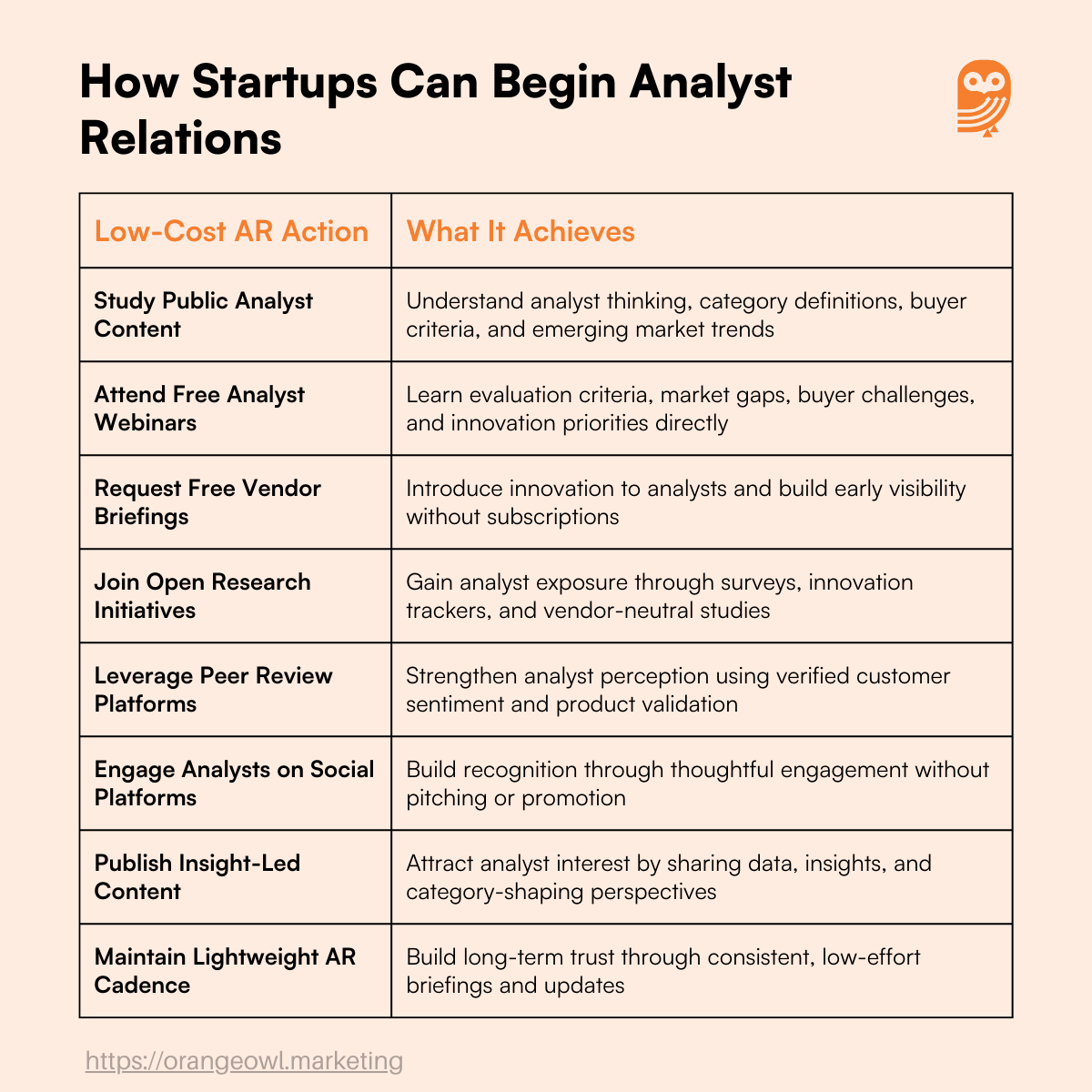
How Startups Can Begin Analyst Relations (For Free or Very Low Cost)
Let’s break down what early-stage teams can do immediately—without subscriptions, retainers, or large teams.
1. Start With Public Analyst Content (Free, Insightful, and Underused)
Every analyst firm publishes a massive amount of free content:
- Blogs
- Podcast interviews
- Webinars
- Public research notes
- Predictions reports
- LinkedIn posts
- Event keynotes
- Market commentary
- Category definitions
Most startups ignore this treasure trove.
Studying public content helps you understand:
- how analysts think
- how they define your category
- what trends they’re tracking
- what gaps they believe exist
- what criteria matter for buyers
B2B Example (MarTech — Email Automation)
A founder of an email automation SaaS studied Forrester’s free “Marketing Automation Predictions” and realized analysts were shifting terminology from “email automation” to “customer engagement orchestration.” They updated their messaging accordingly—and immediately improved resonance with buyers and analysts.
Best Practice
Create a shared internal “Analyst Insights doc” where your team summarizes trends and category definitions from public analyst sources.
Key Takeaway
To speak the analyst’s language, you must first listen to what they’re already saying.
2.Participate in Free Analyst Webinars and Open Sessions
Analyst firms frequently conduct open, no-cost sessions:
- Market forecasts
- Category deep dives
- “Ask the Analyst” events
- Vendor-neutral landscape reviews
- Technology disruption sessions
These events often reveal exactly:
- how analysts evaluate vendors
- what they see as market gaps
- what capabilities matter in your category
- what challenges customers report
- what innovation areas analysts are watching
B2B Example (Fintech — Compliance Automation)
A compliance automation startup joined a free Gartner webinar about “Future of Compliance Tech.” The analyst described “real-time regulatory intelligence” as an emerging category. The startup reoriented their narrative around this theme—and analysts later validated its fit during discussions.
Best Practice
Assign one team member (typically PMM) to attend analyst webinars monthly and brief the leadership team.
Key Takeaway
Free analyst webinars are like sitting in on buyer strategy sessions—use them.
3.Request Free Vendor Briefings (Yes, Analysts Do Accept Them)
Contrary to popular belief, analyst briefings:
- do not always require a subscription
- are often available to early-stage vendors
- can be requested via simple forms or emails
Gartner, Forrester, IDC, ISG, and Everest Group often take briefings if:
- you operate in an emerging category
- you represent meaningful innovation
- you add new perspective to the market
- your product aligns with a research initiative
B2B Example (Logistics Tech — Visibility Platforms)
A small visibility startup requested a 30-minute Gartner briefing. The analyst accepted because the company was solving a new type of multimodal visibility challenge. This initial call led to future mentions in a Market Guide.
Best Practice
Use a simple outreach message:
“Hi <Analyst Name>, we’ve built something relevant to your <category> research. We’d love a 25-minute briefing to share market insights and what we’re observing.”
Key Takeaway
Analysts want to hear from innovative vendors—not just large ones.
4.Contribute to Open & Vendor-Neutral Research Projects
Many analyst firms run:
- open surveys
- vendor-neutral landscape assessments
- voluntary questionnaires
- innovation trackers
These often cost nothing to participate in—and they put your name directly into analysts’ workflows.
B2B Example (SaaS — Customer Experience Platforms)
A CX startup filled out Everest Group’s open “CX Tech Innovation Index.” Their submission—free—resulted in a mention in a downloadable insights report. That one mention became a talking point in sales calls.
Best Practice
Monitor firms like G2, Everest, and IDC—they regularly open free research funnels.
Key Takeaway
Visibility starts with participation. Many entry points are free.
5.Use Peer Review Platforms Strategically (G2, Capterra, TrustRadius)
Analysts increasingly reference peer review platforms for:
- customer sentiment
- product gaps
- experience quality
- customer use cases
Strong reviews on G2 or TrustRadius directly improve analyst perception.
B2B Example (HRTech — Talent Management)
A talent management startup encouraged happy customers to leave detailed reviews. G2 flagged them as a “High Performer,” and analysts later referenced that traction in discussions.
Best Practice
Quarterly review drives → 5–10 detailed customer reviews = meaningful analyst signal.
Key Takeaway
Peer reviews are a low-cost credibility engine.
6.Engage Analysts on Social Platforms (Subtle but Powerful)
Analysts are extremely active on:
- LinkedIn
- X (Twitter)
- Research blogs
You can engage without pitching:
- add thoughtful comments
- react to their insights
- share relevant articles
- ask smart questions
- amplify their research
You appear as a value-adding participant—not a vendor seeking attention.
B2B Example (Cybersecurity — DevSecOps)
A DevSecOps founder regularly commented on analyst posts about shift-left security. Analysts noticed his perspective, which later led to an invitation for a briefing.
Best Practice
Never pitch in the comments. Provide insight, not promotion.
Key Takeaway
Analysts notice consistency and intelligence—not aggressive chasing.
7.Publish Insightful Content That Analysts Want to Read
Analysts notice vendors who:
- publish data
- write market explainers
- share customer patterns
- offer ecosystem predictions
- support category development
A well-crafted blog or whitepaper can spark analyst interest—even if you never ask for a briefing.
B2B Example (Cloud Infra — Observability Tools)
A small observability vendor published a “State of Log Intelligence” report. Analysts from multiple firms shared it on LinkedIn and referenced it in conversations with buyers.
Best Practice
Publish quarterly “insight-heavy” content—not feature announcements.
Key Takeaway
Be a thought partner, not a passive vendor.
8.Build a Lightweight AR Cadence Without Spending Money
Early-stage AR rhythm:
- 1–2 briefings per year
- 1–2 update emails
- 1–2 event interactions
- monthly analyst content consumption
- quarterly internal AR sync
This prevents “spikes” in communication and builds slow, steady trust.
B2B Example (Fintech — Payment Reconciliation)
A fintech startup maintained a simple rhythm: one briefing every six months and short quarterly email updates. Within a year, analysts began referencing them automatically.
Best Practice
Keep your updates factual, brief, and useful—analysts value efficiency.
Key Takeaway
Consistency creates mindshare.
Conclusion
Starting Analyst Relations does not require massive budgets, enterprise maturity, or full-time AR staff. What it requires is clarity, consistency, and a willingness to add value to the analyst community. Early-stage companies who study analyst content, participate in open research, engage genuinely, and share insights proactively lay the foundation for long-term credibility. This approach reflects How Startups Can Start Analyst Relations effectively from day one.
Analysts pay attention to vendors who show intelligence, transparency, and market awareness—not just scale. Even without big budgets, startups can punch far above their weight by understanding analyst expectations and steadily building relationships. Over time, this foundation improves visibility in research reports, strengthens enterprise trust, and opens doors that cold emails never will.