Why Choosing the Right AR Partner Is a Strategic Growth Decision
Analyst Relations has become a critical component of enterprise GTM success — not a PR add-on. Analyst firms now act as trusted evaluation layers that influence how technology vendors are shortlisted, validated, and selected.
According to the TrustRadius 2023 B2B Buying Disconnect Report, 87% of technology buyers altered their decision-making process to ensure they only purchase products that provide measurable ROI. In a landscape where nearly nine out of ten buyers demand proof before proceeding, “How Do You Choose the Right Analyst Relations Partner” becomes a question that sits at the intersection of credibility, revenue, and long-term growth. Selecting an AR firm today is no longer a brand exercise; it’s a strategic decision that directly impacts pipeline quality, deal velocity, and enterprise trust. Understanding “How Do You Choose the Right Analyst Relations Partner” is essential when analyst validation increasingly acts as a prerequisite for serious buyer consideration.
This shift has created a high-stakes challenge:
If you choose the wrong AR partner:
• You miss briefing windows
• Analysts misinterpret your category and differentiation
• You waste budget and momentum
• Competitors secure coverage first
If you choose the right AR partner:
• Analysts clearly understand your product and roadmap
• You earn report visibility faster
• You gain credibility with enterprise buying committees
• Win rates improve as buyer friction drops
This guide breaks down the 7 criteria that determine whether an Analyst Relations partner will actually accelerate your coverage and enterprise growth.
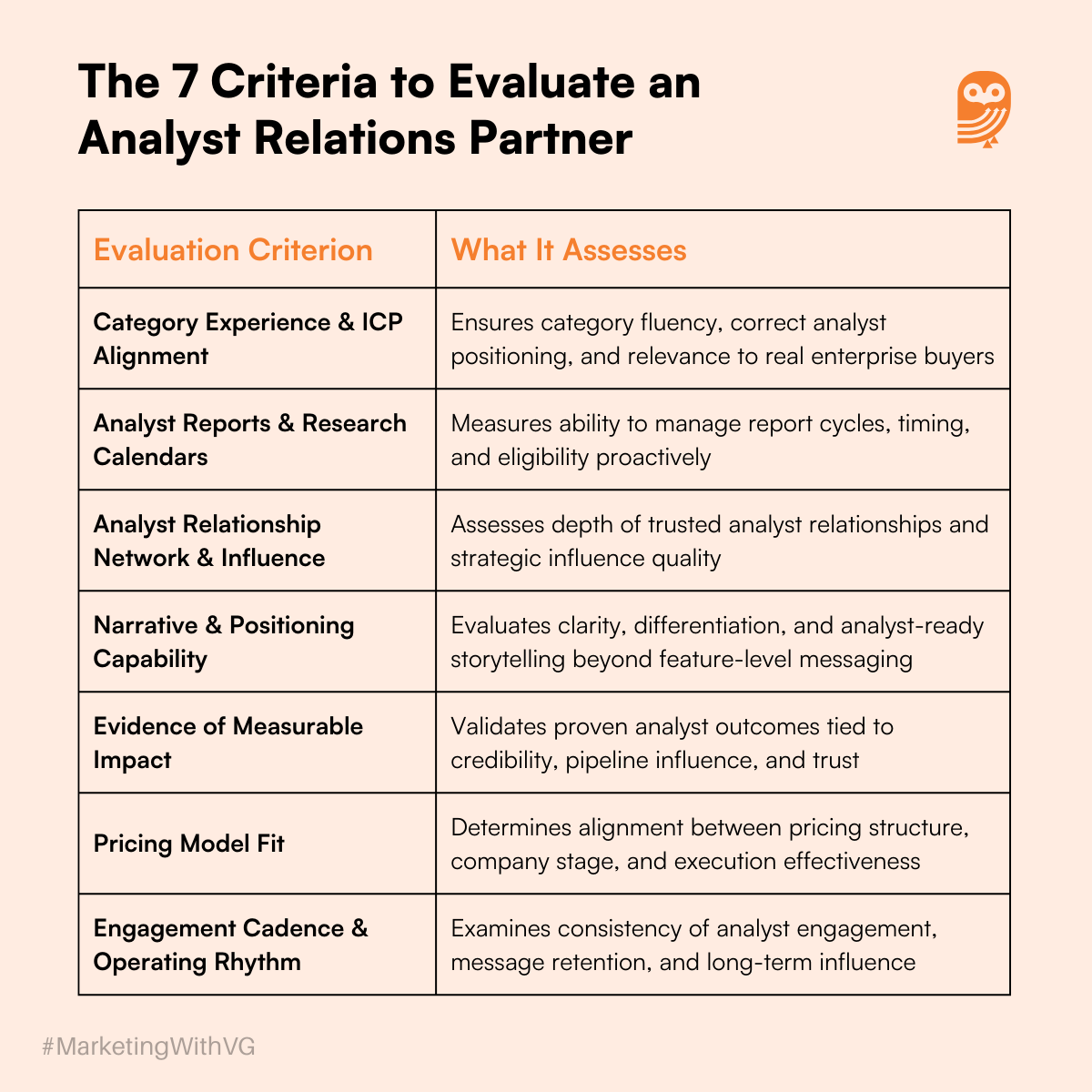
The 7 Criteria to Evaluate an Analyst Relations Partner
Each criterion below includes:
• Why it matters
• Common mistakes to avoid
• What good looks like
• Questions to ask before hiring
• Real B2B example for context
Criteria 1: Category Experience and ICP Alignment
AR partners must know your category and buyer deeply. Analysts trust agencies who consistently educate them with credible category fluency — not broad “tech expertise.”
If they don’t understand:
• The analysts covering your segment
• Your category maturity and adjacent spaces
• Buyer personas driving RFPs
• Your competitive landscape
• Market shifts and category headwinds
They cannot guide you effectively.
Common Mistakes:
• Choosing generalist PR or marketing agencies for AR
• Assuming previous “tech clients” = relevant category expertise
• Hiring based on brand logos rather than category alignment
What Good Looks Like:
• The agency identifies your primary analysts in the first conversation
• They immediately challenge your ICP and category assumptions
• They know your competitors’ analyst perception strengths and gaps
Questions to Ask:
• Which analysts currently cover our category and sub-category?
• What are the top three analyst misconceptions about our space?
• How have you helped companies like us correct category misalignment?
B2B Example:
A DevOps vendor used a PR-led firm with no knowledge of Observability → analysts documented incorrect product category → no Market Guide mentions.
After shifting to a category-specialist AR partner → clear differentiation → report inclusion within two cycles.
Criteria 2: Familiarity With Analyst Reports and Research Calendars
To appear in analyst evaluations, timing is everything.
Analysts run:
• Magic Quadrants and Waves every 12–24 months
• Market Guides that rotate annually
• Rapid-cycle MarketScapes and Radars by region and segment
If your AR partner doesn’t proactively manage these timelines:
• You miss eligibility windows
• Your evidence isn’t ready in time
• Analysts can’t validate your claims
• Your competitors get visibility instead
Common Mistakes:
• Targeting the MQ/Wave you want, not the one you qualify for
• Assuming reports are always active
• Waiting for invitations rather than initiating strategic engagement
What Good Looks Like:
• Clear mapping of all relevant reports
• Reverse-planned preparation roadmap
• Early analyst input before formal cycles begin
Questions to Ask:
• Which reports are realistic targets within the next 12 months and why?
• What are the submission windows, and how do we track them?
• What gaps must be corrected before analysts can consider us?
B2B Example:
A FinOps platform missed the MarketScape input cycle due to late engagement → delayed coverage by 14 months → direct revenue impact on enterprise pipeline.
Criteria 3: Analyst Relationship Network and Influence
AR success is not about volume of outreach. It is about quality of relationships.
Analysts have different influence tiers:
Tier A: Category architects who shape report outcomes
Tier B: Analysts who track adjacent capabilities
Tier C: Analysts who influence buyer inquiries and shortlists
Your AR partner should strategically connect you across these tiers in the right order.
Common Mistakes:
• Believing network promises like “We’ll get you into the MQ”
• Valuing quantity of relationships over quality
• Treating relationships as transactional rather than trust-based
What Good Looks Like:
• Analysts proactively ask agencies for client updates
• Partner knows each analyst’s evaluation lens and feedback style
• They facilitate roadmap advisory, not just one-way briefings
Questions to Ask:
• Which analysts regularly consult you for market insights?
• Have your clients been referenced by analysts in buyer inquiries?
• How do you maintain analyst trust between major briefings?
B2B Example:
A cybersecurity startup gained analyst advocacy early when their AR partner aligned them with a highly influential CISO-tier analyst — leading to category validation before formal evaluations.
Criteria 4: Ability to Shape Your Narrative (PMM x AR Alignment)
Analysts evaluate companies based on clarity of narrative and category fit — not on feature lists or UI polish. If your AR partner cannot help shape a cohesive, differentiated story, analysts cannot represent you accurately.
Analysts expect:
• Crisp category placement
• Clearly defined ICP, use cases, and outcomes
• Strategic differentiation vs. competition
• Roadmap tied to market evolution
Common Mistakes:
• Treating AR like PR — focusing on buzz instead of strategic clarity
• Over-indexing on features instead of business impact
• Bringing messaging to analysts before validating it internally
What Good Looks Like:
• Partner challenges messaging assumptions with buyer and category reality
• Story framework aligns product, revenue, and analyst expectations
• Differentiation expressed through market outcomes, not jargon
Questions to Ask:
• How do you validate our narrative before it reaches analysts?
• Can you show examples where you strengthened a vendor’s positioning?
• How do you align product, sales, and AR messaging?
B2B Example:
A martech startup repeatedly heard from analysts: “We don’t understand where you fit.”
An AR partner restructured messaging around revenue outcomes → analysts repositioned them closer to category leaders → shortlist rates increased.
Criteria 5: Evidence of Impact Through Case Studies
Analyst outcomes should be proven, not implied.
Proof should include:
• Report mentions
• Advisory references
• Category movement
• Analyst quotes in RFP inquiries
• Increase in shortlist inclusion
• Market Guide or Wave participation growth
Common Mistakes:
• Believing vanity metrics like follower counts or “number of briefings”
• Agencies showcasing press outcomes as AR success
• Trusting anecdotal results without measurable impact
What Good Looks Like:
• Clear before/after outcomes tied to analyst sentiment
• Demonstrable improvements in buyer trust and pipeline velocity
• Roadmap influence driven by analyst input
Questions to Ask:
• Can you share 2–3 case studies from similar categories?
• Which analyst firms have referenced your clients most recently?
• How do you measure ROI beyond briefings delivered?
B2B Example:
A cybersecurity vendor tracked win rate for deals where Gartner/Forrester asked buyers: “Did you evaluate this vendor?”
Post-AR engagement → win rate lifted by double digits.
Criteria 6: Pricing Model Fit for Your Stage and Motion
There is no one-size-fits-all AR pricing model. The wrong model creates wasted budget — or underpowered execution.
Common AR Pricing Structures:
• Monthly retainer: Best for ongoing briefing + advisory cycles
• Project-based: Best for short objectives like MQ/Wave readiness
• Hybrid: Best for scale-ups needing flexibility
Pricing Traps to Avoid:
• Retainers without delivery accountability
• Project scopes too narrow to build analyst trust
• Hidden analyst seat costs (not included in agency fees)
Stage-Based Guidance:
• Seed–Series A: Light AR motion, focus on category narrative clarity
• Series B–C: Multi-firm engagement + report activation
• Series D+: Formal evaluation cycles and competitive positioning
Questions to Ask:
• How is success measured within each pricing model?
• What commitments are tied to each milestone?
• How do you maintain analyst engagement between cycles?
B2B Example:
A Series A SaaS startup over-invested in a $25K/mo retainer with no analyst interaction plan → zero outcomes in 6 months.
Switching to a hybrid model aligned cost with actual report readiness.
Criteria 7: Engagement Cadence and AR Operating Rhythm
AR isn’t a launch event — it is a sustained relationship discipline.
A strong AR partner:
• Orchestrates quarterly briefings with top analysts
• Maintains influence between formal report cycles
• Preps PMM, product, and execs for feedback loops
• Aligns AR impact with GTM motions
Weak cadence = forgotten vendors
Strong cadence = evolving analytical trust
Common Mistakes:
• Only briefing analysts once yearly
• No structured feedback-to-roadmap flow
• No CRM tracking for analyst sentiment
What Good Looks Like:
• Predictable quarterly AR calendar
• Pre-brief, briefing, post-brief workflows
• Analyst perception tracking and sentiment scoring
Questions to Ask:
• What AR cadence do you recommend based on our maturity?
• How do you ensure analyst retention of key messages?
• How do we track analyst sentiment improvements?
B2B Example:
A workflow automation company kept losing narrative control. Quarterly AR cadence → analysts proactively requested roadmap updates and recommended inclusion in emerging reports.
AR Partner Evaluation Scorecard (Printable Tool)
Evaluate each partner on a 1–5 scale:
Criteria | Weight | Score (1–5) | Weighted Score |
Category expertise | 25% | ||
Report familiarity | 20% | ||
Analyst relationships | 20% | ||
Narrative shaping | 15% | ||
Case study evidence | 10% | ||
Pricing model fit | 5% | ||
Engagement cadence | 5% | ||
Total | 100% |
Interpretation:
• 4.0+: Strategic category partner
• 3.0–3.9: Viable fit with oversight
• <3.0: Risk of low ROI
10 Questions to Ask an AR Agency (With Red Flags)
Question | Good Answer | Red Flag |
Which analysts cover our category? | Provides names + context instantly | Vague or generic responses |
What reports can we target in 12 months? | Clear cycles + inclusion logic | “We’ll try to get you into MQ/Wave” |
How will you improve our differentiation? | Based on category insights | Marketing fluff or PR jargon |
How do you measure AR success? | Sentiment, inquiries, shortlist rates | Vanity metrics like “briefings booked” |
Who will engage with analysts? | Experienced AR strategist | Junior staff without relationships |
What happens between report cycles? | Structured influence workflows | “We’ll wait for the next briefing” |
Can we see relevant case studies? | Proof tied to outcomes | Press clippings instead of analyst coverage |
How do you handle negative feedback? | Incorporate into roadmap + messaging | Gets defensive or unclear |
How do execs participate? | Founder-level involvement in key briefings | Minimal interaction with leadership |
What will the first 90 days look like? | Forecast with milestones | No structured onboarding |
Agency vs. Internal Readiness Checklist
Before hiring an Analyst Relations (AR) partner, it’s critical to assess whether your internal foundation is strong enough to support effective analyst engagement. Even the best AR agency cannot compensate for unclear positioning or missing proof points.
Internal Readiness Criteria
• Clear ICP, category, and competitive stance
You should be able to clearly articulate who you sell to, the category you operate in (or are creating), and how you differentiate from direct and indirect competitors. Analysts will pressure-test this immediately.
• Initial customer proof (logos, metrics, testimonials)
Early enterprise logos, measurable outcomes, and credible customer stories help analysts validate your claims. Without proof, conversations stay theoretical and slow credibility building.
• Basic analyst list covering your space
You should already know which analysts, firms, and research areas are relevant to your category. This ensures briefings are targeted and not wasted on misaligned coverage.
• PMM foundation established
Core messaging, positioning, use cases, and narratives must be documented and consistent. Analysts expect clarity and will quickly surface gaps if PMM fundamentals are weak.
• Founder or exec availability for key briefings
Senior leadership presence signals seriousness and strategic intent. Analysts value direct access to decision-makers, especially in early category-shaping discussions.
Readiness Signal
If three or more of the above elements are missing, AR engagement is likely premature. In this scenario, budget is better spent strengthening positioning, proof, and internal alignment before introducing an external AR partner.
Strong internal readiness doesn’t just improve analyst outcomes — it dramatically increases the speed at which credibility, coverage, and enterprise trust are earned.
Conclusion: The Right AR Partner Shapes Market Destiny
Analyst Relations Is a Strategic Force Multiplier: How Do You Choose the Right Analyst Relations Partner
Analyst Relations is not about chasing mentions — it is about strategically structuring how the market perceives your product and its potential. A strong AR partner can:
Accelerate credibility in critical buying moments
• Influence how analysts define your category
• Improve competitive positioning and buyer trust
• Increase enterprise pipeline velocity
Your AR partner is not a vendor.
They are a strategic force multiplier in your journey to market leadership.