Why Choosing the Right Analyst Firm Shapes Your Market Perception, Buyer Trust & GTM Velocity
Most B2B companies assume “analyst engagement” simply means briefing Gartner or Forrester — but the analyst ecosystem is far broader, and its influence on enterprise trust is deeper than many GTM teams realise. Analysts shape how categories are defined, which vendors are added to shortlists, and how risk-averse buyers evaluate emerging technologies. This is why many GTM leaders are increasingly asking, “Which Analyst Firms Should Your B2B Company Evaluate?” as part of their growth strategy.
And this is backed by hard, non-repetitive, research-backed data:
According to 6sense’s 2024 Buyer Experience Report, 69% of the B2B purchase process happens before a buyer ever engages with a sales team.
When nearly 70% of the buying journey happens without your involvement, analysts become the “silent influencers” shaping how you are perceived long before your SDRs or AEs step into the picture — reinforcing why the question “Which Analyst Firms Should Your B2B Company Evaluate” is no longer theoretical, but commercially critical.
This makes one thing clear:
Selecting the right analyst ecosystem isn’t optional — it’s a GTM acceleration decision that directly impacts deal velocity, credibility, and category alignment.
The Analyst Ecosystem Has Three Layers (Framework)
The analyst ecosystem operates as a layered influence system rather than a single monolithic channel, and understanding this structure is critical for making the right GTM and positioning decisions. Every analyst firm fits into one of three strategic layers, and each layer shapes buyer perception, category credibility, and deal velocity in a fundamentally different way. Importantly, these layers do not operate sequentially for every company, nor do they carry equal weight at every stage of growth.
Layer 1: Strategic Advisory & Evaluation Firms
(Gartner, Forrester, IDC)
This layer sits at the top of the analyst ecosystem and carries the greatest influence over large enterprise buying decisions. Strategic advisory firms shape how markets are defined, how categories are framed, and how vendors are evaluated. Their frameworks—such as Magic Quadrants, Waves, and market guides—often become the internal decision language for CIOs, procurement teams, and executive buyers. Inclusion or exclusion at this layer can directly impact enterprise shortlists and perceived legitimacy. However, engagement here is most effective only when a company has achieved product maturity, customer scale, and a well-articulated category narrative. For early-stage or emerging vendors, this layer is aspirational rather than immediately actionable.
Layer 2: Deep-Dive Research Firms
(Everest Group, Omdia, ISG, Frost & Sullivan)
Deep-dive research firms operate closer to execution, specialization, and domain expertise. Their influence comes from detailed comparative analysis, vertical-specific insights, and practitioner-oriented evaluations. Buyers often turn to this layer when they are already problem-aware and actively assessing solutions based on capabilities, differentiation, and fit. For scaling B2B companies, this layer is where analyst engagement typically delivers the highest ROI. It enables sharper positioning, credible third-party validation, and more nuanced competitive storytelling without the heavy lift required by top-tier advisory firms.
Layer 3: Peer Review & Buyer Intelligence Platforms
(G2, TrustRadius, PeerSpot)
This layer influences decisions from the demand side rather than through analyst opinion. Peer review platforms shape buyer trust by showcasing real customer experiences, ratings, and use cases. They are especially powerful in mid-market, SMB, and product-led growth motions where buyers self-educate long before engaging sales. Strong performance here reduces perceived risk, accelerates shortlisting, and reinforces proof at scale. While this layer does not define categories, it plays a critical role in conversion, deal velocity, and validation—often acting as the final confidence check in a buyer’s journey.
How to Think About the Layers Together
Each layer matters—but not equally, not simultaneously, and not for every company. The most effective analyst strategy aligns the right layer with the company’s stage, target buyer, and GTM motion. When approached intentionally, these layers work together to shape perception, build trust, and accelerate growth rather than acting as isolated analyst engagements.
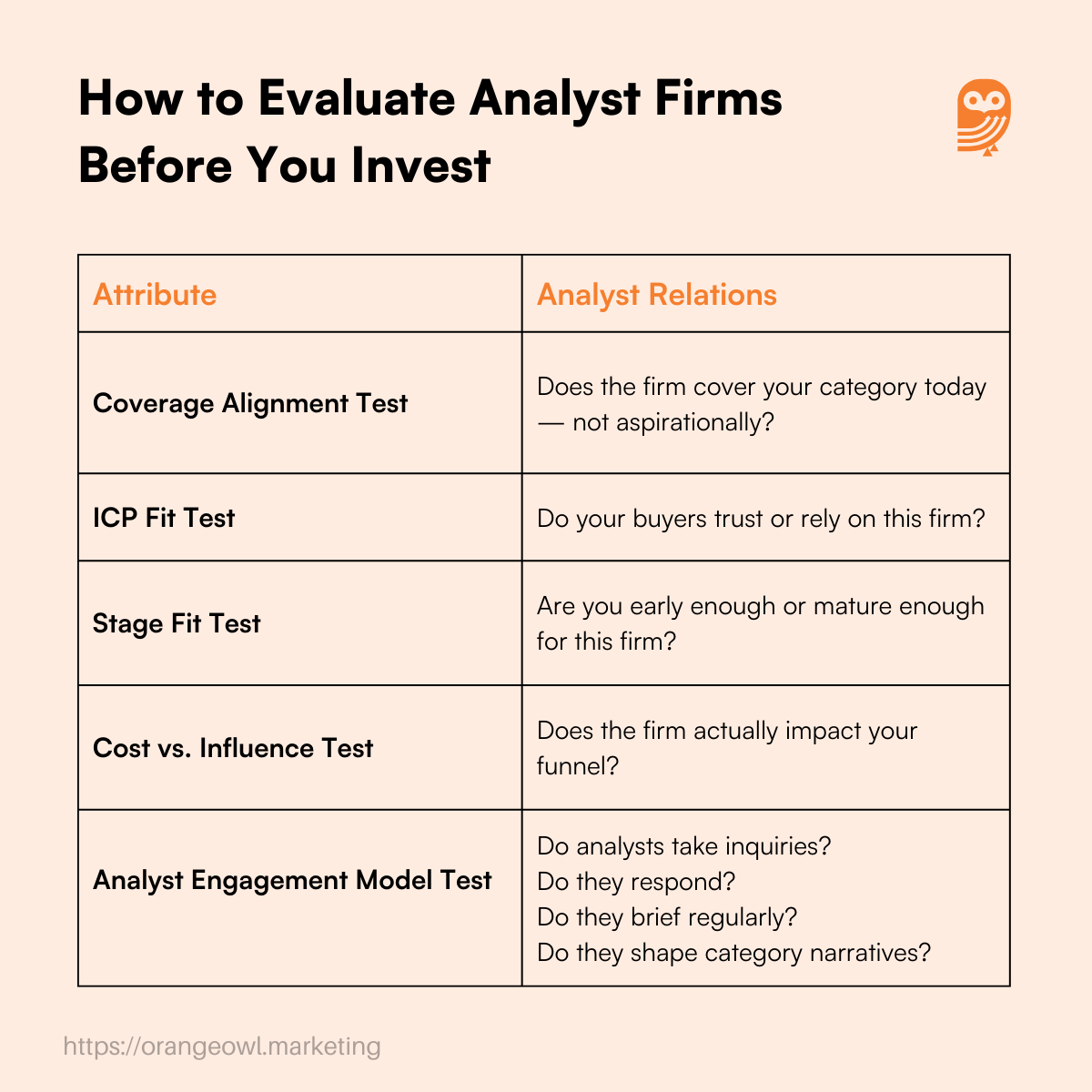
How to Evaluate Analyst Firms Before You Invest
Before allocating Analyst Relations (AR) budget, companies must move beyond brand recognition and adopt an objective, buyer-aligned evaluation framework. Analyst engagement is not a visibility exercise—it is a leverage decision. The wrong firm can consume budget without influencing pipeline, while the right firm can quietly accelerate trust, shortlists, and category authority. The following pre-investment tests help filter analyst firms based on real GTM impact rather than perception.
Coverage Alignment Test
Does the firm actively cover your category today—not aspirationally?
Many analyst firms will signal future interest in your space, but budget should only be invested where active coverage already exists. Review whether the firm currently publishes research, market maps, vendor comparisons, or buyer guidance in your exact category or adjacent problem space. If your product is repeatedly forced into an ill-fitting category during briefings, the analyst firm is not yet ready to support your narrative. True coverage alignment means your category language already exists in their research—not that you are trying to create it from scratch.
ICP Fit Test
Do your actual buyers trust, reference, or rely on this firm?
Analyst influence only matters if your Ideal Customer Profile values it. Validate whether your target buyers—CIOs, CISOs, heads of procurement, founders, or operations leaders—actively consume this firm’s research or cite it during buying conversations. If sales teams never hear the firm mentioned in deals, or if buyers rely on different sources, the firm’s brand equity does not translate into GTM impact. Analyst selection must mirror buyer behavior, not internal assumptions.
Stage Fit Test
Are you early enough—or mature enough—for this firm to matter?
Each analyst firm implicitly expects a certain level of maturity in product depth, customer scale, revenue, and narrative clarity. Early-stage companies may struggle with firms that prioritize established vendors, while mature firms may find limited value in platforms focused on emerging or SMB solutions. Evaluate whether your company’s current stage aligns with the firm’s evaluation criteria, inclusion thresholds, and research cadence. Timing matters as much as positioning.
Cost vs. Influence Test
Does the firm demonstrably influence your funnel or deal velocity?
Analyst retainers and research subscriptions should be evaluated like any other GTM investment. Assess whether the firm influences shortlists, accelerates enterprise trust, supports sales conversations, or appears in RFPs and procurement workflows. If the output is limited to logo visibility or one-off mentions without downstream impact on pipeline, the ROI is questionable. Influence—not presence—is the metric that matters.
Analyst Engagement Model Test
Can you actually work with the analysts, or are you paying for distance?
Not all analyst relationships are equally accessible. Evaluate how the firm operates in practice, not on paper. Do analysts take regular inquiries? Do they respond thoughtfully and on time? Are briefings collaborative or transactional? Do analysts actively challenge, refine, and shape category narratives—or merely document them? Strong analyst engagement is interactive and iterative, not passive or ceremonial.
Using This Framework as a Filter
Taken together, these tests form a practical filter for evaluating all analyst firms—across strategic advisory, deep-dive research, and peer intelligence layers. Firms that pass multiple tests are candidates for investment; those that fail should be deprioritized regardless of brand prestige. A disciplined evaluation process ensures that analyst relations becomes a GTM accelerator, not a sunk cost.
This becomes your filter for evaluating all analyst firms.
Deep-Dive: Which Analyst Firms Should Your B2B Company Evaluate
Gartner
Who It’s For
- SaaS, cybersecurity, fintech, AI, infra, HRTech
- Vendors targeting global enterprises
- Companies needing MQ or Market Guide visibility
Cost Range
- $50K–$200K+ annually
Strengths
- Most trusted among CIO/CISO/CTO buyers
- Magic Quadrants shape entire industries
- High clarity on category definitions
- Major influence on enterprise shortlists
Weaknesses
- High cost
- Requires maturity and customer traction
- Analysts expect strategic clarity, not marketing
Best Stage Fit
- Series B+ and enterprise expansion
Typical Value
- Strong enterprise trust
- Increased RFP inclusion
- Clear competitive position
- Category alignment
Real B2B Example
A DevSecOps vendor moved from being ignored in RFPs to being added to 8/10 enterprise shortlists after appearing in a Gartner Market Guide.
Common Mistake
Treating a Gartner briefing like a product demo.
How to Maximize ROI
- Conduct 3–4 briefings/year
- Strong PMM foundation
- Clean differentiation narrative
- Transparent roadmap
Forrester
Who It’s For
- Martech, fintech, commerce, CX, DevOps
- Buyer-led categories
Cost Range
- $40K–$150K
Strengths
- Deep buyer behavior insights
- Strong Wave evaluation frameworks
- Analysts are collaborative and feedback-driven
Weaknesses
- Fewer categories than Gartner
- High expectation for customer evidence
Best Stage Fit
- Series A–C, especially product-led companies
Typical Value
- Correct category alignment
- Narrative clarity
- Better GTM strategy
B2B Example
A CX automation company corrected its category positioning after Forrester analysts challenged assumptions during a Wave preparation inquiry.
Common Mistake
Pitching like PR or sales. Forrester expects intellectual honesty.
How to Maximize ROI
- Use inquiries
- Send structured post-briefing memos
- Strengthen proof points
IDC
Who It’s For
- Infrastructure, AI, data platforms, hardware, IoT
- Global enterprise GTM
Cost Range
- $30K–$120K
Strengths
- Extremely strong global presence
- Clear MarketScape methodology
- High credibility with CIOs
Weaknesses
- Less influence in early-stage SaaS
- More technical and formal
Best Stage Fit
- Series B+, global expansion
Typical Value
- Technical validation
- Global category visibility
- High credibility in APAC + EU
B2B Example
A distributed database platform used IDC MarketScape inclusion to accelerate deals in Japan, Singapore, and Germany.
Common Mistake
Approaching IDC too early without a mature product.
How to Maximize ROI
- Bring technical depth
- Provide customer references
- Align narrative with global market maturity
Everest Group
Who It’s For
- SaaS, IT services, BPM, HRTech, CX, cloud ops, fintech ops
- Vendors in highly operational, process-heavy, or service-led categories
- Companies competing in outsourcing or managed service environments
Cost Range
- ~$35K–$90K depending on category + engagement model
Strengths
- Deep domain expertise
- Highly respected PEAK Matrix evaluations
- Strong coverage of IT services, cloud, operations, and automation
- Analysts who ask smart, challenging operational questions
Weaknesses
- Less marketing visibility vs Gartner/Forrester
- Stronger alignment with service providers than pure SaaS vendors
Best Stage Fit
- Series B+ for SaaS
- Series A+ for services or platform+service firms
Typical Value
- Strong performance benchmarking
- Operational clarity
- Narrative improvement around capability maturity
B2B Example
A workflow automation platform used Everest Group’s PEAK Matrix recognition to break into enterprise accounts where operations, scalability, and delivery assurances mattered more than marketing narratives.
Common Mistake
Underestimating the evidence needed — Everest analysts expect clear delivery metrics, not just “capabilities.”
How to Maximize ROI
- Provide structured customer proof
- Share operational benchmarks
- Bring your delivery/head of ops team into the conversation
Omdia
Who It’s For
- Telecom, IoT, cybersecurity, media, cloud infra, AI/ML
- Vendors in technology-heavy, complex, or emerging markets
Cost Range
- $25K–$80K
Strengths
- Strong analytical models
- Very technically solid
- Excellent in emerging and frontier categories (5G, IoT, edge, AI security)
- Good analyst responsiveness
Weaknesses
- Lower brand visibility in enterprise RFP cycles compared to Gartner
- Highly technical — can overwhelm startups without strong PMM foundations
Best Stage Fit
- Series A–C
- Especially categories Gartner is late to cover
Typical Value
- Technical validation
- Visibility in emerging segments
- Early category recognition
B2B Example
A 5G infrastructure startup leveraged Omdia coverage to get its first major telecom pilot — Gartner wasn’t yet covering the subcategory, but Omdia was.
Common Mistake
Trying to position yourself too broadly — Omdia analysts expect sharp category precision.
How to Maximize ROI
- Pinpoint your technical differentiation
- Bring your CTO or lead architect to briefings
- Use the evaluation reports in early buyer cycles
ISG (Information Services Group)
Who It’s For
- Services firms, cloud MSPs, transformation companies, outsourcing platforms
- Large-scale IT services organizations
Cost Range
- ~$40K–$100K
Strengths
- Strong voice in services ecosystems
- Widely read by CIOs seeking services partners
- Strong digital transformation expertise
Weaknesses
- Less relevant for pure SaaS
- Reports heavily skewed toward service providers
Best Stage Fit
- Series A–growth for service-led models
- Series B+ for SaaS+services hybrid companies
Typical Value
- Faster trust from CIO teams
- Better alignment with services buyers
- Strong benchmarks
B2B Example
A cloud-managed-services vendor used ISG Provider Lens inclusion to win three enterprise RFPs where Gartner MQ coverage mattered less than validated delivery capability.
Common Mistake
Treating ISG like Gartner — the evaluation logic is very different.
How to Maximize ROI
- Highlight service delivery models
- Share process maturity metrics
- Use case-led storytelling
Frost & Sullivan
Who It’s For
- Companies entering new markets
- Vendors with strong North American or APAC focus
- Firms wanting fast category visibility
Cost Range
- $20K–$80K
Strengths
- Fast turnaround
- Broad category coverage
- Good for early credibility
- Useful for thought leadership assets
Weaknesses
- Lower enterprise influence
- Some buyers treat awards as light-touch
Best Stage Fit
- Seed–Series B
- Especially for companies needing early validation assets
Typical Value
- Early credibility signals
- Rapid category awareness
- Strong competitive snapshots
B2B Example
An HRTech startup used a Frost & Sullivan award to warm early-stage pipeline and convert their first 10 mid-market logos.
Common Mistake
Thinking Frost awards = Gartner-level influence.
How to Maximize ROI
- Use awards for PR
- Leverage reports in founder decks
- Pair with G2 for social proof
G2
Who It’s For
- SaaS vendors
- PLG companies
- Demand-gen-focused organizations
- Mid-market or SMB GTM
Cost Range
- $10K–$80K depending on package
Strengths
- Massive brand awareness
- High trust among mid-market buyers
- Strong social proof
- Demand-gen boosting
Weaknesses
- Less influence on enterprise CIO decisions
- Requires review farming discipline
Best Stage Fit
- Seed–Series B (huge benefit)
- Also useful for later stages as a complement
Typical Value
- Lead conversion lift
- Review-driven credibility
- Category leader badges
B2B Example
A martech startup increased demo bookings by 40% after achieving “Leader in G2 Grid” and restructuring its landing pages around reviews.
Common Mistake
Buying G2 too early before collecting real customer reviews.
How to Maximize ROI
- Run quarterly review campaigns
- Position for Grid Reports
- Use category pages strategically
TrustRadius
Who It’s For
- SaaS vendors with enterprise buyers
- Companies needing high-depth, qualitative reviews
Cost Range
- $20K–$90K
Strengths
- More credible, long-form reviews
- Buyers trust technical depth
- Strong for enterprise due diligence
Weaknesses
- Smaller footprint vs G2
- Fewer categories
Best Stage Fit
- Series B+ (when enterprise audits matter)
Typical Value
- Trust in late-stage buyer reviews
- In-depth reference quality
- Strong due diligence
B2B Example
A cybersecurity vendor used TrustRadius reviews to replace customer reference calls in long compliance-heavy sales cycles.
Common Mistake
Treating TrustRadius like a volume-review platform.
How to Maximize ROI
- Capture long-form technical reviews
- Use them in RFP appendices
- Pair with your analyst deck
PeerSpot
Who It’s For
- Cybersecurity
- DevOps
- Cloud infrastructure
- IT operations platforms
Cost Range
- ~$25K–$75K
Strengths
- Very influential in cybersecurity
- Specialists read PeerSpot heavily
- Deep comparison reviews
Weaknesses
- Limited outside cyber/infra categories
Best Stage Fit
- Series A–C mid-market or enterprise
Typical Value
- High influence on technical buyer decisions
- Powerful for competitive positioning
B2B Example
A cloud security vendor saw conversion lift from practitioners selecting them based on PeerSpot’s comparative reviews.
Common Mistake
Not answering technical buyer questions inside reviews.
How to Maximize ROI
- Engage your security engineers
- Provide precise feature comparisons
- Build credibility in practitioner circles
Comparison Table: Which Analyst Firm Is Best for You?
Analyst Firm | Best For | Stage Fit |
Gartner | Enterprise trust, category clarity | Series B+ |
Forrester | Buyer insights, Wave coverage | Series A-C |
IDC | Tech depth, global expansion | Series B+ |
Everest Group | Services, ops-heavy categories | Series A+ |
Omdia | Emerging tech, telecom, IoT | Series A-C |
ISG | Services, MSPs | Series A-growth |
Frost & Sullivan | Early validation, PR | Seed-Series B |
G2 | Reviews, mid-market GTM | Seed-Series B |
TrustRadius | Enterprise reviews | Series B+ |
PeerSpot | Cyber/infra technical buyers | Series A-C |
Common Mistakes Companies Make When Choosing Analyst Firms
❌ 1. Chasing “brand names” instead of ICP relevance
Gartner isn’t always right for early-stage categories.
❌ 2. Buying subscriptions too early
If you’re pre-revenue → don’t buy.
❌ 3. Picking firms that don’t cover your category
This is the most expensive mistake.
❌ 4. Confusing peer-review sites with analyst research
G2 ≠ Gartner.
TrustRadius ≠ Forrester.
❌ 5. Expecting instant coverage
AR is a 12–18 month compounding motion.
❌ 6. Treating AR like PR
Analysts are strategic educators, not journalists.
❌ 7. Not preparing a PMM foundation
Analysts can’t fix unclear positioning.
Best Practices for Selecting the Right Analyst Firm
✅ 1. Map analyst firms to your buyers
Choose based on ICP buying behavior.
✅ 2. Start with low-cost ecosystems
G2 + Frost & Sullivan for early-stage vendors.
✅ 3. Build an “Analyst Influence Map”
Identify which analysts shape your category.
✅ 4. Choose firms aligned with your GTM motion
Enterprise → Gartner
Buyer-led → Forrester
Technical → IDC/Omdia
Service-led → ISG/Everest
✅ 5. Select firms where your competitors are covered
Coverage parity matters.
✅ 6. Use a 3-year analyst roadmap
Year 1: Reviews + emerging firms
Year 2: Omdia / Everest / IDC
Year 3: Gartner + Forrester
✅ 7. Always do analyst inquiries before subscription decisions
The analyst reaction tells you everything.
Analyst Selection Decision Framework (ARC Compass)
The ARC Compass is a proprietary decision model designed to remove subjectivity from analyst selection and replace it with a buyer- and GTM-aligned evaluation system. Instead of choosing analyst firms based on brand prestige or internal preference, the ARC Compass forces teams to assess which firms actually influence perception, trust, and buying behavior in their market.
At its core, the framework evaluates analyst firms across three dimensions: Alignment, Relevance, and Credibility. Together, these dimensions determine whether an analyst firm will meaningfully shape category positioning and pipeline outcomes—or simply consume budget without impact.
Alignment
Does the firm align with your category, narrative, and ICP?
Alignment measures how closely the analyst firm’s active coverage matches your product category and ideal customer profile. This includes whether your category already exists in their research, whether your solution fits naturally into their evaluation frameworks, and whether their analysts understand the problems you solve without heavy education. High alignment means your company strengthens an existing narrative within the firm’s ecosystem rather than fighting to redefine it. Low alignment indicates miscategorization risk, limited analyst understanding, and slower momentum despite investment.
Relevance
Do your buyers trust, consume, and reference this firm?
Relevance evaluates the firm’s influence from the buyer’s perspective rather than the vendor’s. This dimension asks whether your target buyers actively read the firm’s research, cite it in internal discussions, or rely on it during evaluation and procurement stages. A firm can be globally recognized yet irrelevant to your specific ICP. High relevance means the firm’s insights materially shape buyer perception before sales engagement even begins.
Credibility
Does the firm credibly influence shortlists, evaluations, and final decisions?
Credibility measures the firm’s power to convert insight into action. It assesses whether the firm’s reports, rankings, peer insights, or recommendations directly affect vendor shortlisting, RFP inclusion, or risk assessment. Credibility is reflected in how often sales teams hear the firm mentioned in deals, how frequently procurement references their frameworks, and whether enterprise buyers use the firm to justify decisions internally. Without credibility, visibility remains passive and non-decisive.
ARC Scoring Model (1–5 Scale)
Each analyst firm is scored from 1 to 5 across Alignment, Relevance, and Credibility, creating a composite ARC score.
1–2: Low strategic value, minimal GTM impact
3: Contextual value, selective or situational influence
4–5: High-impact firm with measurable influence on perception and pipeline
This scoring allows teams to compare analyst firms objectively across tiers and identify where budget should be concentrated versus where light-touch engagement is sufficient.
How the ARC Compass Is Used
The ARC Compass is not a one-time exercise. It is applied during initial analyst selection, revisited annually, and recalibrated as the company’s stage, ICP, or GTM motion evolves. When used consistently, it ensures analyst relations remain a strategic lever—focused on influence, trust, and category authority—rather than a branding checkbox.
Conclusion — Your Analyst Strategy Determines Your Category Destiny
Choosing the right analyst ecosystem is not a procurement exercise — it’s a GTM strategy decision that affects positioning, trust, competitive differentiation, and enterprise motion. The analyst firms you align with determine:
Whether you appear in shortlists
How your category is defined
How buyers perceive your product
How fast you earn legitimacy
How strong your narrative becomes
When done right, selecting the right analyst firm amplifies your category authority, accelerates your enterprise funnel, and strengthens every part of your GTM motion — reinforcing the importance of answering Which Analyst Firms Should Your B2B Company Evaluate early and intentionally.
Top 10 FAQs About Which Analyst Firms Should Your B2B Company Evaluate