Most founders assume analyst mentions are won with a single impressive briefing — a polished deck, a confident founder pitch, maybe a few customer logos. But the reality is far less glamorous, far more strategic, and much more human.
Behind every Gartner Market Guide inclusion, every Forrester Wave mention, every IDC MarketScape reference…
there is a relationship.
A relationship built slowly.
A relationship built intentionally.
A relationship built on clarity, credibility, and consistency — not charisma.
And for fast-growing B2B companies, this relationship is no longer optional.
In today’s B2B buying environment, 64% of European B2B buyers report working with analysts or consultants during their purchase process, according to 6sense’s 2024 European Buyer Experience Report. In this context, third-party validation through analyst relationships becomes a strategic must—not just a “nice-to-have.” Analysts now act as trusted advisers, influencing how buyers shortlist vendors long before your sales team engages.
Which means one thing:
If an analyst does not know you, understand you, trust you, or remember you — you do not exist in the enterprise buying conversation.
And that is why this guide exists.
This is not another “AR 101” article. This is the deeper story — the psychology, cadence, nuance, and strategy behind how analyst relationships work that actually translate into report visibility.
Let’s begin.
The Truth Most Founders Don’t Realize About How Analyst Relationships Work
Analysts are not journalists.
They are not influencers.
And they aren’t looking for hype.
Analysts are researchers, advisors, category stewards, and pattern recognizers — people who speak to hundreds of vendors, interview thousands of customers, and shape frameworks that define entire industries.
Here’s what founders often misunderstand:
Analysts don’t remember companies — they remember clarity.
If you cannot articulate who you are, why you exist, and how you’re different in under 60 seconds, analysts will tune out — politely, but decisively.
Analysts don’t need your product to be perfect — only credible.
Over-exaggeration or overstated metrics destroy trust instantly. Honest gaps build confidence.
Analysts don’t include companies they don’t understand.
If your narrative shifts every quarter, analysts lose context.
If your category fit is fuzzy, analysts get confused.
And confused analysts avoid writing about you.
Analysts don’t include companies they don’t hear from consistently.
If you disappear for 12 months and resurface during MQ season, you’ve already lost.
This is why finding your way into research is not about playing the system.
It’s about playing the long game.
Why Analyst Relationships Directly Influence Mentions in Reports
It’s tempting to imagine analysts sitting in a room reviewing every vendor equally.
That’s not what happens.
When an analyst starts working on a Market Guide or Wave, they rely on:
- Vendors they’ve been tracking
- Notes from previous briefings
- Conversations from inquiry calls
- Confidence built over consistent updates
- Evidence of trajectory and category relevance
- Mental models formed through repeated interactions
In other words:
Analysts include the vendors they know, trust, and understand.
Imagine two companies:
Company A
- Briefed analysts twice a year
- Sends quarterly updates
- Shares customer outcomes
- Explains roadmap with honesty
- Clarifies positioning consistently
- Responds promptly to follow-up questions
Company B
- Hosts one flashy briefing
- Sends no follow-up
- Has inconsistent messaging
- Makes exaggerated claims
- Disappears for a year
Even if Company B has stronger technology, Company A gets the mention — because analysts have clarity and confidence.
This dynamic is what separates “unknown vendors” from “tracked vendors,” and “tracked vendors” from “mentioned vendors.”
The Four Psychological Pillars of Analyst Relationships
After hundreds of analyst interactions across B2B tech categories, four foundational pillars consistently emerge:
1. Clarity
Analysts will never include what they don’t understand.
You must answer, with precision:
- What category are you in?
- What problem do you solve?
- Who is your ICP?
- How are you different?
- Why now?
Common Mistakes
- Reusing your sales deck
- Overloading with product features
- Pitching 4 value props to 3 ICPs
- Using jargon analysts don’t care about
- Changing the story every quarter
Best Practice
Anchor your positioning to the analyst’s mental model — not your internal terminology.
B2B Example
A DevOps observability startup struggled because analysts didn’t know whether they were an APM tool, a logs aggregator, or an alerting system.
Once they restructured their narrative around “modern observability for distributed microservices,” they were added to two research trackers.
2. Consistency
One great briefing does nothing.
Six good touchpoints do everything.
Consistency builds:
- Familiarity
- Context
- Credibility
- Memory retention
- Category alignment
- Roadmap visibility
- Relationship equity
Cadence That Works
- Quarterly updates
- 2–4 major briefings per year
- Occasional insights (market shifts, customer trends)
B2B Example
A fintech startup got into Gartner’s Market Guide only after maintaining a 3-quarter update rhythm — not because their product changed, but because their relationship maturity did.
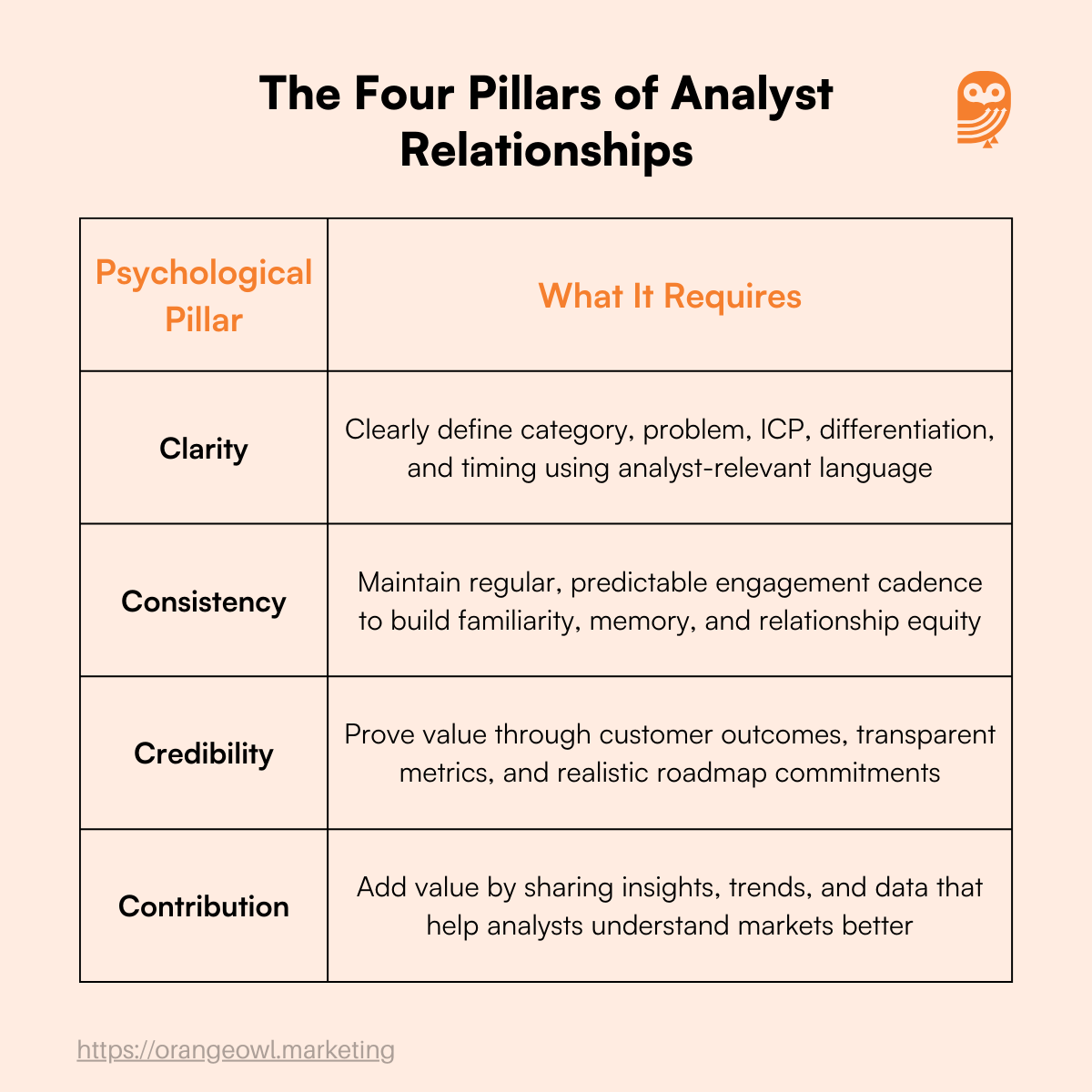
3. Credibility
Analysts don’t care about how big you want to be.
They care about what you can prove.
Credibility Builders
- Real customer outcomes
- Clear ROI stories
- Honest roadmap transparency
- Measurable product traction
- Defensible metrics
Credibility Killers
- Exaggerating revenue
- Claiming “category creation” prematurely
- Fake logos or inflated customer counts
- Hiding weaknesses
- Making promises you cannot deliver
B2B Example
A cybersecurity vendor openly told analysts, “We do not support X compliance yet — but here is our timeline and current progress.”
Analysts appreciated the honesty and later advocated for them in buyer calls.
4. Contribution
The highest-performing vendors don’t just get insights from analysts — they give insights to analysts.
They become “market informants” by:
- Sharing anonymized customer trends
- Explaining why deals are won or lost
- Highlighting emerging patterns
- Offering data analysts can reuse
- Helping analysts stay ahead
B2B Example
A logistics visibility vendor began sending analysts quarterly “market pulse” snapshots (3 slides).
Analysts started referencing their insights across multiple conversations — and later in research.
How Analyst Opinions Shape Entire Categories
Many founders don’t realize analysts are not just observers — they are architects.
Analysts:
- Define category criteria
- Establish evaluation frameworks
- Influence enterprise RFP templates
- Set minimum capabilities
- Choose terminology
- Highlight necessary differentiators
Which means:
Part of your job as a vendor is helping analysts understand where the category is going.
But there is a line.
You cannot “force a new category” prematurely.
Responsible Influence Looks Like:
- Sharing market patterns
- Showing early signals
- Providing customer behavior insights
- Offering objective evidence
- Aligning with analyst taxonomy
Irresponsible Category Manipulation Looks Like:
- Pushing made-up buzzwords
- Renaming your niche as a “new category”
- Claiming category leadership without validation
- Pitching futuristic visions without proof
B2B Example
AI security vendors influenced analysts to formalize the concept of “behavior-based anomaly detection.”
It wasn’t invented by the vendors — it emerged from strong repeated evidence.
How to Follow Up After an Analyst Briefing (This Is Where Most Vendors Lose Mentions)
A perfect briefing with no follow-up is a forgotten briefing.
Within 24 Hours
Send:
- Thank-you note
- Slide deck
- Clarifications on questions
- Promised data
Within 72 Hours
A brief clarity memo:
- What you heard
- What you clarified
- What you’re sending next
- Which questions you plan to answer later
Within 2–3 Weeks
Send:
- Additional customer stories
- Product screenshots
- Competitive insights
- Feature updates
Quarterly
Send:
- Customer wins
- Product improvements
- Market patterns
- Roadmap progress
- Category insights
B2B Example
A MarTech automation vendor corrected an analyst’s misunderstanding using a 1-page memo sent 48 hours after a call. That memo became the basis for their later inclusion in a Market Guide.
Analyst Relationship Intelligence: The Three Analyst Personas
(A new proprietary framework added for deeper authority)
Understanding who you’re briefing is as important as what you’re briefing.
1. The Visionary Analyst
Looks for:
- Category evolution
- Vision clarity
- Big-picture relevance
- Industry patterns
2. The Data-Driven Analyst
Looks for:
- Metrics
- Evidence
- Customer relevance
- Roadmap execution
3. The Category Purist
Looks for:
- Precise category fit
- Taxonomy alignment
- Competitive positioning
Knowing which persona you’re facing helps you tailor your narrative instantly.
Do’s & Don’ts of Analyst Relationship Building
✅ Do’s
- Be consistent
- Share real evidence
- Tell a simple story
- Ask analysts for feedback
- Send structured updates
- Clarify misunderstandings fast
- Bring the founder to key briefings
❌ Don’ts
- Don’t oversell
- Don’t change your story often
- Don’t pitch new categories prematurely
- Don’t spam analysts
- Don’t ignore follow-up
- Don’t present internal jargon as positioning
The Analyst Relationship Cadence That Leads to Mentions
Analyst mentions are rarely the result of a single great briefing. They emerge from a disciplined, predictable engagement cadence that helps analysts track your evolution over time. Consistency signals seriousness, reduces risk, and makes your company easy to reference when buyers ask questions.
Quarterly: Maintain Relevance and Momentum
Quarterly touchpoints are the heartbeat of strong Analyst Relations. These updates are short, focused, and evidence-driven—not sales pitches.
Quarterly updates should include:
Product updates tied to buyer pain points
Customer outcomes with measurable impact
Roadmap execution vs. prior commitments
Market insights observed from customer conversations
These touchpoints help analysts answer: “Is this company progressing the way they said they would?”
Biannual: Reinforce Strategy and Direction
Twice per year, analysts expect a deeper strategic conversation. This is where you connect execution to long-term vision.
Biannual briefings focus on:
Major company briefings with leadership participation
Vision and roadmap alignment to market evolution
Category positioning validation
This cadence ensures analysts understand not just what you’re building, but why it matters.
Annual: Shape the Category Narrative
Annual interactions are about influence, not updates. These conversations position you as a contributor to the category’s future.
Annual engagements include:
Category-shaping conversations
Market trend contributions and predictions
Ecosystem and competitive insights
At this stage, analysts begin to see you as a thought partner, not just a vendor.
How Cadence Translates Into Analyst Recognition
When this rhythm is sustained, analyst perception evolves in clear stages:
Unknown → Known
Analysts recognize your name and basic category placementKnown → Tracked
Analysts monitor progress and recall your narrativeTracked → Mentioned
Analysts reference you in advisory calls and discussionsMentioned → Featured
Analysts include you in Market Guides, Waves, or researchFeatured → Positioned
Analysts clearly articulate your strengths, role, and differentiation
Key Takeaway
Mentions are earned through rhythm, not reach. A consistent analyst cadence transforms visibility into influence—and influence into positioning. The companies that win analyst mindshare aren’t the loudest; they’re the most predictable, credible, and useful over time.
The ARC Loop: How Analyst Relationships Compound Over Time
The ARC Loop is a simple but powerful relationship model that explains how consistent Analyst Relations efforts turn early engagement into long-term influence. Analyst trust is not built through one-off briefings or polished decks—it compounds through repetition, alignment, and proof over time.
A → Alignment
Alignment is the foundation of analyst trust. Your narrative must fit cleanly within established category boundaries—or intentionally and credibly challenge them. This means analysts can quickly answer three questions:
What category are you in?
Who is the buyer?
Why does your approach matter?
When your story aligns with how analysts frame the market, you reduce cognitive friction. Analysts don’t need to reinterpret your positioning, making it easier to remember, reference, and eventually recommend you.
R → Repetition
Repetition builds familiarity. Analysts track hundreds of vendors; only those who show up consistently stay top of mind. Repetition doesn’t mean repeating the same pitch—it means reinforcing the same core story across briefings, updates, webinars, and informal interactions.
Over time, analysts begin to recognize patterns: stable positioning, consistent execution, and predictable progress. This signals maturity and reduces perceived risk for buyers.
C → Credibility
Credibility is earned through evidence. Customer proof, roadmap follow-through, metrics, and analyst-informed adjustments all compound trust. Each interaction should demonstrate that what you said previously is now supported by real-world results.
When analysts see momentum—customers validating outcomes, roadmap milestones achieved, category clarity improving—your credibility accelerates.
How the ARC Loop Compounds
When the ARC Loop repeats quarter after quarter, analyst behavior begins to shift:
Analysts cite you in advisory calls with buyers
They track your progress proactively, without being prompted
They mention you in category discussions and internal research meetings
They invite you into research cycles, Market Guides, and evaluations
And eventually—yes—they begin to reference you in reports, not because you asked, but because you’ve become relevant, credible, and easy to place.
Key Takeaway
The ARC Loop proves that Analyst Relations is not a transactional activity—it’s a compounding system. Alignment creates clarity. Repetition creates recall. Credibility creates influence. Execute the loop consistently, and analyst visibility becomes a natural outcome, not a negotiated one.
Conclusion: Analyst Mentions Are Not Won — They Are Earned Over Time
The vendors who consistently show up are the ones analysts show up for.
Analyst relationships are not about luck, charisma, or one perfect pitch. They are about clarity repeated consistently, credibility demonstrated over time, and contribution made regularly.
When you treat analysts as long-term category partners — not coverage machines — you unlock the real benefits of Analyst Relations:
- Report inclusion
- Buyer influence
- Category alignment
- Narrative clarity
- Competitive differentiation
- Strategic trust
This is how companies go from being misunderstood to being recognized — and ultimately, to being recommended.