Introduction: Why GEO Matters More Than Ever in 2026
Search hasn’t disappeared but it has fundamentally changed.
In 2026, people no longer rely on typing keywords and browsing through multiple links. They ask questions in natural language, expect instant clarity, and increasingly trust AI to do the heavy lifting from research to decision-making.
Instead of scrolling through pages, users now receive:
- Direct answers
- Curated recommendations
- Comparisons tailored to their needs
And in many cases, they act on those answers without ever clicking a single link.
This creates a powerful shift in digital visibility:
- If your brand is not mentioned in the AI’s response
- You are not just ranked lower
- You are completely excluded from the decision
This is exactly where Generative Engine Optimization (GEO) becomes critical.
Just as SEO once determined who gets discovered, GEO now determines who gets recommended. And in 2026, that recommendation often directly influences user decisions sometimes even before they consider alternatives.
What is Generative Engine Optimization (GEO)?
Generative Engine Optimization (GEO) is the process of designing your content and digital presence so that AI systems can:
- Clearly understand what you offer
- Trust your credibility
- Select your content as a reliable source
- And include or recommend you in generated answers
Unlike traditional SEO, where success is measured by rankings and clicks, GEO shifts the focus to inclusion and influence within AI-generated responses.
The Real Shift in Mindset
- SEO → “How do I rank higher?”
- GEO → “Why should AI trust and recommend me?”
This shift may seem subtle, but it changes everything.
This aligns with how modern AI systems use retrieval-augmented generation (RAG) to pull and synthesize trusted information.
In 2026, AI systems don’t just retrieve information; they interpret, filter, and present what they believe is most useful. That means your content must not only exist, but stand out as reliable and contextually relevant.
Why Generative Engine Optimization (GEO) is More Than Visibility
GEO is no longer just about being seen, it’s about shaping decisions.
AI systems today are capable of:
- Shortlisting options
- Comparing alternatives based on context
- Highlighting pros and cons
- Recommending the “best fit”
And increasingly, they are being integrated into tools that can take action on behalf of users.
So, if your brand is not part of that ecosystem, you’re not just missing traffic but influence also.
How AI Search Works (And Why It Changes Everything)
To truly understand GEO, you need to understand how AI-driven search behaves differently from traditional search.
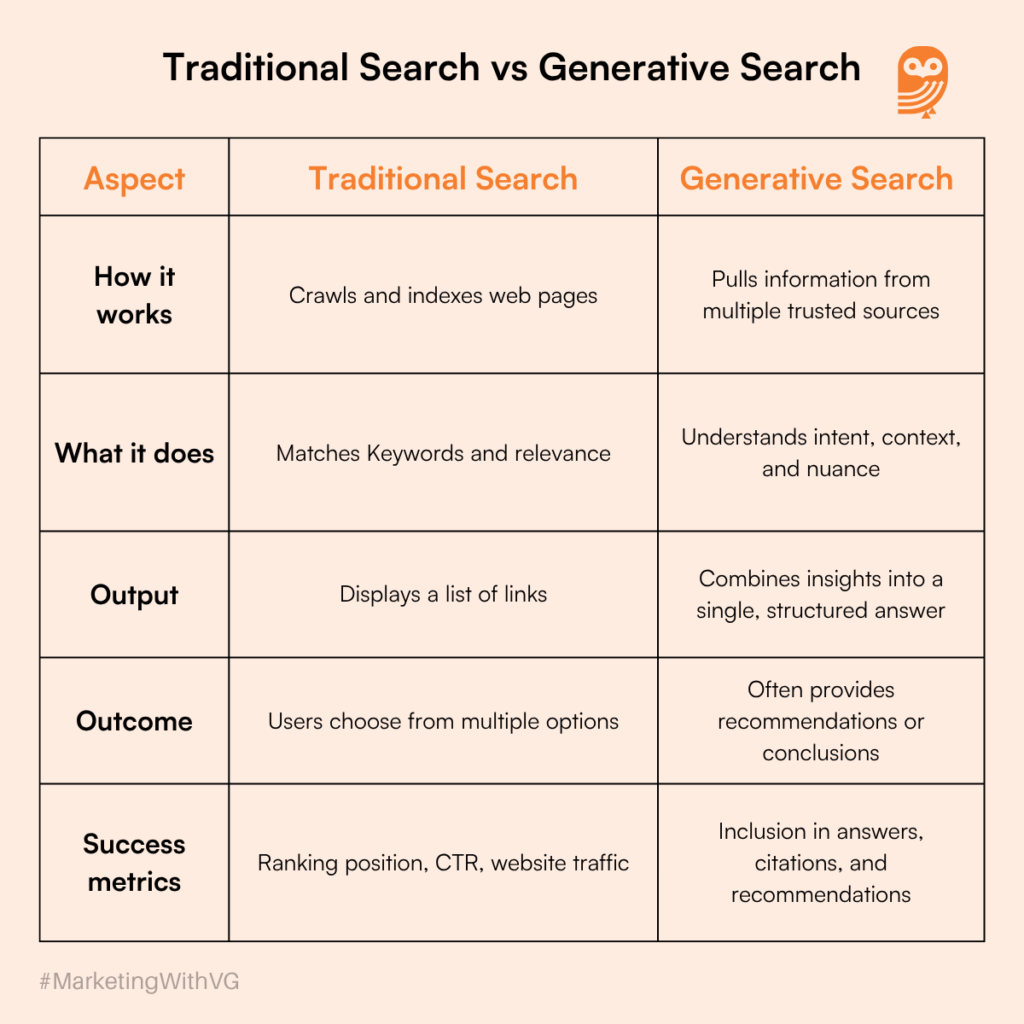
Success now depends on:
Whether your content is included in that answer
What This Means in Practice
Consider this query:
“What’s the best CRM for a small team under ₹2000 per month?”
Instead of showing a list of links, AI delivers:
- A short list of recommended tools
- Key features and comparisons
- Possibly a final suggestion
If your product is not mentioned in that shortlist, the user may never even know you exist.
This is why GEO is fundamentally about earning a place inside the answer itself.
The 6 Core Pillars of GEO
To succeed in AI-driven search, you need a strong foundation. GEO is built on six essential pillars.
1. Content Structure & Clarity
AI systems prioritize content that is easy to interpret.
This means your content should be:
- Logically structured with clear headings
- Broken into smaller, digestible sections
- Written in a direct, question-answer format
Why this matters:
AI often extracts specific sections of content rather than entire pages. If your information is buried in long paragraphs, it’s less likely to be used.
Think in terms of:
- FAQs
- Bullet points
- Step-by-step breakdowns
The clearer your structure, the higher your chances of being selected.
2. Semantic Depth (Beyond Keywords)
In 2026, keywords are just the starting point.
AI systems understand relationships between ideas, not just exact phrases.
For example, instead of only focusing on “CRM software,” your content should naturally include:
- Use cases (sales tracking, automation)
- Context (team size, budget)
- Related concepts (customer retention, integrations)
This helps AI understand:
- When your content is relevant
- And for which type of user or situation
The goal is to create context-rich content, not keyword-heavy content.
3. Authority & Citations
AI doesn’t rely on a single source. It validates information across multiple signals.
If your brand is consistently mentioned across:
- Trusted blogs
- Review platforms
- Industry publications
- Research reports
You build a stronger credibility profile.
In GEO, authority is not just about backlinks, it’s about recognition across the ecosystem.
The more your brand is referenced, the more likely AI is to trust and cite you.
4. Prompt Optimization (The New Keyword Strategy)
Search behavior has evolved into natural conversations.
Users now ask:
- “Which tool is best for my team size?”
- “What’s the most affordable option for beginners?”
These are intent-rich, specific queries.
To align with this:
- Write content in a conversational tone
- Address real-world questions
- Anticipate follow-up queries
Instead of optimizing for isolated keywords, you’re optimizing for complete user intent.
5. Technical & Structured Data
Behind the scenes, technical clarity plays a major role.
AI systems prefer content that is:
- Machine-readable
- Well-organized
- Clearly attributed
Key elements include:
- Schema markup (for products, FAQs, authors)
- Author bios with credentials
- Clean HTML structure
- Fast loading speeds
Even formats like:
- Tables
- Transcripts
- Structured comparisons
make it easier for AI to extract and reuse your content.
6. Continuous Feedback & Iteration
Unlike traditional SEO, GEO is constantly evolving.
AI systems update frequently, and what works today may change tomorrow.
That’s why you need to:
- Regularly test prompts
- Check where your brand appears
- Identify missing opportunities
- Update and refine content
Think of GEO as an ongoing loop:
Test → Learn → Improve → Repeat
GEO vs SEO: What’s Changed
At a glance, the difference looks simple but the implications are massive.
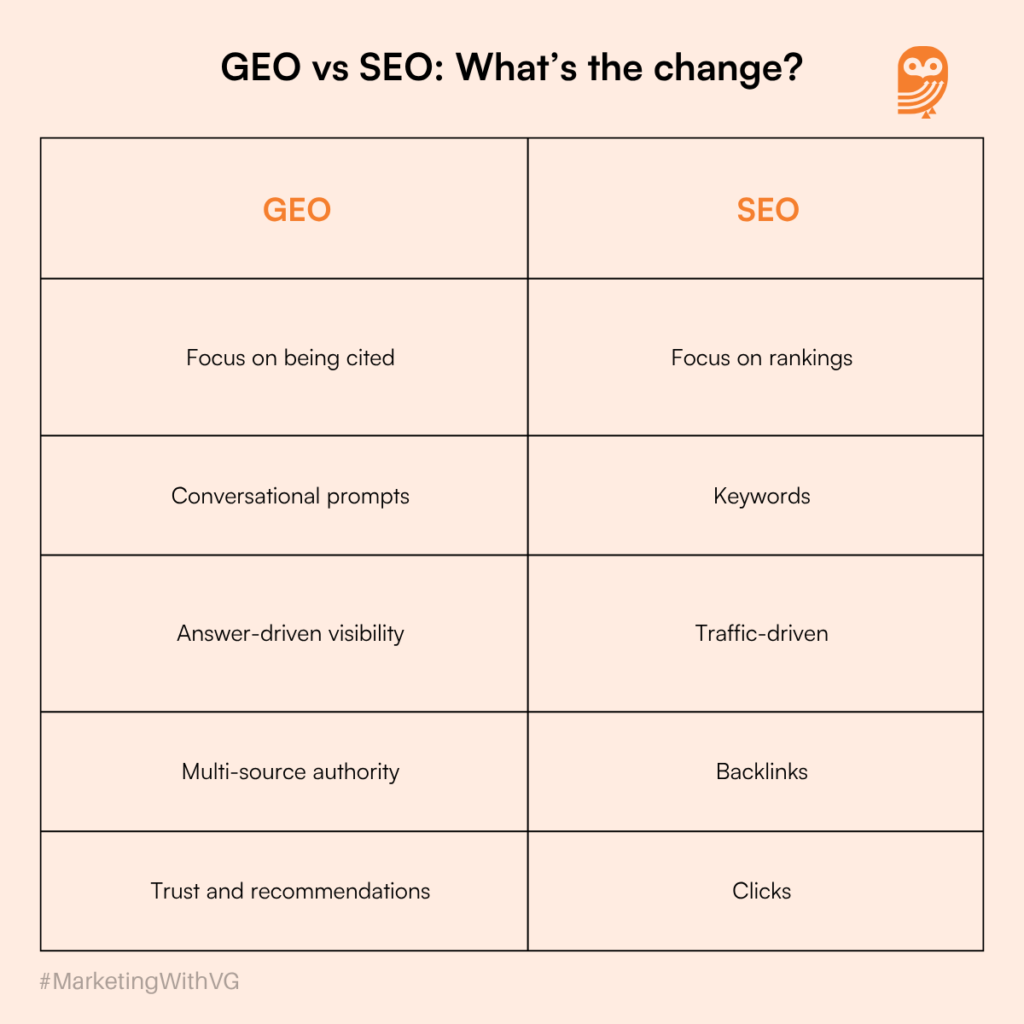
The Real Shift
- SEO = Being found
- GEO = Being chosen
And in 2026, being chosen is what drives outcomes.
How GEO Works Across Industries
GEO applies to any industry where users seek guidance before making decisions.
B2B SaaS
AI frequently recommends tools directly.
To stay competitive:
- Build comparison pages
- Create use-case-driven content
- Strengthen presence on review platforms
Ecommerce
AI tailors product suggestions based on user needs.
To improve visibility:
- Use structured product data
- Include detailed reviews and FAQs
- Get featured in curated lists
Healthcare
Accuracy and trust are critical.
To build authority:
- Publish expert-reviewed content
- Highlight credentials clearly
- Provide structured, factual information
Education
AI often ranks courses and programs.
To stand out:
- Create comparison-based content
- Highlight outcomes and credibility
- Use structured course data
Step-by-Step Generative Engine Optimization (GEO) Framework
Here’s a practical way to get started.
Step 1: Audit Your AI Visibility
Search for your brand using real queries.
Identify whether you are:
- Mentioned
- Cited
- Missing
This gives you a clear starting point.
Step 2: Build a Prompt Map
Document the actual questions your audience asks.
Focus on:
- Long, conversational queries
- Decision-making questions
- Comparisons
Step 3: Restructure Your Content
Make your content easier for AI to use.
Transform it into:
- Q&A formats
- Guides
- Comparison pages
Step 4: Expand Your Presence
Ensure your brand appears across multiple trusted platforms.
AI connects signals from across the web not just your website.
Step 5: Build Authority
Focus on getting mentioned and referenced externally.
Authority grows when others talk about you.
Step 6: Strengthen Technical Foundations
- Implement structured data
- Add author credibility
- Improve site performance
Step 7: Iterate Continuously
Track performance and refine regularly.
GEO is not static; it evolves with AI.
Common Shortfalls to Avoid
- Treating GEO like keyword optimization
- Ignoring external mentions and authority
- Focusing on a single AI platform
- Overlooking author credibility
Each of these weakens your chances of being selected.
Final Thoughts on Generative Engine Optimization
Generative Engine Optimization is not just a trend; it is the new foundation of digital strategy.
In 2026:
- Visibility without trust is not enough
- Content without structure is not enough
- Presence without authority is not enough
The brands that succeed will be those that are:
- Easy to understand
- Trusted across sources
- And consistently recommended by AI
Because in this new landscape:
You don’t win by being seen. You win by being selected.
Explore more of our blogs: orangeowl.marketing
Frequently Asked Questions (FAQ)