Nearly 72% of B2B buying teams now engage external advisers such as analysts and consultants to guide their purchase decisions—a trend highlighted in recent research on enterprise buying behavior. This growing reliance on trusted third-party voices shows why functions like Analyst Relations (AR), Public Relations (PR), and Product Marketing (PMM) have become more strategic than ever for B2B companies.
Yet in fast-moving sectors such as SaaS, cybersecurity, fintech, logistics tech, and cloud infrastructure, these three functions are often misunderstood or treated as interchangeable. Early-stage teams assume PR can get them into Gartner reports, that product marketers can “handle analysts,” or that analysts will automatically understand their product positioning simply by reading the website.
In reality, each function serves a distinct purpose, influences a different audience, and shapes a different stage of the enterprise buying journey. When B2B companies understand these distinctions clearly, they invest smarter, craft sharper narratives, and accelerate enterprise sales cycles dramatically.
This guide breaks down the differences between Analyst Relations vs PR vs Product Marketing with real B2B examples, clear explanations, and actionable insights tailored to companies at different stages of growth.
What Is Analyst Relations (AR)?
Analyst Relations (AR) is all about building long-term, strategic relationships with independent industry analysts who shape enterprise buying decisions. These analysts work at firms like Gartner, Forrester, IDC, Everest Group, Omdia, 451 Research, and G2. Their evaluations influence vendor lists, procurement decisions, competitive landscapes, and market categories.
When you participate in Analyst Relations, you’re not “pitching for coverage.” You’re educating analysts about your company so they can accurately represent you in research reports, conversations with enterprise buyers, and category evaluations.
Why AR Matters for B2B Companies
In industries where buying cycles exceed 60–180 days, analysts act as trusted advisors. For example:
- In cybersecurity, CISOs won’t buy an endpoint protection tool without checking Gartner’s EPP Market Guide or Forrester’s Wave.
- In fintech, banks rely heavily on IDC and Gartner to identify safe, compliant vendors.
- In logistics technology, supply chain leaders check Everest Group before shortlisting visibility platforms.
- In HRTech, Gartner’s “HCM Suites” research directly influences vendor evaluation criteria.
In these environments, Analyst Relations becomes a core growth lever, not a nice-to-have.
A B2B Example: Cybersecurity Vendor Losing Deals
A mid-sized cybersecurity startup repeatedly lost enterprise deals because buyers asked:
“Are you in Gartner’s Magic Quadrant?”
They weren’t — because they had never engaged analysts.
After two structured AR briefings, Gartner included them in a Market Guide. This wasn’t a ranking — just a mention. But it instantly improved their perceived legitimacy. Within two quarters, their RFP win rate rose by 22%.
Actionable Insight
If enterprise buyers ask “Where do you stand in the MQ/Wave?”, that’s a sign you need AR — today, not next quarter.
What Is Public Relations (PR)?
Public Relations (PR) deals with shaping your public image through media, publications, thought leadership articles, social credibility, and brand exposure. PR builds broad visibility — not enterprise-specific trust.
PR communicates with:
- Journalists
- Media outlets
- Influencers
- Business press
- Startup and tech news platforms
PR is designed to build awareness, brand recall, and market visibility.
What PR Does in B2B?
Common PR outcomes:
- A TechCrunch or YourStory article after funding
- Founder interviews on podcasts
- Press releases about product launches
- Media mentions during events
- Brand storytelling in trade publications
PR is powerful for visibility, but it rarely influences enterprise buying decisions directly.
B2B Example: Logistics SaaS Expanding to the US
A logistics visibility startup used PR extensively as it entered the US market. Articles in FreightWaves, SupplyChainDive, and Forbes Tech gave them strong top-of-funnel visibility.
But enterprise procurement teams still asked:
“Is this vendor covered in Gartner’s Supply Chain reports?”
PR helped build awareness, but AR shaped trust where it mattered most.
Actionable Insight
PR is a megaphone — it spreads your story widely. But it doesn’t replace AR, which validates your story with trusted experts.
What Is Product Marketing (PMM)?
Product Marketing (PMM) defines who you are, what you offer, why it matters, and how it is different. PMM creates the central narrative that aligns product, sales, and marketing.
A strong Product Marketing (PMM) function drives:
- Market positioning
- Messaging frameworks
- ICP and persona clarity
- Product launch strategy
- Sales enablement
- Competitive intelligence
- ROI/value proposition clarity
PMM is the backbone of every go-to-market motion.
How PMM Impacts Enterprise Sales
A good PMM team helps prospects understand:
- What category you belong to
- Why you exist
- What makes you different
- Why now
- How the product works
- The business impact
Even the greatest sales team will struggle if PMM is not well-defined.
B2B Example: MarTech Company Fixing Positioning
A Customer Data Platform (CDP) startup kept losing deals to bigger players. Analysts didn’t understand their differentiation, and journalists found their messaging unclear.
After a strategic PMM overhaul — adjusting messaging to emphasize real-time personalization — both analysts and buyers finally understood their value. Their inbound demo requests increased by 36%.
Actionable Insight
Before approaching analysts or investing in PR, ensure your PMM foundation is solid. Analysts can instantly spot unclear positioning — and unclear positioning kills credibility.
The Key Differences Between Analyst Relations vs PR vs Product Marketing
Although they appear similar, the differences are enormous.
1. They Influence Different Audiences
- AR → analysts and enterprise buying committees
- PR → media, public market, general audience
- PMM → customers, prospects, internal teams
2. They Solve Different Business Problems
- AR reduces enterprise buying friction
- PR increases visibility
- PMM improves clarity and differentiation
3. They Impact Different Stages of Growth
- PMM = foundational
- AR = scaling to mid-market/enterprise
- PR = amplifying brand stories
B2B Example: Fintech Startup Misallocating Budget
A fintech reconciliation SaaS spent ₹40 lakhs on PR expecting analyst mentions. PR delivered press hits — but analysts didn’t cover them because analysts require structured briefings, data, and roadmap clarity.
Six months later, procurement teams still asked:
“Are you covered by Gartner or IDC?”
This is a classic case of confusing PR for AR.
Actionable Insight
Never expect PR to generate analyst coverage. Analyst Relations is a completely different expertise and workflow.
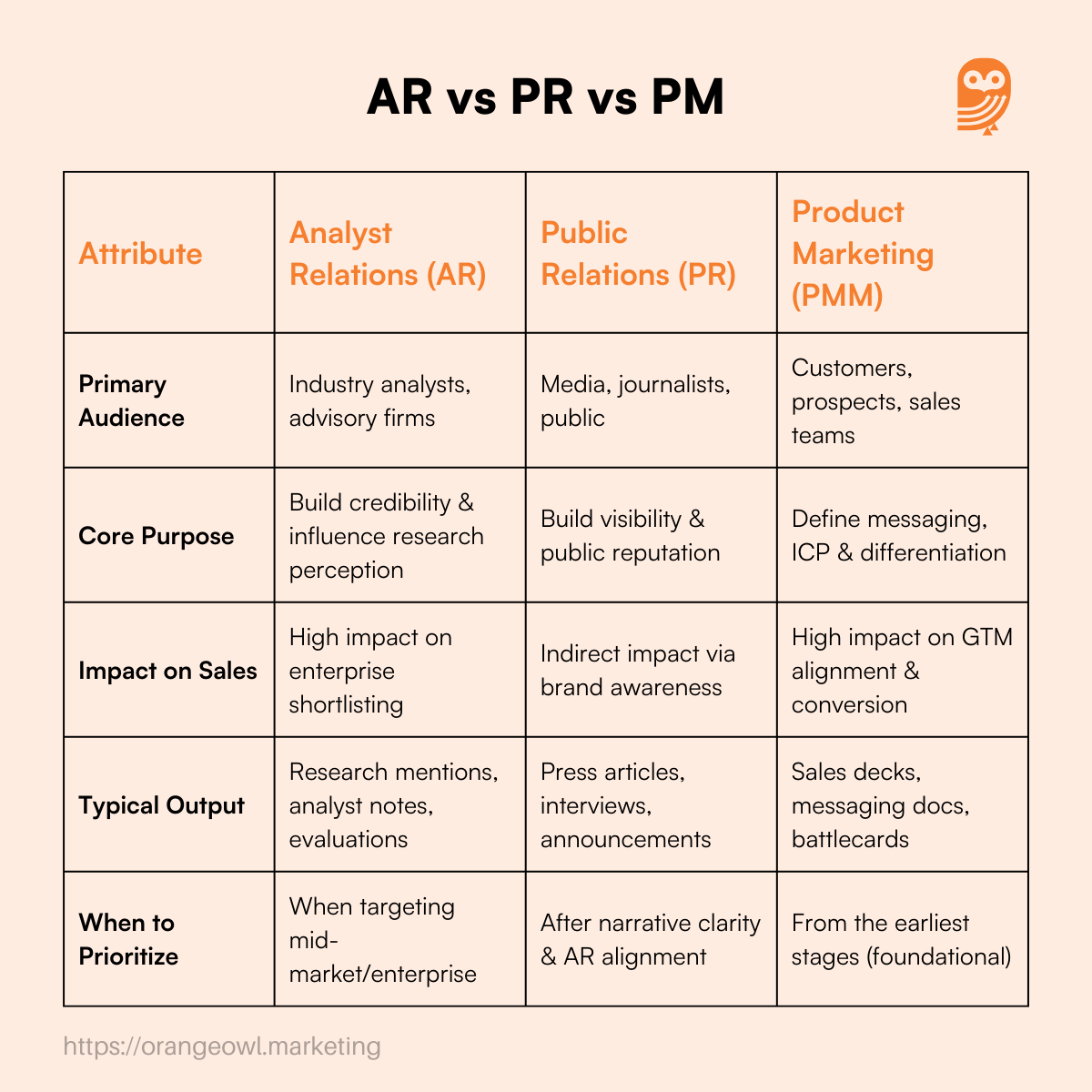
Comparison Table: Analyst Relations vs PR vs Product Marketing
| Attribute | Analyst Relations (AR) | Public Relations (PR) | Product Marketing (PMM) |
|---|---|---|---|
| 1. Primary Audience | Industry analysts, advisory firms, enterprise buying committees | Media, journalists, press, influencers, general public | Customers, prospects, sales teams, internal stakeholders |
| 2. Core Purpose | Build analyst understanding, influence research perception, improve credibility with buyers | Increase visibility, reputation, and public awareness | Define positioning, messaging, ICP, and value proposition |
| 3. Impact on Sales | High impact on enterprise sales and vendor shortlist placement | Indirect impact; builds brand awareness but doesn’t drive shortlist inclusion | High impact on sales enablement, conversion, and narrative clarity |
| 4. What They Influence Most | Category alignment, vendor evaluation, competitive positioning | Public image, thought leadership reach, brand narrative | Product-market clarity, pitch consistency, use cases, differentiation |
| 5. Typical Output | Research mentions, Market Guides, Waves, MQs, advisory calls | Press coverage, interviews, articles, press releases | Messaging docs, battlecards, personas, sales decks, product narratives |
| 6. Engagement Style | Strategic, data-driven, roadmap-focused | Storytelling, media-driven, brand-led | Analytical, customer-driven, GTM-aligned |
| 7. Required Inputs | Product vision, customer metrics, roadmap, differentiation, competitive view | Founder story, media angles, launches, milestones | User insights, product capabilities, competitive data |
| 8. Best Time to Invest | When scaling to mid-market/enterprise or joining competitive categories | After achieving narrative clarity & analyst validation | From Day 1 — foundational for GTM and sales |
| 9. Risks of Doing It Wrong | Misalignment with category, poor representation in research, lost enterprise deals | Misleading or weak PR stories, low ROI, irrelevant media coverage | Confusing positioning, inconsistent messaging, sales inefficiency |
| 10. Success Indicator | Analyst understanding, positive mentions, improved RFP win rate | Share of voice, media mentions, visibility spike, authority | Clear narrative, higher conversions, strong sales confidence |
How AR, PR, and PMM Work Together in High-Performing B2B Companies
When executed together, the impact compounds.
1. Product Marketing (PMM) defines the story.
They clarify ICP, category, value proposition, feature positioning, and differentiation.
2. Analyst Relations (AR) validates the story.
Analysts help refine positioning, correct market alignment, and improve strategic clarity.
3. Public Relations (PR) amplifies the story.
Once validated, the story is pushed into the broader market for awareness.
B2B Example: Mid-Market SaaS Scaling to Enterprise
A workflow automation startup used:
- PMM to refine category messaging
- AR to brief Gartner analysts
- PR to publicize new enterprise features
This sequencing led to:
- MQ Market Guide inclusion
- Increased enterprise trust
- Higher website conversion
- Better competitive win rates
Actionable Insight
Sequence matters. The most powerful combination is:
PMM → AR → PR.
What Should Startups Prioritize First?
Here’s the simplest and most practical framework for prioritization:
If you’re Seed → Focus on PMM
At this stage, you need clarity — not analysts or press.
If you’re Series A–B → Start AR in parallel with PMM
This is when enterprise buyers begin evaluating you.
If you’re Series B–C and beyond → Invest in PR to scale awareness
Once your story is clear and validated, amplify it through PR.
B2B Example: Cloud Infra Startup Prioritizing Wrongly
A cloud observability platform went heavy on PR early on. They got media attention — but analysts found their category alignment weak. Buyers remained confused about whether they were an APM tool, an observability suite, or a logs aggregator.
After revisiting PMM → AR → PR sequencing, their evaluations improved and their pipeline doubled.
Actionable Insight
Start with PMM. Add AR as soon as enterprises enter your pipeline. Use PR only when your story is polished and validated.
Conclusion
Analyst Relations (AR), Public Relations (PR), and Product Marketing (PMM) are three pillars of B2B growth, but they are not interchangeable. They serve different strategic purposes, speak to different audiences, and influence different parts of the enterprise buying journey. Analyst Relations (AR) helps you earn trust with the people who guide enterprise decisions. Product Marketing (PMM) ensures your story is clear, compelling, and differentiated. Public Relations (PR) amplifies that story to the world and strengthens your broader brand presence.
When these functions are understood correctly and sequenced thoughtfully, they can transform how the market perceives you. Strong Product Marketing (PMM) gives you a sharp, confident narrative. Analyst Relations (AR) validates that narrative through trusted, independent voices that enterprises rely on. Public Relations (PR) then scales the narrative so prospects, partners, talent, and media hear it beyond analyst circles.
B2B companies that invest in the right function at the right time grow faster, win more enterprise deals, and position themselves for long-term category leadership. Whether you’re refining positioning, building analyst credibility, or expanding brand visibility, clarity on these three motions helps you avoid wasted effort and focus on what truly moves the needle.
As the market becomes more crowded and buying committees become more risk-averse, the companies that understand how Analyst Relations vs PR vs Product Marketing complement each other will stand out—not just with loud marketing, but with meaningful authority, trust, and strategic alignment. The smartest B2B teams don’t choose between these functions; they integrate them in a way that creates momentum at every stage of the customer journey.
Top 10 Frequently Asked Questions About Analyst Relations vs PR vs Product Marketing