
Introduction: Top 10 Lessons from Leading FinTech Unicorns
In the span of a single decade, the financial landscape has been utterly transformed. A once-staid, heavily regulated sector has been violently disrupted by a wave of agile, technology-first startups—the Fintech unicorns. These companies, valued at over a billion dollars, didn’t just digitize old processes; they fundamentally reinvented the architecture of money, commerce, and identity. From revolutionizing global payments to creating ‘no-fee’ banking models and building the institutional infrastructure for crypto, these pioneers have offered a masterclass in modern market disruption.
This deep-dive analysis examines ten of the world’s most influential financial services unicorns—Stripe, Chime, Ripple, GoodLeap, Bolt, Gusto, Digital Currency Group (DCG), Chainalysis, Fireblocks, and FalconX—to distill the defining strategies that fueled their multi-billion-dollar ascent. These are the Top 10 lessons for any founder, entrepreneur, or executive looking to build not just a profitable business, but a company that changes the way the world handles its finances.
1. Build the ‘Picks and Shovels’ of Digital Commerce
The first, and arguably most potent, lesson comes from the company that became the invisible infrastructure for the internet economy. Stripe(Case Study) realized that as commerce moved online, every business, from a small e-commerce shop to a massive software platform, needed a simple, elegant way to accept payments. Instead of building a direct-to-consumer product, they built the API-first toolkit that developers loved.
This “picks and shovels” strategy is powerful. While others chased the fleeting glory of the gold rush (the consumer), Stripe became the supplier of the essential tools (the payment processing, fraud prevention, and billing management). Their success stems from abstracting away the sheer complexity of financial regulation and payment systems into lines of code. This didn’t just make integration easy; it made it scalable, enabling them to capture a percentage of every single transaction that powers the modern internet. The first lesson from the top 10 lessons is : Don’t just chase the end-user market; own the foundational layer that enables the entire market to function.
2. Achieve Radical Customer Centricity by Abolishing Fees
The traditional banking model thrives on complexity and opaque fees—a strategy ripe for disruption. Chime(Case Study) seized this opportunity by adopting a model of radical customer centricity, offering what traditional banks never could: genuine, no-fee banking. By eliminating overdraft fees, minimum balance requirements, and monthly service charges, Chime successfully onboarded millions of financially underserved consumers who were tired of being nickel-and-dimmed by incumbent institutions.
Chime monetizes not through punitive fees, but by collecting a percentage of the interchange fee every time a user swipes their Visa debit card. This aligns their financial success directly with their customers’ success and usage, not their misfortune. Their phenomenal growth proves that in an industry built on extracting value, the most powerful disruption is often to create and share value. The second lesson from the top 10 lessons is: The trust generated by abolishing fees is more valuable than the fees themselves.
3. Solve a Real-World, Regulatory-Heavy Problem (Cross-Border Payments)
Some of the greatest opportunities lie in the most complex, regulated, and outdated corners of finance. Ripple(Case Study) focused its immense effort on one of the world’s most inefficient processes: cross-border institutional payments. Traditional correspondent banking is slow, expensive, and non-transparent. Ripple used its blockchain technology (XRP Ledger) to offer banks and payment providers a real-time, lower-cost alternative for global transactions.
The key to Ripple’s growth wasn’t just the technology, but its willingness to navigate the treacherous waters of international financial regulation. Unlike consumer-facing crypto companies, Ripple pursued a B2B strategy, proving that revolutionary technology must be packaged in a way that is palatable, compliant, and beneficial to the incumbent industry players. The third lesson from the top 10 lessons is: By offering liquidity and speed in a regulatory-aware manner, Ripple positioned itself as an indispensable utility in global finance.
4. Master the Art of Embedded Finance and Vertical Specialization
The future of finance is “invisible,” seamlessly integrated into the point of sale for non-financial products. GoodLeap(Case Study), a financing platform specializing in solar and home efficiency loans, exemplifies this trend. GoodLeap didn’t start by building a general lending platform; it focused on a single, high-growth vertical—sustainable home improvement—and embedded its finance solution directly into the sales process of contractors and installers.
This specialization creates a massive advantage: a superior underwriting model built on deep vertical data (e.g., specific solar panel models, local energy savings, contractor performance) that general lenders lack. By controlling the financing experience at the moment the consumer is ready to buy (the installation of a solar array or a new roof), GoodLeap maximizes conversion and minimizes fraud. The fourth lesson from the top 10 lessons is: Don’t try to be the finance layer for everything; become the expert, indispensable finance layer for one high-value ecosystem.
5. Ruthlessly Optimize for the Frictionless Experience
In the digital commerce world, the smallest amount of friction can lead to massive revenue loss. Bolt(Case Study), a company focused on one-click checkout and payments, built its valuation on the principle of ruthless optimization for the conversion funnel. They recognized that a shopper who has filled their cart can be easily lost by a cumbersome, multi-step checkout process.
Bolt’s single-click solution not only reduced cart abandonment for its retail partners but also created a persistent digital identity for the shopper across the “Bolt network,” making every subsequent purchase instant. Their strategy is a masterclass in user experience driving business value. The fifth lesson from the top 10 lessons is simple but difficult to execute: Identify the single point of greatest friction in your customer’s journey and engineer a solution so elegant that it feels like magic.
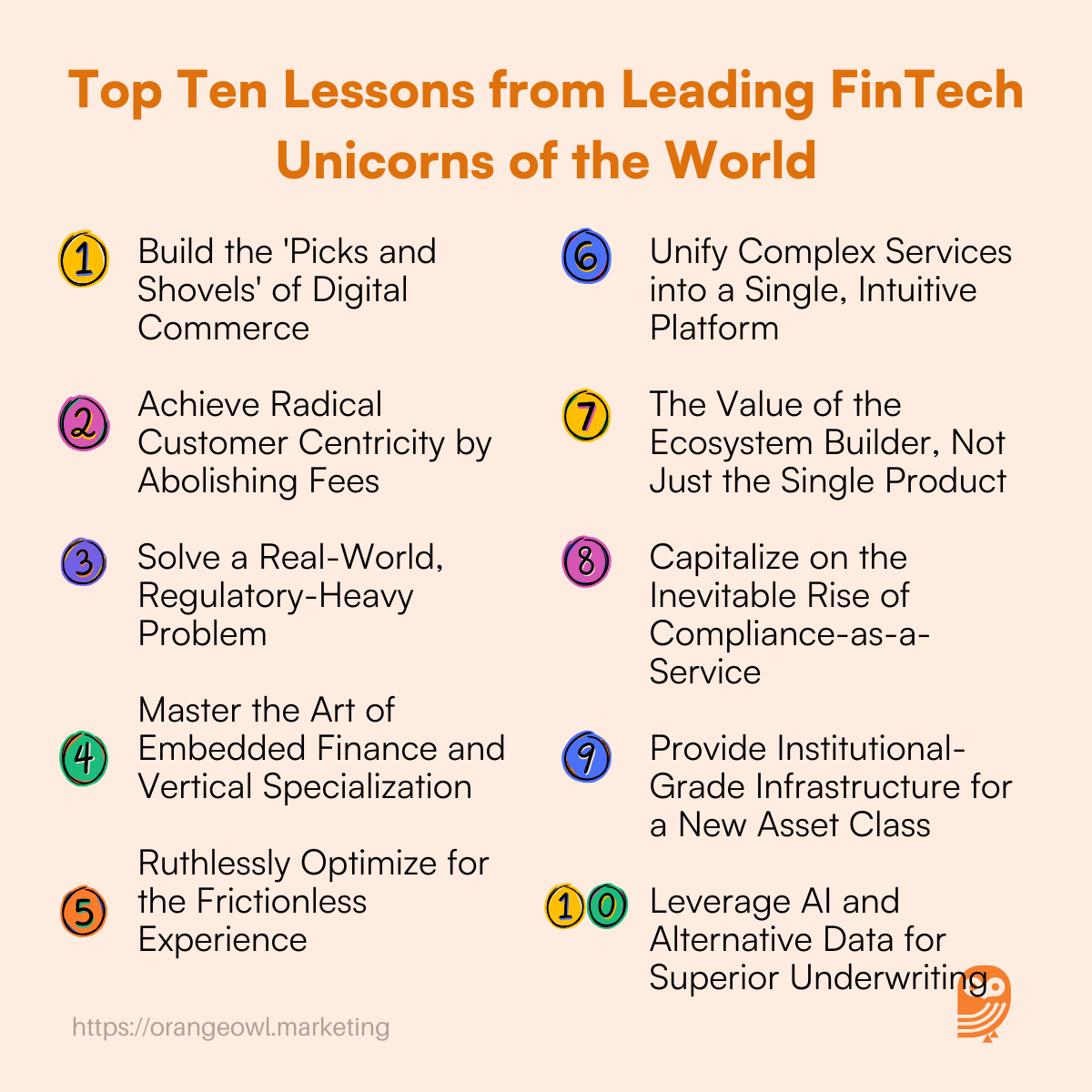
6. Unify Complex Services into a Single, Intuitive Platform
For small and medium-sized businesses (SMBs), managing essential but non-core functions like payroll, benefits, and HR can be a complex, fragmented nightmare involving multiple providers. Gusto(Case Study) earned its unicorn status by building an all-in-one, unified platform that simplifies this entire compliance and people-management burden.
By integrating these disparate functions—from automatically calculating tax withholdings and filing W-2s to managing health insurance and 401(k)s—Gusto allows SMB owners to spend less time on administration and more time on growth. This strategy proves that in a world of specialized software, there is immense value in rebundling complex, related services into a singular, intuitive, and compliant experience, this is the the sixth lesson from the top 10 lessons. Gusto sells peace of mind, bundled with powerful software.
7. The Value of the Ecosystem Builder, Not Just the Single Product
While many founders focus on a single, brilliant product, companies like Digital Currency Group (Case Study) demonstrate the strategic power of building an entire ecosystem. DCG is not a crypto exchange or a payment app; it’s a venture capital firm that invests in and operates companies across the entire crypto and blockchain industry. Its subsidiaries include Grayscale (a massive digital asset manager) and CoinDesk (a leading crypto media/events platform), alongside dozens of portfolio companies spanning exchanges, mining, and infrastructure.
This comprehensive approach allows DCG to gain intelligence, influence, and diversified revenue streams across every stage of the crypto asset lifecycle. It’s a powerful lesson in vertical integration applied to a nascent industry. The seventh lesson from the top 10 lessons is: To dominate a new market, don’t just build one killer app—build the interconnected set of businesses that are essential to the market’s survival and growth.
8. Capitalize on the Inevitable Rise of Compliance-as-a-Service
As the cryptocurrency and digital asset space matured, a critical need emerged: security, compliance, and institutional trust. Chainalysis(Case Study) and Fireblocks(Case Study) exemplify the success of meeting this need head-on.
Chainalysis provides the necessary software to law enforcement and financial institutions to track and analyze cryptocurrency transactions, making the transparent ledger compliant and understandable. They turned an apparent weakness of crypto (transaction anonymity/opacity) into a strength for institutions.
Fireblocks provides a secure, institutional-grade platform for moving, storing, and issuing digital assets. They focused entirely on addressing the security and operational complexities that were barriers to entry for banks and large corporations.
The eighth lesson from the top 10 lessons is : The biggest opportunities in a rapidly evolving, high-risk sector often lie in providing the security, compliance, and infrastructure that allows mainstream institutional capital to flow safely. These Fintech unicorns are the trusted gatekeepers in a trustless world.
9. Provide Institutional-Grade Infrastructure for a New Asset Class
While the early crypto market was dominated by retail trading platforms, the massive valuations of companies like FalconX(Case Study) highlight the shift toward institutional-grade infrastructure. FalconX operates as a prime broker, providing major institutions—hedge funds, VCs, and asset managers—with a single gateway to cryptocurrency trading, credit, and settlement.
Institutions require more than a simple trading app; they demand high-frequency execution, deep liquidity, robust security, and white-glove service. FalconX’s success is rooted in its ability to marry the complexity and 24/7 nature of digital assets with the strict, high-touch demands of traditional finance. These Fintech unicorns demonstrate that as a disruptive market matures, the fastest path to massive valuation is to build the premium, reliable on-ramp for the largest pools of capital.
10. Leverage AI and Alternative Data for Superior Underwriting
The common thread across companies like GoodLeap (Lesson 4) and many other modern lending/insurance platforms is the shift away from legacy credit scores to AI-driven alternative data. These new unicorns recognize that traditional underwriting models, which often rely on outdated and incomplete credit bureau data, exclude large segments of the market and lead to suboptimal risk assessment.
By analyzing thousands of data points—from transaction history and employment status (Chime/Gusto data) to specific technological deployment data (GoodLeap’s home energy models)—Fintech unicorns create superior, predictive models that can assess risk more accurately. This allows them to offer loans or policies to consumers the incumbents reject, leading to massive market expansion and better unit economics. The final lesson from the top 10 lessons is that data, harnessed by AI, is the new competitive advantage in finance. It unlocks profitable markets that are invisible or inaccessible to players relying on outdated, generalized data models.
Conclusion: The New Architecture of Trust and Velocity
The collective success of leading Fintech unicorns like Stripe, Chime, and Chainalysis paints a clear picture of the future of finance: it will be frictionless, transparent, interconnected, and increasingly invisible. These ten Fintech unicorns did not become titans by incrementally improving legacy systems; they achieved their billion-dollar valuations by identifying points of maximum pain and building a completely new architecture for value exchange.
The primary themes are a powerful combination of unbundling and rebundling:
Unbundling: They unbundled core banking services (payments, checking, lending) from the physical bank branch.
Rebundling: They rebundled these functions into superior, digital-native products defined by a few core principles: API-first accessibility (Stripe), extreme customer alignment (Chime), and institutional-grade compliance (Chainalysis/Fireblocks).
For the next generation of financial innovators, the blueprint is clear: the opportunity is no longer in competing with banks, but in becoming the indispensable software layer upon which all future financial interactions are built. Whether it’s solving a complex regulatory problem like cross-border payments, providing institutional security for new assets, or simply making the payment experience disappear into the background, the path to unicorn status lies in creating value through technological superiority and radical clarity. Embrace complexity, own the infrastructure, and always prioritize the velocity of money and the peace of mind of the user—that is the definitive lesson from the top 10 lessons from the Fintech Unicorns revolution.
Dive into more Unicorn insights at orangeowl.marketing/unicorn-chronicles . Here are the Lessons from the Top 10 Enterprise Tech Unicorns of the world.