
Own Success Story Introduction
The rise of cloud applications created a critical, yet often unacknowledged, blind spot for enterprises: data protection. When companies migrated their core operations, customer records, and intellectual property onto platforms like Salesforce, they mistakenly assumed these SaaS providers handled total data security. Own (formerly OwnBackup) stepped into this void, becoming the definitive answer to cloud-to-cloud data security and challenging this dangerous assumption head-on.
Founded by Sam Gutmann, Ori Yankelev, Daniel Gershuni, and Ariel Berkman in 2015, the company’s rapid ascent is one of the most compelling case stduies in enterprise software. It’s a textbook example of a B2B startup that identified a mission-critical infrastructure pain point and grew to be non-negotiable for enterprise customers.
Own achieved unicorn status with a $1.4 billion valuation in January 2021 and peaked at a remarkable $3.35 billion later that year following its Series E funding. Its ultimate journey, which culminated in the 2024 acquisition by Salesforce for a total valuation of approximately $2.1 billion, provides a crucial lesson for aspiring entrepreneurs on how to build a scalable, infrastructure-level solution by focusing squarely on the financial and compliance risks facing the modern enterprise.
Origin Story
The company was started to solve the fundamental problem embedded within the SaaS Shared Responsibility Model. While SaaS vendors like Salesforce are responsible for the infrastructure, application uptime, and physical security of the data center, the customer remains fundamentally responsible for the data itself, its integrity, its security against user error, malicious insiders, faulty code deployments, and complex third-party integrations. This misconception was a multi-billion dollar pain point. When a company accidentally mass-deletes millions of customer records or a bad custom integration corrupts metadata, the SaaS vendor’s native backup tools are often insufficient for a granular, rapid, and complex restoration. The cost and time (often weeks) associated with manual recovery were unacceptable risks for enterprise-level business continuity. Own’s purpose was to eliminate that risk.
The company was co-founded by Sam Gutmann, Ori Yankelev, Daniel Gershuni, and Ariel Berkman. CEO Sam Gutmann provided the venture with instant, invaluable credibility as a second-time entrepreneur in the data protection space, having previously founded and sold the backup company Intronis. This depth of domain expertise meant the team understood not just how to build a backup product, but how to build an independent, enterprise-grade data protection company capable of handling the legal, security, and restoration complexities inherent in B2B transactions.
The initial mission was laser-focused on conquering the Salesforce ecosystem by providing a reliable, automated, and granular data recovery solution that went far beyond the capabilities of native export tools. Their core vision, articulated by CEO Sam Gutmann, was simple yet profound, framing data loss as an unacceptable risk and positioning the company as the necessary insurance policy for the cloud era:
“Since day one, we’ve believed that no company operating in the cloud should ever lose data. We are laser-focused on achieving our vision of a single pane of glass for companies to manage, backup, and secure all of their SaaS data.”– Sam Gutmann
Business Space and Early Challenges
Own entered the highly specialized and rapidly growing Cloud Data Protection sector, a vital niche within the larger $150+ billion B2B enterprise software and compliance industry. Their business model is pure B2B, selling mission-critical data resilience directly to companies whose revenue and regulatory compliance depend on the continuous, accurate function of major SaaS platforms. The market opportunity was directly correlated with the growth of the overall SaaS market, positioning Own for exponential, defensible growth.
The primary challenge in this industry was, initially, customer education. Before they could sell the solution, Own had to first dispel the myth that the cloud provider was entirely responsible for disaster recovery. They had to systematically educate administrators, security teams, and executive leadership that the “Shared Responsibility Model” put the onus of data backup and recovery squarely on the customer.
Secondarily, the technical challenge of building the solution was immense. Salesforce data is complex. It’s not just a flat database; it’s composed of data, metadata (configurations, settings, code), and intricate parent-child relationships between objects. A successful restore operation must capture all three layers and be able to reconstruct them flawlessly, often requiring the manipulation of Salesforce IDs—a technical hurdle many competing solutions failed to master. Without the ability to maintain these complex relationships, a data recovery effort is useless, costing companies weeks of manual effort. Own’s ability to offer granular, relationship-aware recovery became its core technical differentiator.
In the beginning, like many startups, establishing trust and visibility within the dominant Salesforce AppExchange ecosystem was challenging. Enterprise organizations are risk-averse; they required Own to prove their independence, reliability, and security rigor far exceeding the industry standard. They had to overcome the perception that any third-party solution was an unnecessary complication. This involved achieving rigorous certifications (like SOC 2, FedRAMP, HIPAA, and GDPR compliance) early on, proving they were not just a tool, but a secure, auditable platform ready for the world’s largest companies. They had to be demonstrably more secure and reliable than the platform itself.
Growth Strategies
Own’s core strategy was a masterclass in niche-to-platform expansion. After achieving undeniable dominance and saturation within the Salesforce data protection niche, they used that financial stability, deep architectural knowledge, and proven technology to strategically expand to other critical SaaS ecosystems. This measured expansion approach mitigated the risk of over-diversification while maximizing total addressable market (TAM).
Securing funding from strategic investors, including Salesforce Ventures, provided more than just capital; it provided crucial industry credibility and validation that opened enterprise doors globally. It was a stamp of approval from the very platform they were protecting, easing fears of platform incompatibility or future vendor lock-out.
Unique Strategic Moves
The most unique and powerful strategic move was the intentional transition from being “OwnBackup” (a necessary, single-purpose product) to “Own” or “Own Company” (a full-service SaaS data platform). This strategic rebrand and product expansion signaled a move into broader data management, including security posture, archiving, and data activation (e.g., using backup data for analytics).
The expansion to platforms like Microsoft Dynamics 365 (the second-largest CRM globally) and ServiceNow (the IT workflow leader) demonstrated a multi-cloud vision—a critical strategic takeaway that justified their peak $3.35 billion valuation.
The company’s funding milestones clearly demonstrate its hyper-growth trajectory: a $1.4 billion valuation in early 2021 (Series D), followed just six months later by a massive Series E round that resulted in a stunning $3.35 billion valuation. Having raised nearly $500 million cumulatively, these rounds were clear metrics that the market not only validated their initial product but enthusiastically endorsed their platform expansion strategy into the broader data resilience landscape.
Marketing Strategies
Own used a blend of traditional B2B marketing, relying heavily on thought leadership that focused on data compliance, regulatory risk, and the growing threat of sophisticated ransomware attacks targeting SaaS environments. This was combined with an innovative, highly targeted channel marketing approach that leveraged the inherent design of the SaaS marketplace.
Their most effective and dominant channel was the Salesforce AppExchange. By focusing obsessively on user reviews, technical documentation, and deep integration, they became the leading, most-trusted solution in this marketplace. This allowed them to effectively leverage the entire Salesforce customer base as their pool of potential customers.
The marketing focus was not on comparing features, but on tapping directly into the C-suite’s deepest fears by selling risk mitigation, compliance assurance, and guaranteed rapid recovery. They didn’t sell software; they sold the ability to avoid being the next front-page headline for a catastrophic data loss event.
The 2023 rebranding to “Own Company” was a powerful marketing and branding move that reflected their evolution. It consciously shifted their identity from merely being a reactive backup utility to a proactive, empowering, end-to-end data platform. This signaled a maturity ready for broader, multi-cloud enterprise adoption and the move beyond simply ‘backup’ to ‘data ownership.’ The strategic lesson here is that branding must evolve to meet the company’s expanding mission, giving the company a more generalized, lasting identity:
“When we established the Company eight years ago, we were primarily a backup and recovery product. Today, we are a full service SaaS data platform… The new name reflects the fact that we empower our customers to own their own data, unlocking more ways to transform their businesses.” – Sam Gutmann
Scaling to Unicorn Status
The most crucial milestones were the massive 2021 funding rounds (Series D and E), which rapidly escalated the valuation and confirmed the success of their expansion beyond the initial Salesforce niche. The ultimate milestone, however, was their successful acquisition by Salesforce in 2024. This was a lucrative success story that positioned their technology to become a core, native part of the world’s leading CRM platform, cementing their status as the gold standard for cloud data protection.
The “Secret Sauce”
Own’s secret sauce was their timing and their founders’ deep domain expertise in the backup and recovery world. They correctly anticipated that as companies wholeheartedly embraced SaaS, they would inevitably realize the critical, systemic need for a separate, independent recovery solution to address the complexity of data, metadata, and relationships. This expertise allowed them to execute a smooth product expansion, which CEO Sam Gutmann further elaborated on:
“In a weekend companies realized they needed to do a massive acceleration on their digital transformation projects… all the processes in place really introduced a lot more risk because everyone dispersed. And having OwnBackup in place allowed the customers to move as fast as they needed to while mitigating all that risk in case something were to go wrong.” – Sam Gutmann
5 Key Lessons for Entrepreneurs
1. Identify the Critical Gap in the Shared Responsibility Model
The core lesson for B2B startups is to find a high-stakes problem that the major platforms overlook or shift responsibility for. Own found a perfect, naturally scaling example in the SaaS data protection gap, a problem that grows proportionally with the entire cloud industry. By solving the technical complexity of restoring relationships and metadata, they cornered a segment the platform provider could not easily replicate.
2. Use Niche Dominance for Platform Expansion
Own started by becoming the undisputed leader in Salesforce data protection. This initial specialization provided the financial stability and the proven technology blueprint necessary to execute a highly successful strategic expansion into other major ecosystems (Microsoft Dynamics 365, ServiceNow, etc.). The rule is: Specialization is the path to stability; Multi-Platform Expansion is the path to maximum enterprise valuation.
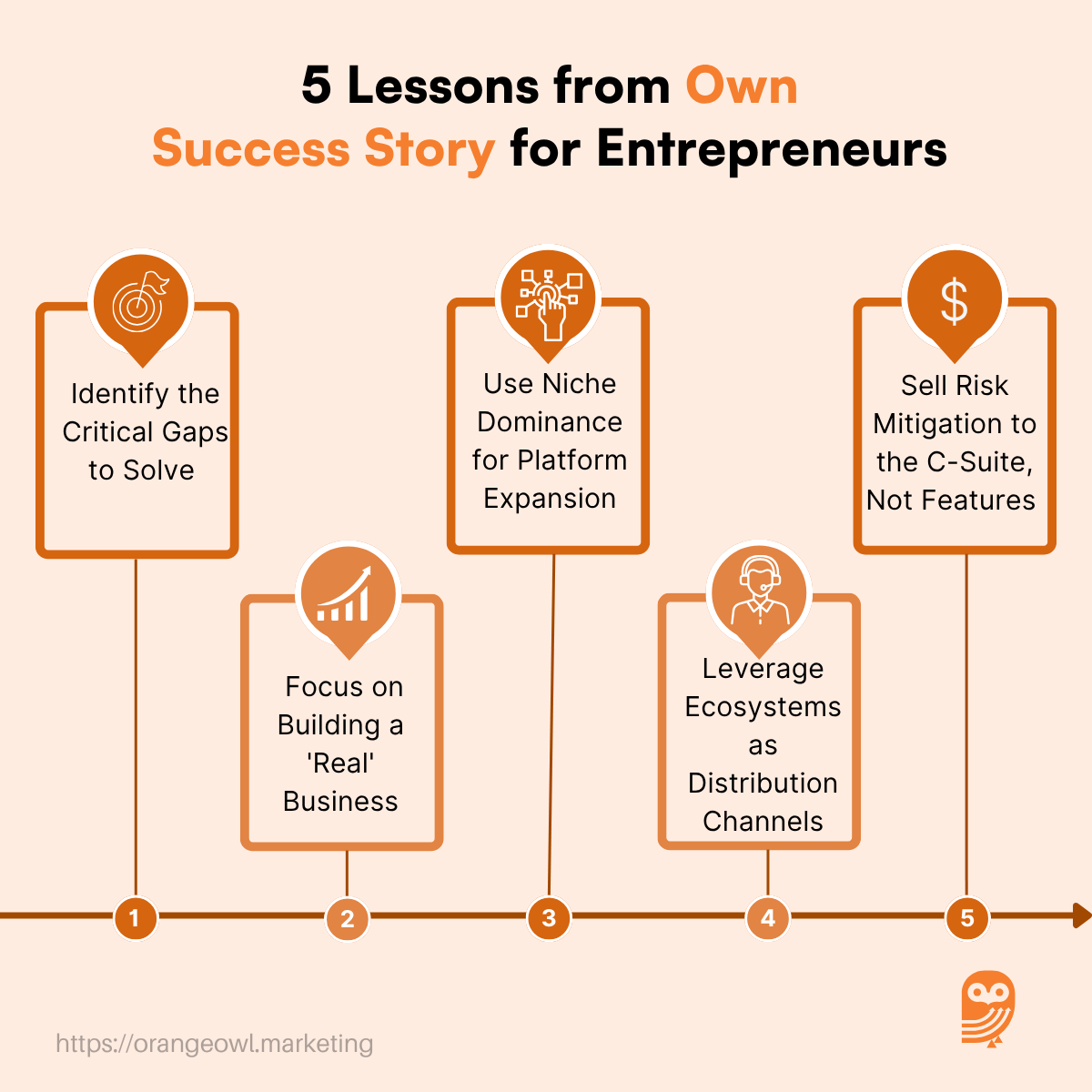
3. Sell Risk Mitigation to the C-Suite, Not Features to the Admin
In B2B, especially for infrastructure products, the most effective marketing takeaway is to sell certainty and compliance. Own successfully framed its product not as a backup utility, but as disaster recovery, compliance insurance (SOX, GDPR, HIPAA), and cyberattack mitigation, selling directly to the executive fear of legal liability, system downtime, and brand damage.
4. Leverage Ecosystems as Distribution Channels
By deeply integrating with the Salesforce AppExchange and becoming the top-rated solution, Own turned a potential competitor into a primary distribution partner. This minimized customer acquisition costs and provided immediate, trusted access to their ideal enterprise customer base. This strategy reduces friction with the host platform and leverages its market reach.
5. Focus on Building a ‘Real’ Business Over Hype
The repeated success of Sam Gutmann as a second-time entrepreneur emphasizes the importance of focusing on “real customers, a real business, real revenue,” a strategy that prioritizes defensibility, domain expertise, and enterprise-grade security and compliance over rapid, unsubstantiated valuation hype. This approach ensures longevity and makes the company an eventual acquisition target rather than a flash in the pan.
Own Success Story Conclusion
Own’s journey provides a masterclass in building a B2B infrastructure giant. The primary takeaways from this case study are that specialization in a critical, non-negotiable area—data resilience—combined with a clear vision for multi-platform expansion, can transform a niche startup into a unicorn. They built a solution that was not a luxury, but a mandatory insurance policy for the modern enterprise, directly addressing the massive legal and financial risks of data corruption and loss.
As an integral part of Salesforce, Own’s technology is now positioned to protect and unlock the vast amount of data within the Salesforce Customer 360 platform, making data protection a first-class citizen in the new, AI-driven enterprise. Their future is one of deep integration and platform enhancement across all mission-critical cloud applications.
“This achievement reflects the dedication and vision of the entire Own team. We are driven to innovate and empower our customers to protect their data — and activate it to unlock historical insights and shape predictive outcomes.” – Sam Gutmann