Fanatics Success Story Introduction
The modern era of sports commerce is defined by Fanatics, a digital sports platform that has fundamentally changed how fans buy and engage with licensed merchandise. While the company’s origins date back to 1995, the Fanatics we know today was shaped by Michael Rubin, who acquired the company in 2011 and integrated his expertise in e-commerce and vertical commerce into the business.
Under Rubin’s leadership, Fanatics transitioned from a traditional retailer into a technology-driven powerhouse, securing exclusive partnerships with nearly every major professional sports league and team globally, including the NFL, NBA, MLB, and NHL. This aggressive, tech-first approach to a fragmented industry drove the startup to a staggering reported valuation of $25 billion as of late 2024, cementing its status as a massive unicorn and a dominant force in the sports ecosystem.
The purpose of covering this company’s growth story is to distill the hard-won lessons and strategic takeaways from Michael Rubin’s journey, offering an inspiring case study for aspiring entrepreneurs on how to achieve hyper-scale by focusing on a relentless work ethic, vertical integration, and an unshakeable “will to win”.
Origin Story
The genesis of Michael Rubin’s involvement in what became the modern Fanatics was driven by his vision for vertical commerce—controlling every part of the value chain from manufacturing to the final customer sale and a deep belief in the power of licensed sports products. He recognized that the existing model was slow and fragmented, leaving money on the table whenever a sports event created sudden, massive demand (e.g., a championship win). Rubin aimed to fix this supply chain gap, ensuring fans could get the right product, at the right time, with maximum speed.
The modern Fanatics is synonymous with Michael Rubin, the former CEO and current Executive Chairman. Rubin’s background is one of a serial entrepreneur and prodigious hustler. Starting at just 8 years old, he ran his own businesses, hiring neighborhood kids to shovel snow and demonstrating an early and powerful lesson in commerce:
“I’ve worked nonstop since I’ve been 8 years old and I felt like it’s the greatest honor in the world.”– Michael Rubin
Before Fanatics, Rubin built two other successful companies: GSI Commerce, which was sold to eBay for $2.4 billion, and his first major success, KPR Sports. This history of high-stakes startups provided the playbook for scaling Fanatics.
The core vision for Fanatics was to become the global digital sports platform, shifting the company’s focus from being a mere retailer to a tech-first, integrated partner for all major sports leagues. Their mission became centered on maximizing value for sports properties through three key pillars: licensed merchandise, trading cards (via Fanatics Trading Cards), and betting/gaming (via Fanatics Betting & Gaming). The overarching goal was to serve the fan wherever they are, building a 24/7/365 relationship with the fan base.
Business Space and Early Challenges
Fanatics operates within the licensed sports merchandise and broader digital sports commerce industry. This space is high-volume, global, and hyper-seasonal, driven entirely by team performance and calendar events. The traditional industry was plagued by slow manufacturing, excess inventory risk for retailers, and stock-outs for hot items. Fanatics’ competitors include Nike, Adidas (for apparel manufacturing), and smaller independent retailers.
The central challenge for any company in this space is managing real-time, unpredictable demand. A single game-winning play can create millions of dollars in instant demand for a new t-shirt or jersey. The old supply chain could not react quickly enough, which created massive friction and lost revenue.
Rubin’s journey wasn’t without setbacks, an important lesson for any entrepreneur. Prior to Fanatics, his stock in a previous company had been worth $250 million, but a market downturn caused it to drop by 90%, giving him a negative net worth. Facing such failure hardened his resolve and underscored the need for resilient, flexible business models—a principle he later applied to Fanatics’ supply chain. He overcame this by maintaining his core entrepreneurial drive and later selling that company for billions.
Growth Strategies
Fanatics pursued an aggressive strategy of exclusive, long-term partnerships with leagues, teams, and athletes. They effectively told sports organizations: We will be your single, dedicated e-commerce partner, handling all your logistics, fulfillment, and manufacturing, allowing you to focus on the game. In return, Fanatics gained immense market exclusivity and scale, a powerful takeaway for platform startups.
Unique Strategic Moves
The company’s most unique strategic move is its V-Commerce (Vertical Commerce) model, which controls the entire merchandise flow. This includes:
Manufacturing: Producing licensed apparel in-house or through closely controlled partners.
Logistics: Operating a massive network of distribution centers.
Data/Tech: Using sophisticated data analytics to forecast demand and automate fulfillment.
This integration allows Fanatics to offer “Fanatics Live” (short-run apparel printed immediately after a major event, like a World Series win) a key component of their success story. This vertical control eliminated the inventory risk that crippled old retail models.
The sheer magnitude of the company’s valuation—$25 billion—and its market consolidation are the most telling metrics. Fanatics has become the official e-commerce operator for over 900 sports properties globally, demonstrating successful execution of their vertical integration and partnership strategy.
Marketing Strategies
Fanatics shifted the marketing focus from static, seasonal product drops to real-time, event-driven commerce. Their most innovative approach is making the product a real-time reflection of the news cycle. By being able to print a championship shirt minutes after a game ends and deliver it the next day, the product itself becomes a massive, viral marketing moment. This is a crucial lesson for modern startups: speed is a marketing tool.
Their core marketing channel is their exclusive relationship with the leagues. Every time an NFL team posts an official link to their store, it directs traffic to Fanatics. They use every major sports moment—a blockbuster trade, a new jersey reveal, or a record-breaking performance—as an immediate, non-traditional marketing campaign. They utilize digital ads and social media heavily, but their primary engine is the organic traffic generated by the sports news cycle.
The Fanatics brand identity is built on authenticity and speed. They are the trusted, official source for licensed gear. This trust is essential. By continually emphasizing their official partnerships, they instill confidence that their merchandise is legitimate, high-quality, and directly supporting the teams and leagues.
Scaling to Unicorn Status
The key milestones included:
2011 Acquisition: Michael Rubin integrates his e-commerce platform and vision with the existing Fanatics business.
V-Commerce Development: Massive investment in technology and manufacturing to create the vertical supply chain.
Exclusive League Partnerships: Securing multi-decade, exclusive rights with major leagues, creating an unmatchable market moat.
Diversification: Expanding the platform from merchandise into high-value adjacent sectors like trading cards and sports betting, ensuring long-term relevance and accelerating the path to the current $25 billion valuation.
The “Secret Sauce”
The “secret sauce” of Fanatics is the Tech-Driven V-Commerce Model coupled with an unparalleled Will to Win. Michael Rubin’s philosophy of outworking the competition and using common sense to solve complex supply chain problems is the engine. As he states:
This mindset transformed the company from a mere e-commerce site into the indispensable, vertically integrated infrastructure for global sports commerce, a powerful success story.
5 Key Lessons for Other Entrepreneurs
Fanatics’ dynamic growth and market domination offer a definitive case study in how strategic vision and relentless execution can transform a traditional industry. These are the critical takeaways for aspiring entrepreneurs and startups.
1. The Necessity of the “Will to Win” Philosophy
Michael Rubin’s explicit philosophy is dominated by the “will to win,” which he defines as outworking the competition, using common sense, and leveraging relationship skills. The fundamental lesson for any startup is that talent is rarely enough; sustained success stories are built on an enduring, almost obsessive commitment to competitive execution. This goes beyond long hours; it’s about making better decisions faster than the competition, which is driven by a deep, internal desire for victory.
2. Build a Vertically Integrated Moat, Not Just a Website
Fanatics’ most strategic takeaway is the implementation of the V-Commerce (Vertical Commerce) model. Instead of just operating a store, they own or control the entire supply chain, from manufacturing to logistics. This eliminated the historical problems of the sports merchandise industry (slow production, inventory risk, stock-outs). For entrepreneurs, the lesson is to look for the highest friction point in your industry and absorb it into your core business, creating a strategic moat that competitors cannot easily cross.
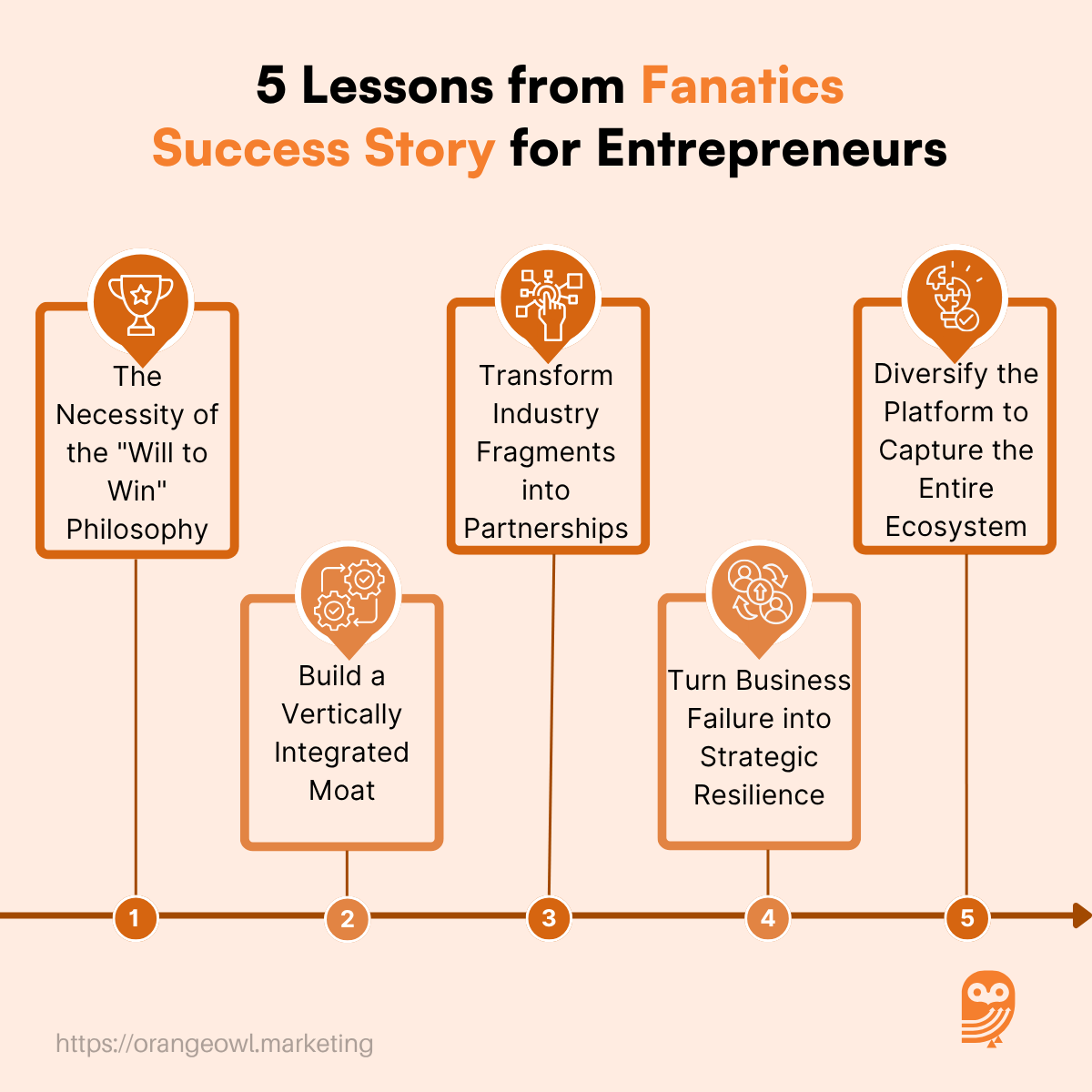
3. Transform Industry Fragmentation into Exclusive Partnerships
The sports commerce market was highly fragmented, with every team and league running its own small, inefficient merchandise operation. Fanatics consolidated this fragmentation by offering long-term, exclusive partnerships. This is a critical takeaway for B2B startups: instead of competing with the incumbents (the leagues and teams), offer to become their indispensable technological partner. By solving their complex operational problems, you gain exclusive access to their massive customer base, accelerating your success story.
4. Turn Business Failure into Strategic Resilience
Michael Rubin faced a dramatic low point where his previous company’s value dropped by 90%, giving him a negative net worth. The lesson here is that financial setbacks are often inevitable, but they build resilience and knowledge. The experience of managing extreme risk informed his strategies at Fanatics, which is built around mitigating inventory risk. Entrepreneurs must embrace failure not as an ending, but as tuition for a better, more robust future startup.
5. Diversify the Platform to Capture the Entire Ecosystem
Fanatics did not stop at apparel; they aggressively moved into trading cards and sports betting. This shows a sophisticated takeaway: once you have a dominant platform and massive customer data, use it to capture the entire customer ecosystem. The lesson for other startups is that the highest value lies in becoming the indispensable infrastructure for your entire industry, not just a single product line. By owning adjacent, high-growth categories, Fanatics ensured its long-term relevance and continued status as a dynamic case study.
Fanatics Success Story Conclusion
The Fanatics success story is a dynamic case study in operational ambition. The core takeaways are the importance of a vertically integrated supply chain, the strategic leverage gained from exclusive partnerships, and the relentless, founder-led pursuit of market dominance.
Fanatics is positioned to continue its expansion across all facets of the digital sports world. With a massive war chest and continued investment in technology and data, the company is striving to become a comprehensive digital sports platform, encompassing everything from merchandise to live engagement, securing its future as a global commerce leader.
For any aspiring entrepreneur, Michael Rubin’s journey offers a timeless lesson: success is not just about having a great idea, but about the relentless energy and conviction you bring to executing it. As a founder who embraced failure and emerged stronger, he proves that with a clear vision and an unyielding will to win, you can transform an entire industry and write your own legendary success story. His commitment to working nonstop since childhood, as he says, is a clear indicator of the dedication required for this level of success:
“I really was an awful student. Like I had every learning disability you could possibly have.”– Michael Rubin