
Niantic Success Story Introduction
Niantic is a visionary technology company that has fundamentally reshaped the landscape of mobile gaming and augmented reality (AR). The company was co-founded by John Hanke and Phil Keslin, both of whom leveraged their deep experience in mapping and engineering to create a unique space in the tech world. Hanke serves as the CEO, guiding the company’s strategic vision, while Keslin is the CTO, the architect of their underlying platform.
The company achieved massive unicorn status, reaching a peak valuation of $9 billion in November 2021, driven by the unprecedented global phenomenon of Pokémon GO. The purpose of examining this success story is to provide aspiring entrepreneurs with a clear understanding of the lessons learned from blending entertainment with spatial technology, highlighting the power of a long-term platform strategy.
Origin Story
Niantic was started with a profound belief in the power of real-world discovery. John Hanke observed a growing disconnection between people and their physical environment, driven by increasingly isolating digital experiences. He sought to use mobile technology not to distract from the real world, but to enhance it, encouraging people to explore, exercise, and connect with their communities. The initial concept aimed to merge digital engagement with the physical world, filling a fundamental gap in how technology interacts with location.
The company was co-founded by John Hanke and Phil Keslin. Hanke’s background at Google, where he led the Geo team (responsible for Google Maps and Google Earth), gave him the unique technological foundation and vision. Keslin, as the CTO, brought the engineering expertise needed to build the highly scalable, location-based infrastructure. Their combined experience created a powerful partnership essential for a technological startup of this magnitude.
Niantic’s initial vision, formulated while still operating as Niantic Labs within Google, was to use technology to enrich real-world experiences. Hanke recalls the core idea that drove the early team:
“The thing that we thought was really interesting was using technology to help you learn about the world.” – John Hanke
This vision extended beyond just gaming. The mission was to develop a geospatial AR platform-a digital map of the world overlaid with interactive experiences that would evolve to serve many applications, making the physical world more magical, informative, and social.
Business Space and Early Challenges
Niantic operates primarily in two high-growth, high-risk sectors: Augmented Reality (AR) gaming and Geospatial AR Platform development. The gaming side is highly competitive and relies on continuous innovation to maintain user attention. The platform side, Niantic Spatial Inc., positions the company as a key infrastructure provider for the future of spatial computing, a challenge that pits them against some of the world’s largest tech companies.
Early challenges for the startup included building a robust, massively scalable platform that could handle real-time location data for millions of simultaneous users. Unlike traditional mobile apps, Niantic’s products require constant interaction with the physical world, which presented hurdles in data accuracy, battery consumption, and global deployment across varying mobile networks. Furthermore, the cultural challenge was overcoming public skepticism about AR technology before its mass adoption.
Niantic’s first product, Ingress, was a critical test of their location-based technology, but it remained a niche success. The biggest struggle was transforming a successful internal Google project into an independent, profitable entity. This required the founders to secure significant funding and, crucially, a game-changing intellectual property partnership. Navigating this transition from a corporate incubator to a standalone startup is a crucial lesson in corporate spin-offs for entrepreneurs.
Growth Strategies
Niantic’s fundamental growth strategy has been Platform-First. They did not just build a game; they built the underlying platform—the Real World Platform (now Niantic Lightship)—which allows them to launch multiple games and partner-led experiences using the same core technology. This is a classic takeaway for modern startups: build an asset that can be leveraged across various products. Subsequent growth was driven by securing key Intellectual Property (IP), most notably the partnership with The Pokémon Company.
Unique Strategic Moves
The launch of Pokémon GO in 2016 was a defining, unique strategic move. By coupling their robust AR platform with one of the most beloved global IPs, they created a product that transcended gaming to become a cultural and social phenomenon. This masterstroke, achieved through relentless effort and strategic licensing, served as a case study in how a well-executed partnership can bypass traditional customer acquisition hurdles, leading to explosive growth.
The most striking metric of success is the $9 billion valuation achieved in 2021. More importantly for their long-term vision, Niantic measures success by the scale of its platform adoption and community engagement, demonstrated by Pokémon GO generating billions of dollars in lifetime revenue and driving users to physically walk billions of kilometers—a powerful metric of real-world impact. This revenue has provided the runway to keep developing their underlying platform.
Marketing Strategies
Niantic’s marketing is inherently innovative, relying almost entirely on the product experience itself. Traditional advertising takes a backseat to organic, community-driven viral loops. The excitement of finding rare in-game items in real-world locations or joining thousands of other players for massive in-game events creates a unique, self-sustaining marketing engine. Their approach has proven a significant takeaway for startups operating in digital and real-world spaces.
The most noteworthy campaigns are their in-game live events, such as “Pokémon GO Fest,” which have successfully mobilized millions of players globally to specific locations, turning cities into giant, interactive playgrounds. This is a modern case study in experiential marketing, blending digital rewards with real-world activity, thereby generating massive media attention and social media buzz with minimal traditional ad spend.
Niantic’s branding is centered on the concept of Adventure and Discovery. By using well-known IPs like Pokémon and Harry Potter, they instantly tap into existing fanbases, but their unique brand promise is that the adventure happens outside. The founders believe their greatest impact is helping people overcome challenges in the real world:
This focus on the real-world benefit—not just the digital product—is a powerful element of their brand identity.
Scaling to Unicorn Status
Niantic’s path to unicorn status was defined by several pivotal moments:
2010: Founding of Niantic Labs within Google, allowing for foundational technology development.
2015: Spin-out from Google, securing independence and initial major funding.
2016: Launch of Pokémon GO, a global phenomenon that validated the AR-location model.
2018-2021: Subsequent multi-billion-dollar funding rounds, fueled by Pokémon GO‘s sustained profitability, solidifying its unicorn status and pushing the valuation to $9 billion.
The “Secret Sauce”
Niantic’s secret sauce lies in its pioneering of geospatial platform technology and its unique philosophy of using technology to drive real-world activity. While most tech companies focus on maximizing screen time, Niantic deliberately created an incentive to explore. This focus on real-world movement and community formation, driven by the founder’s core mission, is the fundamental differentiator in their success story.
The commitment required for such a large-scale, complex technology is immense, as summarized by the founder when asked about the definition of ‘Grit’:
“Getting up more times than you’re knocked down.”– John Hanke
This resilience has been vital for a company constantly breaking new ground in a challenging technological space.
5 Key Lessons for Other Entrepreneurs
The Niantic journey offers invaluable takeaways and practical lessons for startups aiming for global scale and lasting impact.
1. Prioritize Platform Over Product for Longevity
Niantic’s long-term success story isn’t just about Pokémon GO; it’s about the geospatial AR platform—the Niantic Lightship—that was built beneath it. Many startups focus narrowly on a single application. Niantic’s lesson is to build a horizontal platform that enables multiple future applications and partnerships. This core technology becomes a defensible, revenue-generating asset that transcends the life cycle of any single consumer product. This strategic choice is a powerful case study for any tech entrepreneur.
2. Harness the Power of Authentic, Global IP
Pokémon GO was the proof point that validated the Niantic platform and turned it into a unicorn. The takeaway is that a transformative product often requires pairing cutting-edge technology with culturally resonant content. For entrepreneurs, this means seeking out strategic partnerships that provide instant, global recognition and a passionate, existing fanbase, dramatically lowering the cost and time required for mass adoption.
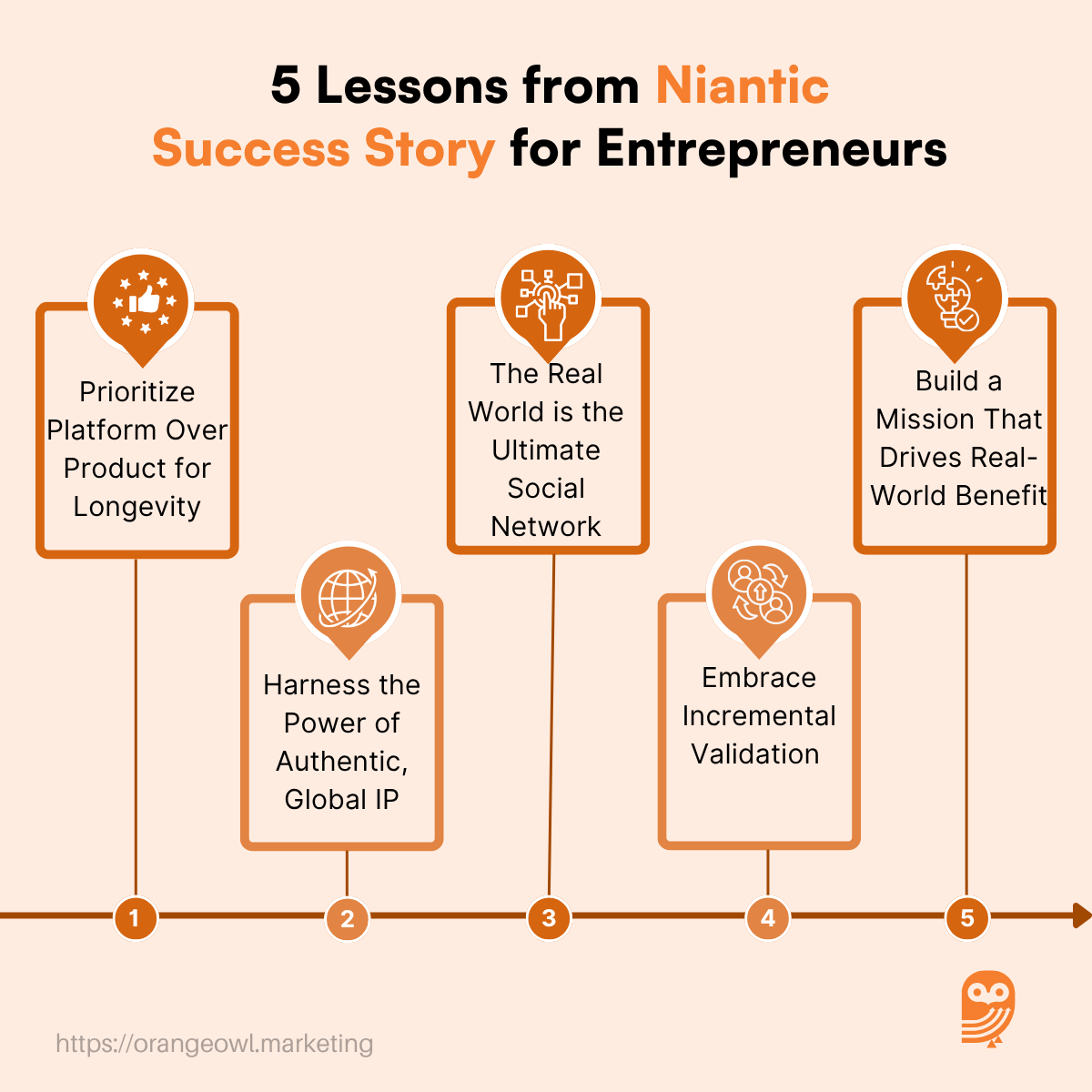
3. The Real World is the Ultimate Social Network
Niantic’s products are fundamentally social. By forcing players to move to physical locations, they create opportunities for real-world interaction, forming communities around shared goals (catching a rare Pokémon, solving a puzzle). The lesson here is that the future of digital engagement may lie in augmenting, not replacing, physical interaction. Startups should look for ways to use technology as a catalyst for real-world social connection, which is a powerful and unique value proposition.
4. Embrace Incremental Validation from a Skunkworks Approach
The company started as Niantic Labs, an internal startup within Google. This protected environment allowed the founders to experiment with ambitious, long-lead-time technology (geospatial AR) without the immediate pressure of external VC milestones. The takeaway for entrepreneurs is to find ways to de-risk highly novel concepts, whether through corporate partnerships, internal “labs” funding, or phased prototyping, before facing the highly demanding world of external venture capital.
5. Build a Mission That Drives Real-World Benefit
Niantic’s commitment to getting people outdoors, exercising, and exploring is more than marketing; it’s a mission. This mission provides strong internal alignment and creates an emotional connection with users, which fosters tremendous loyalty. The ultimate lesson for startups is that a mission focused on a tangible, positive human benefit (like health or community) can be a more powerful driver of long-term success stories than a mission focused purely on profit or feature development.
Niantic Success Story Conclusion
The Niantic success story provides clear takeaways for every aspiring entrepreneur. Their journey underscores the importance of a resilient, platform-first approach, the immense power of high-leverage IP partnerships, and the competitive advantage gained by using technology to enhance the real world rather than merely consuming screen time.
Having established the commercial viability of AR gaming, Niantic is now pivoting its core business to focus on its geospatial platform, officially known as Niantic Spatial Inc. The long-term plan involves positioning the company as the foundational technology provider for the open metaverse, shifting from consumer applications to an infrastructure play that powers hundreds of other applications globally.
Niantic’s journey is a powerful reminder that truly transformative startups are often those that take the biggest technical and creative leaps. For readers on their own entrepreneurial journey, embrace the challenges, learn from the failures, and remember that, like the entrepreneurs at Niantic, your ultimate lesson in grit is found in “getting up more times than you’re knocked down.”