
Clubhouse Success Story Introduction
In the landscape of social media, few startups have experienced the meteoric, overnight rise quite like Clubhouse. The audio-only application, founded by Paul Davison and Rohan Seth, burst onto the scene in early 2020, becoming a phenomenon during the global lockdowns. By April 2021, a mere year after its launch, the company achieved an astounding $4 billion valuation, solidifying its status as a unicorn and an immediate, compelling case study in hyper-growth social networking.
The purpose of covering this incredible success story is to dissect the journey of the platform, offering critical takeaways and practical lessons for aspiring entrepreneurs looking to innovate and scale rapidly in the competitive tech space.
Origin Story
The idea for Clubhouse was born from a decade of prior experience and a continuous focus on the social connectivity space. The founders saw a gap in the market for a medium that combined the nuance and intimacy of the human voice with the scalability of a social network. They believed that while text and visual posts had dominated social interaction, the authentic, real-time nature of audio was a missing piece.
The company was founded by Paul Davison, a seasoned entrepreneur who previously founded the location-based social app Highlight (acquired by Pinterest), and Rohan Seth, a former Google engineer who also founded Memry Labs. Their combined technical expertise and product vision formed the perfect partnership for creating a disruptive social platform. As Davison recounted his journey:
Clubhouse’s initial vision was not just to create a new way to communicate, but to foster deeper human connection. Their ultimate, enduring mission is focused on increasing genuine interaction. Paul Davison articulated this foundational purpose:
This core mission of fostering authentic connection guided every product decision, from the initial invite-only gating to the design of the virtual “rooms.”
Business Space and Early Challenges
Clubhouse entered the crowded “social networking” sector, but carved out a unique niche as a “social audio” platform. This was a relatively undeveloped space, allowing them to quickly define the category. Their novelty was their greatest asset, but also their biggest challenge.
Initially, the biggest challenge was defining the product’s value proposition. Without the polished visuals of Instagram or the rapid-fire text of Twitter, Clubhouse had to convince users that listening to unstructured, long-form conversation was a valuable use of their time. Other challenges included managing the massive, unexpected server load that came with rapid scaling and fending off numerous competitors who swiftly launched copycat features.
The most crucial early struggle was managing community quality and user experience, especially during the exclusive, invite-only phase. The initial exclusivity fueled hype, but it also meant that not all new users had a good onboarding experience, a critical lesson for any burgeoning social startup.
This early lesson in user segmentation was vital for future product refinements.
Growth Strategies
Clubhouse’s initial growth strategy was a masterclass in controlled scarcity. The invite-only model for iOS users created immense FOMO (Fear of Missing Out), transforming every early user into a de facto growth agent. This strategy allowed them to scale their infrastructure gradually while concentrating their initial user base among key influencers, venture capitalists, and high-profile entrepreneurs.
Unique Strategic Moves
The company’s most unique strategic move was its focus on high-profile content. By attracting influential figures like Elon Musk, Mark Zuckerberg, and Oprah Winfrey to host rooms, Clubhouse instantly created viral marketing moments. These events functioned as high-value case studies in the power of live audio, drawing millions of global users to search for the app. The sheer caliber of speakers turned the platform into a must-join for ambitious startups and business leaders.
In the early days, the key metrics of success were not merely user counts, but minutes of audio consumed and repeat hosting/joining rates. These metrics proved the platform was driving engagement and habit formation, the true signs of a durable social network. The rapid succession of successful funding rounds, culminating in a $4 billion valuation, was a clear external metric of the investor community’s belief in the company’s trajectory.
Marketing Strategies
Clubhouse avoided traditional, costly performance marketing (like paid ads). Instead, their approach was 100% reliant on a powerful, innovative blend of exclusivity and organic virality. They let the community and the content itself do the heavy lifting.
Their “campaigns” were organic, often tied to a single, high-profile event. For instance, an interview with a major tech CEO would instantly become a global news story, driving massive spikes in sign-ups without a dollar spent on advertising. The initial exclusivity on the iOS App Store, though a constraint, also acted as a form of innovative channel, creating a secondary “invitation marketplace” that kept the brand constantly in the news cycle, a powerful takeaway for modern startups.
The brand identity was built on being the “digital town square” for smart, ambitious people. The initial logo (a rotating image of a notable community member) and the clean, audio-focused interface reinforced this brand of intellectual curiosity and human connection. This narrative differentiated them from established visual and text-based platforms and formed the bedrock of their success stories.
Scaling to Unicorn Status
The path to unicorn status was incredibly fast:
April 2020: Launch and initial seed funding.
December 2020: Achieving a $1 billion valuation in a Series B round, making it a unicorn.
April 2021: Reaching a peak $4 billion valuation after a Series C round led by Andreessen Horowitz.
Mid-2021: Launching the Android app, removing the invite-only requirement, and beginning international expansion.
These funding milestones demonstrated that the initial hype was backed by significant investor confidence in the platform’s long-term potential as a premier destination for entrepreneurs and thought leaders.
The “Secret Sauce”
The “secret sauce” was timing combined with a unique product. The timing—during a period of global isolation and a thirst for authentic, unscripted human interaction—was perfect. The unique product, a simple, low-effort way to join a conversation, provided the key to unlocking this massive pent-up demand. Their ability to attract and retain high-quality content creators was the true key to their sustained, albeit fluctuating, success.
5 Key Lessons for Other Entrepreneurs
This case study provides five invaluable lessons for any founder or team building the next generation of startups:
1. Embrace Controlled Scarcity (Initial Hype-Building)
Clubhouse successfully weaponized FOMO. For early-stage products, limiting access can create powerful organic buzz, allowing the company to carefully stress-test infrastructure and community standards before a mass rollout. This intentional constraint is a powerful growth driver and an important takeaway.
2. Focus on Content Quality, Not Just Quantity (The 80/20 Rule)
By concentrating their initial efforts on attracting high-value speakers, Clubhouse ensured that even a small user base had access to world-class content. This drew an influential audience that then became a self-sustaining magnet for other thought entrepreneurs. Quality over quantity should be the mantra for new platforms.
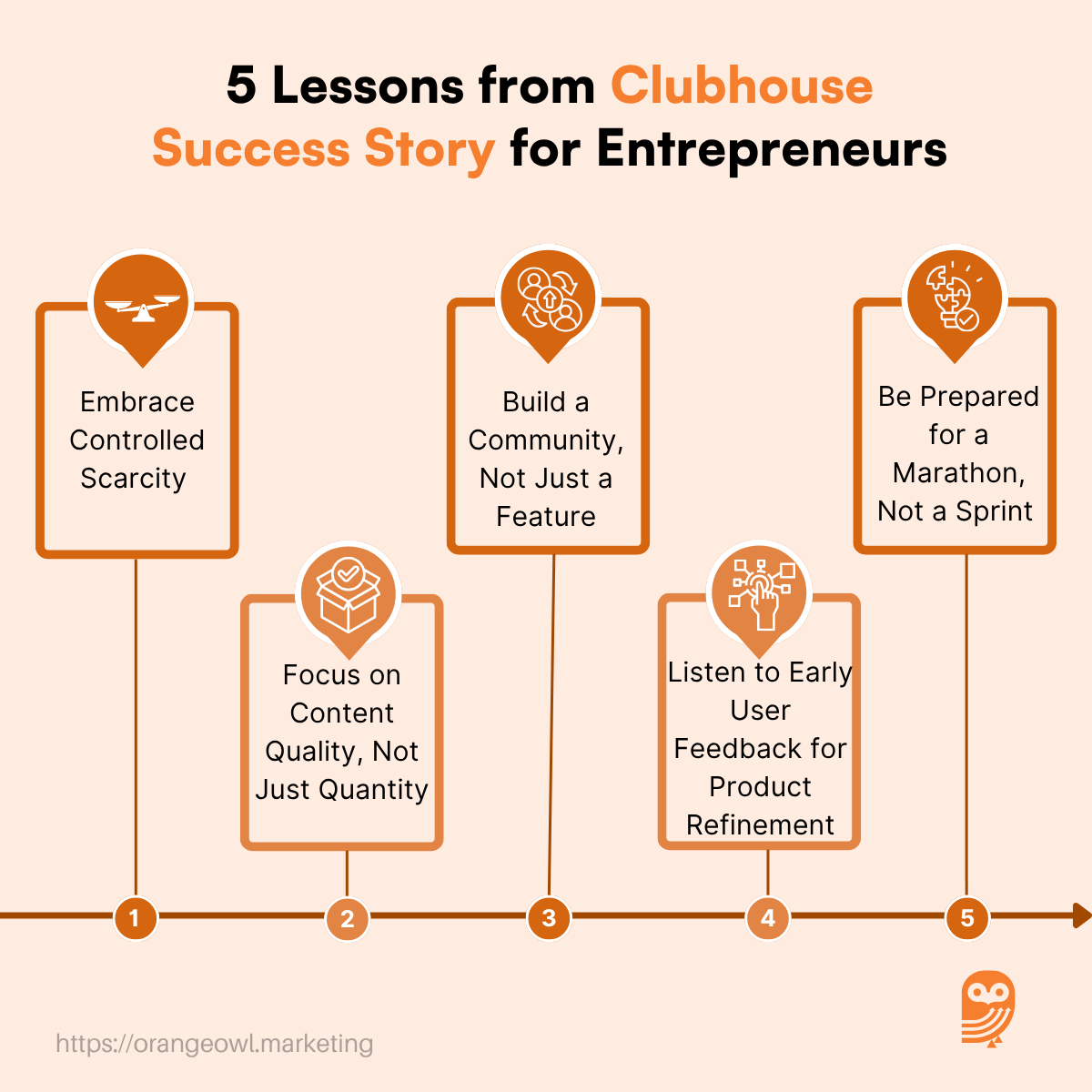
3. Build a Community, Not Just a Feature (Retention is King)
The company understood its mission was about friendship, not just talking. For a social platform, the product must facilitate relationships. The earliest lessons learned about user experience were critical: they continuously invested in tools that helped users find rooms, connect with speakers, and build recurring audiences, all aimed at improving long-term retention.
4. Listen to Early User Feedback for Product Refinement (Iterative Development)
The quote from the founder about the mistake of treating every user the same is a powerful lesson in product iteration. Successful startups must quickly differentiate their user base and tailor the experience (e.g., to hosts vs. listeners) to maximize value for all parties. They adapted their app quickly based on this feedback, allowing them to rapidly fix critical pain points.
5. Be Prepared for a Marathon, Not a Sprint (Sustained Innovation)
While the initial spike was a sprint, sustaining a tech success story is a marathon. The emergence of competing products from larger tech giants forced Clubhouse to constantly innovate, remove the initial constraints, and build in new features like direct messaging and recording capabilities. The real lesson is that scaling requires a long-term commitment to innovation, even after the initial hyper-growth phase.
Clubhouse Success Story Conclusion
The Clubhouse success story provides an exceptional case study in modern social platform development. The core takeaways revolve around the strategic use of exclusivity, the power of high-quality content, and the necessity of rapid product iteration based on early user segmentation. The journey shows that even in saturated markets, a truly novel medium, combined with perfect timing, can create a multi-billion dollar business. For entrepreneurs and startups, this experience provides concrete lessons in how to capture global attention and build a product that taps into a fundamental human need: authentic connection.
Having moved beyond the early hype cycle, Clubhouse is focused on its long-term future: evolving from a high-profile, exclusive event space to a scalable, everyday utility for voice interaction. The future involves embedding audio more deeply into the fabric of daily online life.
The company’s rapid ascent from a small team of founders to a multi-billion dollar unicorn is a powerful reminder for every aspiring entrepreneur. The journey to success is often non-linear, but it is always driven by a clear vision and a relentless focus on solving a core human problem. If you stick with your mission—as Paul Davison noted, even after “a decade” of building social apps—magic can happen.