Runway Success Story Introduction
Runway, the company spearheading the revolution in generative Artificial Intelligence for content creation, is one of the decade’s most compelling success stories. Co-founded by Cristóbal Valenzuela, Anastasis Germanidis, and Alejandro Matamala, the company has quickly established itself as the indispensable tool for filmmakers, designers, and marketers, proving that complex AI can be both powerful and accessible. Founded in 2018, Runway officially achieved unicorn status in June 2023, following a substantial $141 million Series C funding extension, solidifying its valuation at over $1 billion. This rapid and transformative growth makes Runway an invaluable case study in modern technological disruption, providing critical lessons for aspiring entrepreneurs aiming to build the next generation of creative startups.
Origin Story
The foundation of Runway was born from a deep-seated belief that advanced technology should empower, not intimidate, artists. The founders saw a fundamental disconnect: the rapid advancements in machine learning were locked away in research labs, inaccessible to the creative professionals who could benefit from them most. They recognized the market gap was not for another piece of video editing software, but for a whole new type of creative partner; one that used AI to eliminate mundane technical tasks and unlock unprecedented new forms of visual expression.
The three co-founders, Cristóbal Valenzuela (CEO), Anastasis Germanidis (CTO), and Alejandro Matamala (Chief Design Officer), met while pursuing their master’s degrees at the Interactive Telecommunications Program (ITP) at NYU’s Tisch School of the Arts. This shared background—sitting at the intersection of technology and art—was pivotal. Their academic environment encouraged experimentation, allowing them to fuse their skills in design, engineering, and creative computing to lay the groundwork for a truly unique product.
The initial vision was to “democratize creativity” by building tools that made powerful machine learning models instantly usable by anyone. The mission was to translate complex AI algorithms into simple, intuitive interfaces, turning a year’s worth of post-production work into a matter of minutes. This focus on empowering the user above all else is a key lesson for B2B and B2C startups alike: the technology itself is only as valuable as its ease of use.
Business Space and Early Challenges
Runway operates in the hyper-competitive and rapidly evolving space of Generative AI and Creative Technology. The company is not just a video editor but a foundational model company, competing with internal research efforts at tech giants and other well-funded startups. The market demand for video content—driven by social media, marketing, and entertainment—has never been higher, providing a massive tailwind for a tool that accelerates production.
The early days were fraught with specific challenges inherent to the Generative AI space:
Computational Cost: Training and running large AI models like the ones Runway develops is immensely expensive.
Quality vs. Speed: Achieving high-fidelity, high-resolution video that can be generated quickly remains a constant technical balancing act.
Ethical Algorithmic Design: Ensuring the models are fair, unbiased, and responsible.
Regarding this last point, CEO Cristóbal Valenzuela emphasized the built-in safeguards of the product experience, offering a valuable takeaway for all new entrepreneurs:
Like many deep-tech startups, one of Runway’s initial struggles was proving the commercial viability of a research-heavy product. They had to transition from an “experimental hub,” as described by Valenzuela, to a robust, scalable enterprise tool. This meant securing early funding from visionary investors who understood that the true return would come from building a technological moat around their generative models. Their journey is a classic case study in navigating the transition from a novel idea to a sustainable business.
Growth Strategies
Runway’s growth was driven by a powerful Product-Led Growth (PLG) strategy, centered on viral, jaw-dropping technology. Their broad strategies included:
Iterative Model Releases: Constantly releasing newer, more powerful versions of their core models (Gen-1, Gen-2, Gen-3) which generated immense media and user buzz.
Community Development: Hosting major creative challenges and film festivals (like the Gen:48 competition) to turn users into evangelists.
Strategic Funding: Raising capital from investors who understood the long-term play of owning foundational AI models.
Unique Strategic Moves
Runway’s most unique move was its steadfast focus on the creative professional first. While many AI startups aimed for enterprise or general consumer markets, Runway deeply integrated itself into the worlds of film, design, and art, ensuring their tool felt like a native extension of the creative process. This focus allowed them to build a highly engaged, high-signal user base. Cristóbal Valenzuela reflected on the evolution of their product:
The most apparent metric of their success is the $1 billion+ valuation and the high-profile adoption of their tools across various industries, from indie filmmakers to major Hollywood studios. Furthermore, the volume and quality of videos generated by their users—which often go viral—serve as a constant, organic demonstration of the product’s value, confirming this is a compelling success story.
Marketing Strategies
Runway minimizes traditional marketing spend. Their most effective approach is innovative: letting the product market itself. The moment a user creates something truly new or impossible with their tool, that piece of content becomes a viral advertisement. They rely on the “wow” factor of generative AI to drive organic adoption, a key lesson in branding for modern startups.
The company’s most impactful “campaigns” are the releases of their new models (Gen-1, Gen-2, etc.). Each release is an event, positioning Runway as the innovation leader. They focus on channels where creators congregate: Twitter, YouTube, Discord, and professional film/VFX communities.
Runway’s branding is centered on empowerment and limitless possibility. They don’t just sell a feature; they sell a new creative superpower. Their brand narrative is the modern success story of the creator who can now execute their vision without technical or financial barriers.
Scaling to Unicorn Status
Runway’s journey to unicorn status was characterized by significant funding rounds that quickly escalated their valuation. The $141 million Series C extension in 2023, led by major venture capital firms, was the decisive moment that crossed the $1 billion threshold. This funding demonstrated investor confidence not just in their current product, but in their position as a long-term leader in foundational AI.
The “Secret Sauce”
Runway’s ultimate “secret sauce” is the user interface (UI) that sits on top of their powerful AI models. They solved the critical problem of translating complex machine learning into simple, intuitive tools. Their focus is not just on the algorithm but on the experience, which is a powerful takeaway for all technical startups. CEO Cristóbal Valenzuela highlighted the importance of this:
5 Key Lessons for Other Entrepreneurs
Runway’s experience provides a rich pool of takeaways and practical lessons for ambitious entrepreneurs and early-stage startups, particularly those in deep technology fields.
1. The Interface is the Technology (The Democratization Lesson)
Runway understands that the best AI is useless if the average creator cannot wield it effectively. Their core lesson is that the user interface, design, and user experience (UX) are as crucial, if not more so, than the underlying algorithm. They invested heavily in making complex models accessible via a simple, visually appealing, and intuitive online platform.
Actionable Takeaway: For technical startups, your competitive moat is often not just what your technology can do, but how easily people can do it. Prioritize design-led engineering; turn complexity into simplicity to achieve mass adoption. This is a vital lesson illuminated in this case study.
2. Embrace the ‘Magic’ of Product-Led Growth
Runway’s most effective marketing is the viral nature of its output. When a user creates something truly mind-bending—a fantastical video from a simple text prompt—they share it. This virality drives immediate, high-quality sign-ups.
Actionable Takeaway: Design your product to generate a result that is instantly shareable and induces a “wow” factor. This organic, product-led engine is exponentially cheaper and more powerful than any traditional ad campaign. Focus on the core transformation your product offers and make the evidence of that transformation easily distributable.
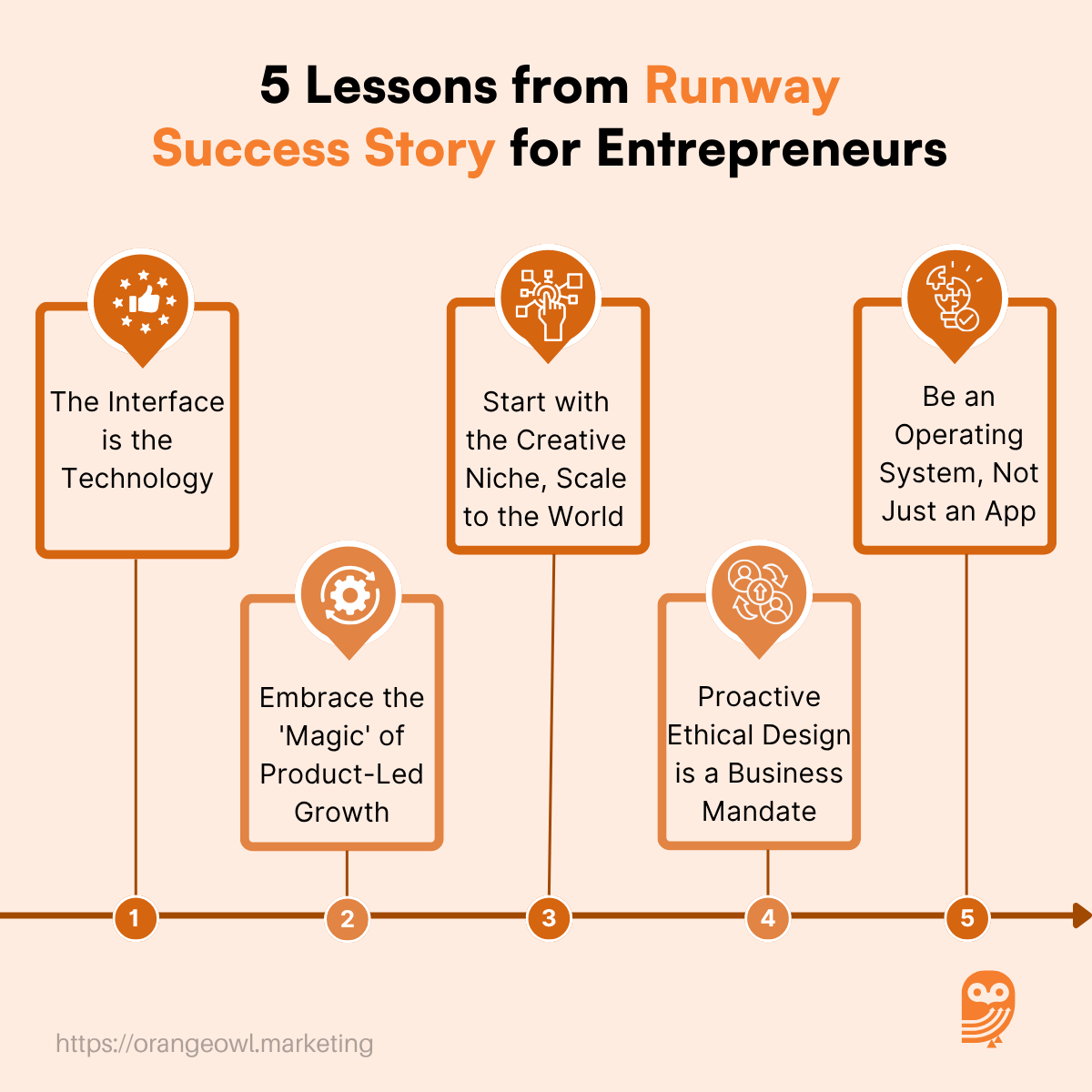
3. Start with the Creative Niche, Scale to the World (The Focus Lesson)
By targeting the art and film communities first, Runway built a passionate, early-adopter user base that provided the highest-quality feedback. These users were willing to endure early bugs because the utility for their specific craft was so high.
Actionable Takeaway: Don’t try to build a solution for everyone on day one. Focus on a narrow, deeply engaged niche—the users with the hardest problem—and delight them. Once you have a polished tool that works for the most demanding users, expanding to the broader enterprise or consumer market becomes a natural path to scaling your success story.
4. Proactive Ethical Design is a Business Mandate (The Algorithmic Responsibility Lesson)
The Generative AI space is rife with ethical and legal questions (e.g., copyright, bias, deepfakes). Runway’s commitment to building models that avoid bias or simply “don’t work” when trained poorly, as stated by Valenzuela, is a proactive approach that builds long-term trust and a more robust product.
Actionable Takeaway: Entrepreneurs in AI must treat ethical and responsible design as a core product feature, not an afterthought. Building trust prevents future legal and public relations disasters and creates a more durable case study for future startups.
5. Be an Operating System, Not Just an App (The Platform Lesson)
Runway’s vision extends beyond a single tool; it is a platform that hosts many AI models and is intended to be the central hub for the entire creative workflow. This mindset allows them to capture more value per user and build a larger ecosystem.
Actionable Takeaway: Entrepreneurs must think beyond their first successful feature. Ask: “How does this feature become a platform? How can I enable other products to be built on top of my core technology?” This approach creates a powerful network effect and is a fundamental step toward achieving unicorn status.
Runway Success Story Conclusion
Runway’s journey from an NYU art project to a billion-dollar unicorn is a monumental success story that defines the new era of generative AI. The key takeaways are clear: the future of startups is built on deeply fusing technology and design, prioritizing the user experience over technical complexity, and using product innovation as the primary marketing engine.
The company is relentlessly focused on advancing its foundational models, promising even more sophisticated and realistic video generation capabilities. As the demand for video content explodes, Runway is positioned not just to be a tool, but to fundamentally redefine the economics and workflow of creative production globally.
For all entrepreneurs and founders of technical startups: Runway proves that the greatest lessons are often learned at the intersection of disciplines. By merging the rigor of engineering with the empathy of design, you can build products that truly feel like magic. Have the courage to build the future you believe in, and your success story will inspire countless others.