
Newfront Insurance Success Story Introduction
In the heart of Silicon Valley’s disruptive startups landscape, where digital innovation meets traditional industry, Newfront Insurance has emerged as a financial technology powerhouse. Co-founded by entrepreneurs Spike Lipkin and Gordon Wintrob in 2017, Newfront set out to digitize the traditionally antiquated commercial insurance brokerage business. By blending a modern technological platform with the expertise of seasoned brokers, they created a unique, data-driven approach.
Newfront Insurance’s groundbreaking journey reached a major milestone when it achieved unicorn status with a valuation of $2.2 billion in March 2021, solidifying its position as one of the fastest-growing insurance startups in the U.S. This case study on Newfront’s growth is a critical source of inspiration, offering a powerful lesson and practical takeaways for every aspiring founder seeking to disrupt established markets.
Origin Story
The idea for Newfront was born from a fundamental belief that the insurance industry was due for a technological overhaul. The founders recognized that while technology was rapidly advancing in nearly every other financial sector, commercial insurance relied heavily on decades-old, manual processes.
The initial goal was not to replace the broker, but to augment them to provide an intuitive, modern platform that could eliminate administrative burdens and allow human experts to focus purely on client consultation and service. This was a core lesson in strategic disruption: don’t automate the impossible; empower the expert.
The firm was founded by entrepreneurs Spike Lipkin (CEO) and Gordon Wintrob (CTO). Lipkin brought a background in finance and high-growth startups, having worked as an investor at Blackstone and helping Opendoor.com scale from a five-person company. Wintrob, with a deep technical background, provided the engineering vision necessary to build a proprietary, industry-specific platform. Their complementary skills—business scaling and technical innovation—formed the perfect foundation for a modern insurance brokerage’s success stories.
The initial mission was to build the best possible client experience by creating a single, integrated platform that handled everything from quoting and data analysis to policy management.
In the words of founder Spike Lipkin, reflecting on the iterative and user-centric approach they took:
This fast, iterative development became a key initial takeaway for the new breed of broker-technologists they cultivated.
Business Space and Early Challenges
Newfront Insurance entered the massive, highly regulated commercial property and casualty (P&C) insurance market. This industry, though crucial, is often characterized by information asymmetry and a resistance to change, making it ripe for a technology-focused case study.
Newfront positioned itself as an “insurance platform,” a term intended to signal that they were a software company that happened to sell insurance, fundamentally differentiating them from traditional brokerages.
One of the biggest hurdles was integrating technology into a deeply entrenched human-relationship business. Insurance buyers expect personalized, expert advice—they don’t want a purely automated chat-bot solution. Early challenges included convincing top-tier, established brokers to leave old firms for a tech startup, and simultaneously proving to clients that a new company could handle complex risk management better than industry stalwarts. The dual-sided challenge required mastering both technology and talent acquisition.
Like many startups, Newfront Insurance faced the classic chicken-and-egg problem: they needed great brokers to attract great clients, and they needed a proven platform to attract great brokers. The solution was the rapid feedback loop described by Lipkin, where the first handful of hires were deeply involved in shaping the product, creating a compelling sales pitch for future hires: “Come here and build the future of your own job.” This proved to be an invaluable lesson.
Growth Strategies
Newfront’s scaling strategy was a masterclass in combining organic growth with strategic consolidation. Their core approach centered on hiring experienced, high-performing brokers and equipping them with proprietary technology that instantly made them more efficient. This allowed brokers to handle more clients with higher quality service, dramatically improving unit economics—a vital takeaway for other tech startups.
Unique Strategic Moves
The most unique and powerful move was the merger with ABD Insurance and Financial Services in 2020. ABD was a long-established, highly respected West Coast firm. This move instantly solved two major problems: it provided Newfront with thousands of established clients and a vast team of veteran brokers, catapulting its revenue and market presence overnight.
Spike Lipkin noted the strategic synergy, framing it as a search for complementary expertise:
This strategic combination is one of the most compelling recent case studies in the FinTech world.
Post-merger, the company’s growth accelerated dramatically, culminating in the $2.2 billion valuation and unicorn status. Key performance indicators centered on broker efficiency (revenue per broker) and platform adoption rate, demonstrating that the tech-plus-human model was superior to traditional brokerage models.
Marketing Strategies
Newfront Insurance employed a hybrid marketing strategy. Traditionally, insurance brokerage marketing is hyper-local and relationship-driven. Newfront retained this by hiring brokers with deep community ties. The innovative part was their focus on employer branding and thought leadership.
Instead of heavy client-side advertising, Newfront primarily focused on attracting the best talent. Their platform itself was the core “product,” and their marketing efforts were directed at showing experienced brokers why the Newfront platform was superior. This approach drove powerful internal success stories that led to organic external growth.
Newfront’s branding emphasized transparency, technology, and trust—often lacking in the old-guard insurance sector. They published data and insights from their platform, using content to demonstrate their technological edge, which served as a powerful lesson in industry expertise.
Scaling to Unicorn Status
The journey to unicorn status was marked by three key milestones:
2017-2019: Building the proprietary technology and proving the broker-empowerment model with a small, elite team.
2020: The transformative merger with ABD Insurance, providing immediate scale and market depth.
2021: Securing a major funding round that validated their hybrid model, officially marking the company as a unicorn.
The “Secret Sauce”
Newfront Insurance’s secret sauce lies in its commitment to the human-technology hybrid. They didn’t view technology as a replacement for expert advice but as a tool to unlock human potential. By creating a unified digital experience, they solved the broker-client communication and data-flow problem, ensuring brokers could deliver high-touch service backed by high-tech efficiency—a major lesson for B2B startups.
Spike Lipkin often stressed the importance of continuous learning, even from rivals:
This ethos of open learning fueled their rapid development and cultural integration.
5 Key Lessons for Other Entrepreneurs
The Newfront story provides crucial takeaways and lessons for aspiring entrepreneurs looking to build billion-dollar startups in traditional sectors.
1. Target the “Under-Automated” Expert, Not the End-User
The company’s immediate focus was not on making insurance simpler for the client, but on making the broker’s job simpler. By increasing broker efficiency and reducing their administrative load, Newfront created a superior intermediary, which naturally led to a better client experience.
Entrepreneurs should identify the highly paid, highly skilled expert in their target industry and build a platform that dramatically enhances their productivity. This is a foundational lesson in scaling a professional services startup.
2. Embrace the Fast Feedback Loop as a Product Foundation
As evidenced by Lipkin’s quote, Newfront Insurance’s early success was a direct result of placing product developers and users (brokers) side-by-side. The ability to “fix it and send it back to them” within minutes turned product development into a real-time, high-speed iteration engine.
This creates a culture where the product is perpetually aligned with user needs, a clear takeaway for any founder building B2B software.
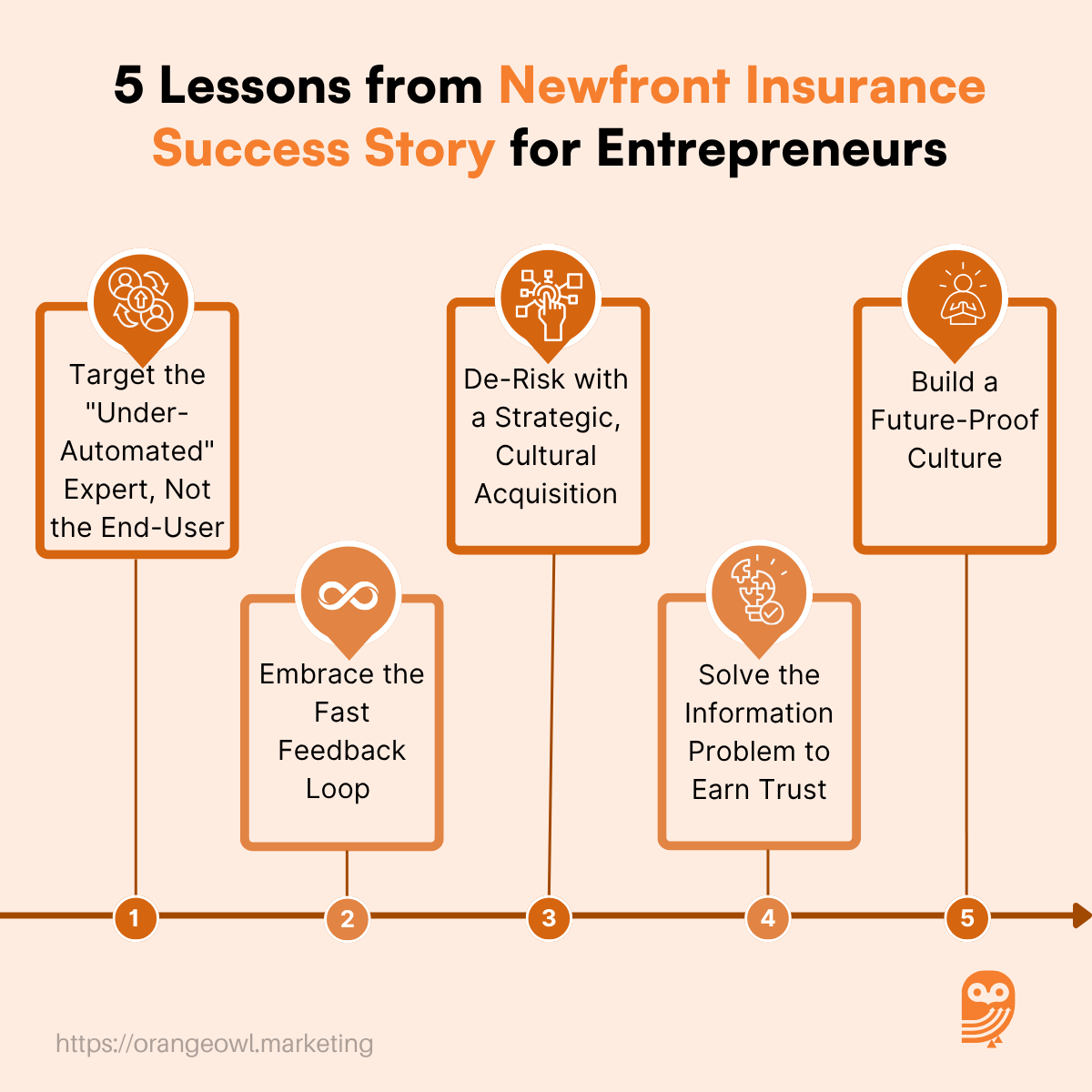
3. De-Risk with a Strategic, Cultural Acquisition
The merger with ABD was not a simple acquisition; it was a strategic combination of technology and talent. It was a massive de-risking move that provided instant scale and credibility in a relationship-driven industry.
While organic growth is key, recognizing when a merger provides necessary cultural capital and deep industry knowledge—not just revenue—is a powerful lesson from this case study. It accelerated their path to a true success story.
4. Solve the Information Problem to Earn Trust
The insurance industry thrives on proprietary, siloed information. Newfront’s platform immediately provided a unified, transparent view of markets, quotes, and client history. This transparency—or “data-driven advice”—transformed the broker from a data-gatherer into a strategic advisor.
The lesson here is that in complex, highly compensated professional services, trust is built on your ability to synthesize and present information better than anyone else.
5. Build a Future-Proof Culture
Newfront focused on a culture that celebrates both the veteran broker’s experience and the young engineer’s innovation. The early team’s practice of getting together for drinks (as mentioned in the transcript) shows the importance of building a unified community.
The takeaways for entrepreneurs are that culture isn’t a poster on the wall; it’s a living feedback loop where different professional archetypes feel equally valued and inspired to collaborate.
Newfront Insurance Success Story Conclusion
Newfront Insurance success story is one of the most compelling modern case studies in business transformation. It offers a clear lesson: industries perceived as “un-disruptible” are often the most fragile. Their success stories prove that the true disruption comes not from eliminating the expert but from empowering them with technology that removes antiquated, manual work. The core takeaways for all startups are the power of a rapid feedback loop, the strategic use of consolidation to gain scale and credibility, and the necessity of building an efficient human-technology partnership.
As Newfront Insurance continues its scaling efforts, its focus remains on leveraging its platform to handle increasingly complex risks and expand its geographical footprint. The company is set to be a long-term winner in the InsurTech space, not just for its technology, but for demonstrating how to effectively merge two different worlds—Wall Street tradition and Silicon Valley agility—to create a new standard of efficiency and client service.
The success story of Newfront Insurance is a testament to the power of vision and collaboration. For every entrepreneur watching a large, established industry and thinking, “That’s how I could do it better,” Newfront provides the ultimate playbook. Build the right platform, recruit the right people, and remember that even in a billion-dollar insurance startup, the fastest feedback loop wins.