Unqork Success Story Introduction
Unqork is one of the most compelling success stories in the recent wave of enterprise technology startups. It didn’t just aim to improve software development; it sought to redefine it completely. Founded by former MetLife CIO Gary Hoberman, the company has championed the no-code movement, proving that complex, highly regulated applications—the kind that underpin financial services and insurance—don’t require millions of lines of custom code.
With a valuation that soared past $2 billion, Unqork cemented its unicorn status in 2020. This milestone marked a significant validation of its disruptive approach. This case study on Unqork’s journey provides an essential lesson and powerful inspiration for aspiring entrepreneurs everywhere, demonstrating how deep domain expertise can unlock a new generation of transformational technology.
Origin Story
The foundation of Unqork was born out of profound frustration from within the enterprise C-suite. Gary Hoberman, having spent decades in high-level technology roles, including as CIO of MetLife, experienced firsthand the crippling inefficiency of traditional software development. Projects were slow, costly, and constantly susceptible to bugs and technical debt, especially in highly regulated industries. He saw a gap where innovation was being throttled by the sheer complexity of code. The initial motivation was simple: to build a platform capable of handling the most complex enterprise applications without writing a single line of traditional code.
The principal founder is Gary Hoberman, a seasoned technology executive with over twenty years of experience leading massive digital transformations. While Gary Hoberman is the primary visionary, he is also credited with co-founder Alex Schmelkin. Hoberman’s unique perspective—moving from a customer’s pain point to an innovative solution is the core driver of the company’s DNA.
Hoberman’s personal history played a foundational role in shaping his entrepreneurial mindset. Drawing on his family’s influence, he reflects on the lesson of independence:
Unqork’s initial mission was to give enterprises the power to build, deploy, and manage applications at speed and scale without creating any technical debt. The vision was to replace the entire software development lifecycle—from front-end user experience to back-end logic and integrations—with a purely visual, declarative interface. This would allow business experts, not just coders, to build mission-critical solutions, dramatically reducing time-to-market and lifetime maintenance costs.
Business Space and Early Challenges
Unqork operates in the colossal and rapidly growing enterprise software and application development market. Specifically, it targets the most complex, regulated sectors: Financial Services, Insurance, Healthcare, and Government. This niche is often referred to as “hard-code territory,” where a single error can lead to regulatory disaster or billions in losses. Its product is a no-code application platform (NCAP), a subset of the broader low-code/no-code market, but one focused specifically on the complexity and security demands of the Global 2000.
The core challenge in this space is trust and security. A major bank or insurer cannot simply use a consumer-grade no-code tool. They require ironclad security, scalability for millions of users, and adherence to thousands of regulatory rules (like HIPAA or SOC 2). The industry itself was heavily skeptical that a no-code solution could ever handle the rigor of an established core banking system. Hoberman faced the immediate obstacle of convincing CIOs to abandon decades of deeply ingrained coding culture in favor of an entirely new paradigm.
The earliest obstacles for the startup involved product development and customer acquisition. To overcome the skepticism, Unqork had to prove its technology was enterprise-ready from day one. This meant focusing on core functionalities often ignored by other low-code competitors: data governance, integration with legacy systems, and most critically, maintaining high performance under massive load. Securing initial lighthouse case studies from major financial institutions was crucial to prove the concept was viable for the largest, most conservative companies in the world.
Growth Strategies
Unqork’s growth strategies centered on a “land and expand” model within the enterprise segment.
Targeting the Top Tier: Instead of going after small businesses, Unqork focused on the Global 2000. This strategy meant longer sales cycles but secured high-value, high-impact initial case studies that validated the platform’s ability to handle scale and complexity.
Product-Led Enterprise Sales: By providing a highly visual, demonstrably faster way to build applications, Unqork turned product demonstrations into compelling business takeaways—showing that a new app could be built in weeks, not months.
Strategic Funding Rounds: The startup secured significant capital from top-tier venture capital firms and strategic investors like BlackRock and Goldman Sachs. This funding was critical for rapid product development and aggressive hiring to service its massive enterprise clients
Unique Strategic Moves
Unqork’s most unique strategic move was its radical adherence to pure no-code. While many competitors embraced low-code (which still requires some traditional programming), Unqork doubled down on a 100% visual interface. This created an unbridgeable moat: only pure no-code eliminates all technical debt, a crucial lesson for long-term enterprise value. This unique proposition allowed the company to attract a different kind of developer—the business expert—dramatically expanding the talent pool for its customers.
Gary Hoberman emphasized the revolutionary nature of the platform’s core offering, hinting at the future of development:
Key performance indicators (KPIs) for Unqork revolved around client adoption and total value delivered. The most compelling metric was the reduction in time-to-market, often bringing enterprise applications from an 18-month timeline down to 4-6 weeks. The total contract value (TCV) and the ability to upsell to more divisions within a major financial institution were critical signs of success, validating the platform’s utility across multiple internal case studies.
Marketing Strategies
Unqork’s marketing was highly targeted, shunning broad consumer campaigns for a focus on executive-level thought leadership. The approach was less about selling software and more about selling a new paradigm. Its innovative approach centered on proving the no-code model with undeniable evidence, showcasing complex, live-in-production case studies from its initial enterprise clients. This was a clear message to other CIOs: “If this platform works for the most regulated bank in the world, it will work for you.”
The company heavily utilized executive briefings and industry events, focusing on FinTech and insurance conferences to directly address its target audience of CIOs and CTOs. Webinars and white papers focused on the cost of technical debt and the regulatory advantages of a code-free environment. Unqork made a point of transforming its clients into evangelists, publishing detailed success stories about the speed and compliance benefits delivered by the platform.
Unqork’s branding is built around sophistication and disruption, often using metaphors to explain its complex technology. The brand successfully positioned itself as the “enterprise-grade” no-code solution—setting it apart from consumer or small business low-code tools. Its content strategy focused on deep dives into industry-specific problems, providing a clear lesson on how their technology directly solved decades-old regulatory and technical bottlenecks.
Scaling to Unicorn Status
Unqork’s journey to unicorn status was characterized by rapid, large-scale funding rounds, confirming investor belief in its massive market opportunity. Key milestones include:
2017: Founded by Gary Hoberman.
2019: Raised a $80 million Series B, demonstrating early adoption success.
2020: Achieved unicorn status with a $207 million Series C round led by funds like BlackRock and managed accounts, valuing the company at over $2 billion. This capital infusion allowed the startup to accelerate its expansion into new verticals like healthcare and government, proving its modular technology could be applied far beyond its financial services roots.
The “Secret Sauce”
Unqork’s secret sauce lies in its unyielding commitment to pure no-code coupled with deep enterprise experience. The technology, built on a visual interface of “Creators,” fundamentally abstracts away the underlying code, ensuring no technical debt is ever created. This architectural choice is their core differentiator. Furthermore, the founder’s background—having been the customer—gave Unqork an unparalleled understanding of the enterprise buyer’s needs and pain points, providing a massive advantage over other startups in the space. The success stories that resulted were proof of concept for the whole industry.
5 Key Lessons for Other Entrepreneurs
The Unqork success story provides invaluable takeaways and lessons for aspiring entrepreneurs looking to build high-value, disruptive startups.
1. Solve a Personal, High-Value Pain Point
Hoberman didn’t start a company based on a trend; he started it to solve the biggest, most expensive problem he faced as a CIO: the inefficiency and cost of traditional software development. Entrepreneurs should look for problems they know intimately are costing large companies billions, rather than chasing marginal improvements. The depth of the pain point directly correlates with the potential value of the solution.
2. Aim for 100x Disruption, Not 10% Improvement
Many low-code tools offer a slight speed improvement. Unqork sought to eliminate code entirely. This wasn’t iteration; it was a paradigm shift. Aspiring startups must ask: Does my solution fundamentally change how the job is done? Aiming for a massive technological leap is what attracts billion-dollar valuations and industry-defining success stories.
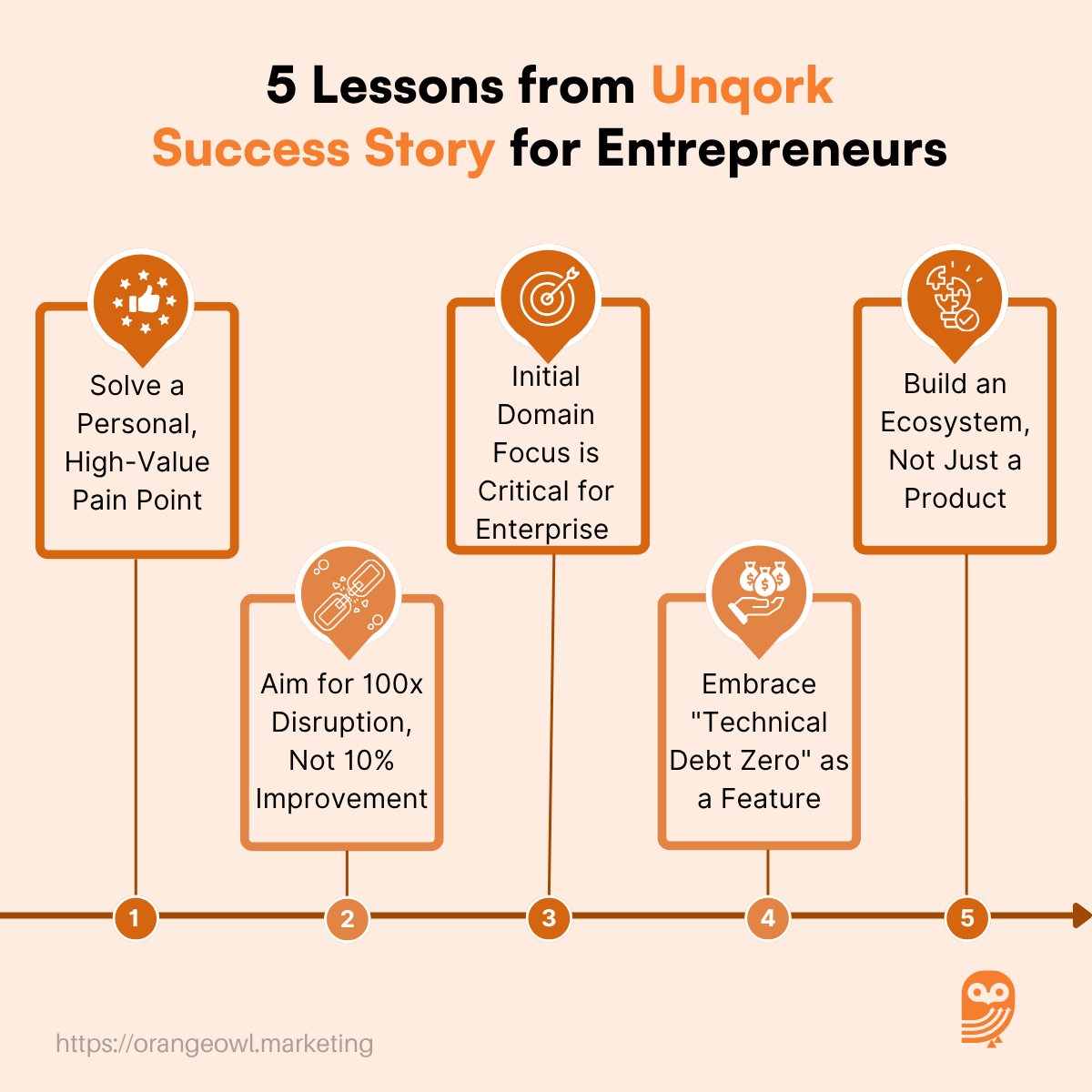
3. Initial Domain Focus is Critical for Enterprise Trust
Unqork didn’t try to be everything to everyone at first. It focused fiercely on financial services and insurance—the sectors with the highest trust and regulatory barriers. By conquering the hardest industry first and building compelling case studies there, the company earned the credibility to expand into others. This is a crucial lesson in strategic market entry for B2B ventures.
4. Embrace “Technical Debt Zero” as a Feature
Technical debt is the hidden tax on every large enterprise. Unqork’s pure no-code approach is a value proposition that sells itself to C-suite executives who understand long-term costs. The takeaway for startups is to position a core technical advantage (like zero debt or instant compliance) as the main business value, translating a technical feature into a massive financial benefit.
5. Build an Ecosystem, Not Just a Product
Unqork’s platform is designed to allow customers to build complex solutions that they can then share, creating a network effect of best-practice blueprints for new startups and enterprise users. The future value is not just in the software, but in the community of creators and the library of solutions built on the platform. Entrepreneurs must envision how their product facilitates the creation of a collective knowledge base or shared resource.
Unqork Success Story Conclusion
Unqork’s journey offers clear takeaways and a powerful lesson in creating enterprise value. Its success story is not just about a technology platform, but about leveraging deep industry knowledge to challenge a decades-old status quo. The fundamental lesson for all entrepreneurs and startups is that the most lucrative opportunities often lie in the most complex, frustrating, and heavily-coded enterprise systems. By moving past incremental improvements and offering a genuinely revolutionary solution, Unqork has cemented the no-code paradigm as a force in high-value industries. The case studies of its early clients continue to serve as the blueprint for future growth.
As the pressure for digital transformation continues to accelerate, Unqork is poised to become the industry standard for regulated application development. Its expansion into government and healthcare suggests a future where critical infrastructure is built without code. The company’s continued focus on eliminating technical debt positions it strongly against legacy software vendors
Unqork’s success stories demonstrate that the greatest innovation often comes from those who refuse to accept the existing limitations of their industry. Founder Gary Hoberman’s drive, in his own words, is deeply personal and enduring:
This perspective is the final takeaway for all entrepreneurs: true success stories are driven by a desire to build a legacy that inspires the next generation of builders.