Extend Success Story Introduction
Extend is a premier example of how modern startups can radically transform a legacy industry through technology and a laser-focus on customer experience. Founded in 2019, Extend set out to modernize the antiquated extended warranty and product protection market. The company provides a simple, API-first solution that allows merchants to offer product protection plans at the point of sale, turning what was once a cumbersome, low-trust transaction into a delightful and revenue-generating service.
The company, led by co-founder and CEO Woodrow Levin, quickly demonstrated the power of its model. Extend achieved its coveted unicorn status in 2021 following a massive $260 million Series C funding round, validating its mission to become the dominant player in the space. The purpose of this case studies examination is to distill the company’s incredible growth journey into actionable lessons and inspiring takeaways for aspiring entrepreneurs and startups navigating their own path to success.
Origin Story
The genesis of Extend was born from a fundamental frustration with the existing product protection landscape. For too long, the experience of purchasing and utilizing a warranty was characterized by opaque terms, complex paperwork, and frustrating claim processes. For merchants, offering protection plans was a logistical headache, often requiring messy integrations and leading to poor customer experiences that damaged brand loyalty.
Woodrow Levin and his co-founders recognized a massive gap in the market: the absence of a modern, digital-first, and customer-centric product protection offering. The vision was not to just digitize the old process, but to reinvent it entirely. They saw an opportunity to create a new layer of financial infrastructure—a protection-as-a-service platform—that could integrate seamlessly with any e-commerce or point-of-sale system.
The initial mission was clear: to offer intelligent and intuitive product protection. This vision centered on using Artificial Intelligence (AI) to power all aspects of the service, from instant claims approval to dynamic pricing. The objective was to transform product protection from a customer service liability into a clear and predictable revenue stream for merchants, and a value-add for consumers. This revolutionary approach to the industry is one of the most compelling aspects of the Extend success stories.
Business Space and Early Challenges
Extend operates at the intersection of Fintech and Insurtech, a sector that specializes in applying technology to modernize financial and insurance services. They entered a market historically dominated by large, slow-moving, and analog insurance carriers. Extend’s niche is providing a fully embedded solution that merchants can use to offer protection plans seamlessly, which is far superior to traditional, clunky third-party warranty providers.
The early journey for the startup was not without significant hurdles.
Regulatory Complexity: The insurance industry is heavily regulated, requiring licenses in multiple states and navigating complex underwriting requirements. This regulatory maze is a major barrier for entry for many aspiring entrepreneurs.
Legacy Integration: Most merchants already had existing, often proprietary, e-commerce platforms. The initial challenge was convincing them to rip out old, cumbersome solutions and trust a young company with a crucial part of their revenue.
Consumer Trust: Extended warranties have a notoriously poor reputation. Overcoming years of consumer skepticism required building a product that delivered on its promise of a frictionless claims experience—a core lesson in branding and delivery.
Like many ambitious startups, Extend had to prove its model worked efficiently. The initial struggles involved securing large enterprise clients who would validate the technology. This phase was critical for building early case studies. The team had to meticulously demonstrate how their AI-driven platform not only increased conversion rates at checkout but also reduced the administrative burden of handling claims, proving their platform was a net positive for the merchant’s bottom line and customer loyalty. This approach offered vital early takeaways for their business development strategy.
Growth Strategies
Extend’s scaling journey is a masterclass in modern SaaS (Software as a Service) growth, rooted in an API-first approach that prioritized flexibility and seamless merchant integration.
API-First Architecture: Building the platform on a powerful, easily accessible API was a game-changer. It allowed merchants to integrate Extend’s product protection offering in days, not months, a stark contrast to legacy competitors. This technological foundation was key to their explosive growth.
Strategic Funding: Raising significant capital from top-tier VCs allowed them to invest heavily in engineering, sales, and data science, fueling their aggressive market expansion.
Broad E-commerce Ecosystem Integration: They focused on building deep integrations with major e-commerce platforms like Shopify, BigCommerce, and Salesforce Commerce Cloud, instantly unlocking thousands of potential merchant partners.
Unique Strategic Moves
Extend’s most defining strategic move was treating product protection not as an insurance product, but as an e-commerce feature designed to boost Average Order Value (AOV) and customer loyalty. This reframing allowed them to sell to the Head of E-commerce or Chief Revenue Officer, rather than just the Head of Risk or Compliance. This simple shift in target audience accelerated their B2B adoption. By the time of their unicorn funding round, the company had reportedly powered hundreds of millions of dollars in protection plan sales and was seeing massive growth in its network of merchants, a testament to the effectiveness of their strategy and a highlight in technology success stories.
Marketing Strategies
Extend’s marketing strategy was B2B2C, focusing on two main stakeholders: merchants and consumers.
Their approach was innovative in that it leveraged data and technology to simplify the traditional marketing of protection. The traditional approach involves fine print and fear; Extend’s approach uses clear, concise, branded messaging at the point of sale, often powered by AI models that recommend the most relevant plans.
Extend’s primary marketing channel is the merchant’s own checkout flow. By providing merchants with beautiful, branded widgets and a powerful back-end, the integration itself acts as the primary marketing tool. They focused on creating co-branded case studies and success stories with key merchants to prove the value proposition—showing how a partnership with Extend led to tangible increases in revenue and customer satisfaction.
The brand identity is built on trust, transparency, and simplicity. This is crucial in a low-trust industry. Their content strategy focused on educating merchants on the financial and customer-loyalty benefits of embedded protection, positioning Extend as an innovative revenue partner, not just a vendor. This focus is a vital lesson for any startup entering a trust-deficit market.
Scaling to Unicorn Status
Extend achieved unicorn status when it closed a $260 million Series C funding round in May 2021, pushing its valuation past the $1 billion mark. This rapid scaling was the culmination of aggressive platform development and market penetration.
The Series C round solidified their position as a market leader. Key milestones included:
Rapid expansion of its merchant base across various retail verticals (furniture, electronics, fitness, etc.).
Continuous deployment of new product offerings, such as claims automation for instant approvals.
Establishing a robust claims network that ensured a smooth post-purchase experience, fulfilling the promise of their technology.
The “Secret Sauce”
Extend’s secret sauce is its technology-first mindset in an insurance world. It was culture and technology working in harmony. They were willing to rebuild the complex infrastructure of underwriting and claims from the ground up, using software to remove the friction that defined the legacy market. The customer experience, both for the merchant and the end-consumer, was the core metric of success, turning a difficult part of the retail journey into a seamless one.
5 Key Lessons for Other Entrepreneurs
The Extend journey provides invaluable takeaways and practical lessons for aspiring entrepreneurs and early-stage startups:
1. Master the ‘Unsexy’ Vertical
Extend is a powerful case studies example of finding massive opportunity in industries that others overlook because they seem “boring” or overly complex (like warranties). These legacy spaces are often ripe for disruption because incumbents are slow to adopt modern software and customer-centric design. Lesson learned: Look for friction in large, established, complex markets, and use technology to eliminate it.
2. Build an API-First Infrastructure
Their core strength is their technical foundation. By building a clean, robust, and well-documented API, Extend minimized the integration effort for merchants, dramatically shortening their sales cycle. For any B2B startup, an API-first approach is crucial for achieving viral adoption within the business ecosystem. This is a vital lesson for scaling speed.
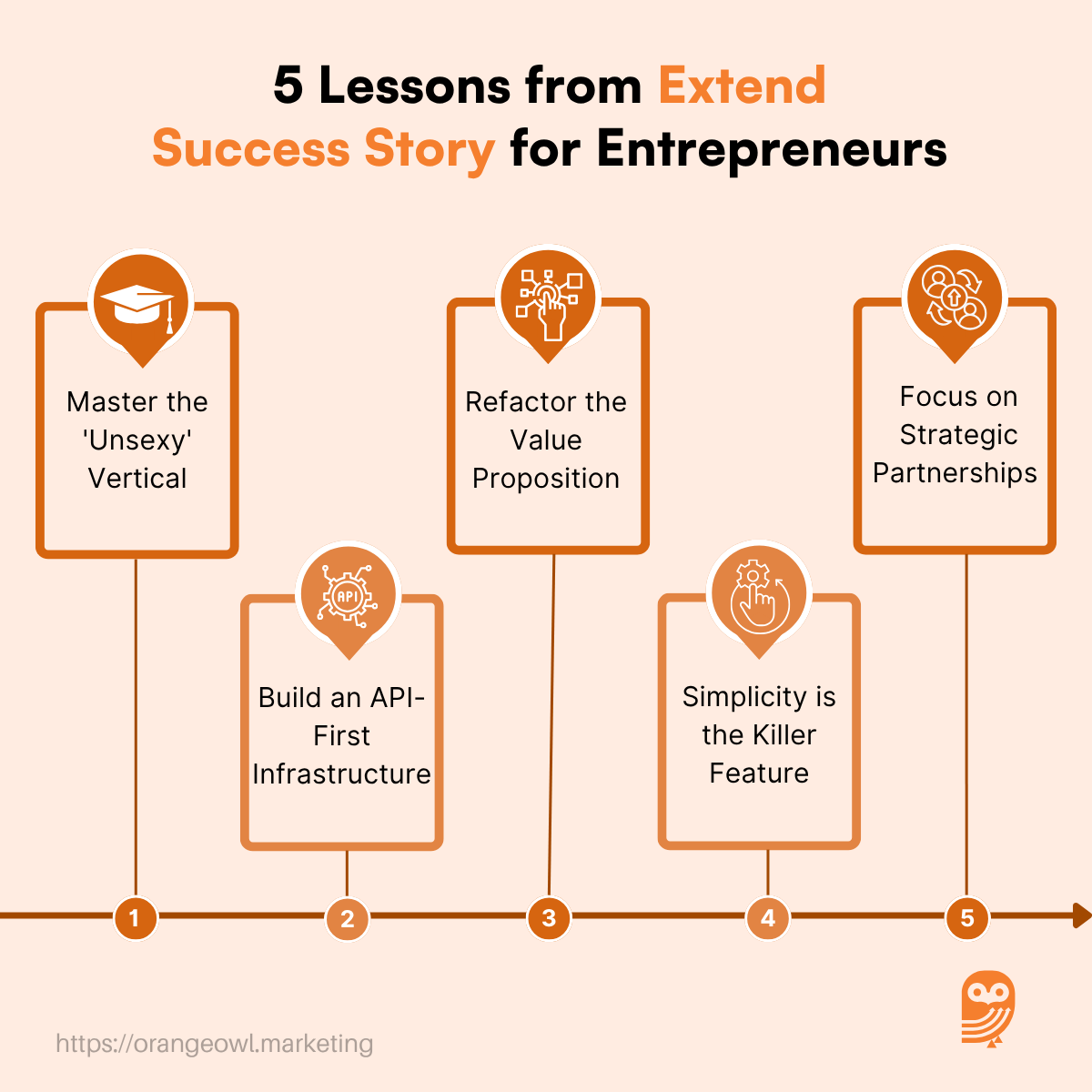
3. Refactor the Value Proposition
Extend didn’t just sell “warranties”; they sold “increased revenue and customer loyalty” to merchants, and “peace of mind” to consumers. This reframing allowed them to overcome the negative perception of the product protection industry. Takeaway: Don’t describe your product by its traditional name; define it by the value it creates for your customer’s most important metric.
4. Simplicity is the Killer Feature
The insurance and claims process is inherently complex. Extend used advanced AI and data science to handle this complexity behind the scenes, delivering a simple, three-click experience for the end-user (claims filed and approved in seconds). Lesson for entrepreneurs: The more sophisticated your back-end technology, the simpler the front-end user experience must be. Frictionless transactions build trust and generate powerful success stories.
5. Focus on Strategic Partnerships over Direct Sales
Instead of battling every merchant one-by-one, Extend prioritized integrating deeply with e-commerce platform providers (like Shopify). These partnerships essentially turned the platforms into a distribution channel, providing massive reach and reducing customer acquisition costs for the startup. Takeaway: Identify the ecosystem players who already have your target customer base and make your product indispensable to them.
Conclusion
The Extend success stories offer a compelling playbook for 21st-century startups. By tackling a complex, low-trust industry with a high-trust, technology-driven solution, the company managed to rapidly ascend to unicorn status. The fundamental lesson remains clear: value creation comes from removing friction and delivering simplicity where it is least expected.
The biggest takeaways from this case studies analysis are the power of the API-first strategy, the necessity of re-framing a product’s value, and the relentless pursuit of an effortless customer experience. For any aspiring entrepreneurs, the Extend journey proves that legacy markets are not immune to modern disruption—they are, in fact, the most fertile ground for growth.
Extend continues to expand its offerings, exploring new insurance products and greater market penetration. The trend of embedded financial services is accelerating, and Extend is perfectly positioned to capture this growth, driving further innovation in the world of insurtech.
The journey of Extend, led by its founders, is a powerful inspiration. It teaches that true innovation isn’t always about inventing a brand new product, but often about reinventing the experience around an existing one. If you can solve a decades-old pain point with a modern, elegant solution, your startup can write its own powerful success stories.